

 Residency
  28 December 2025
  Reading time: 6 min
 Portugal D7 visa: citizenship after 5 years for financially independent individuals
Portugal D7 visa suits those with passive income. It is for financially independent individuals who want to live in a developed European country.
The applicant must prove a passive income of at least €870 per month and hold €10,440 in a savings account.
The D7 visa is valid for several months. During this time, the applicant enters Portugal and obtains a residence permit. After 5 years, one can apply for citizenship.

 Share
Share  Telegram
  Facebook
 Save
Save 

Who can obtain a D7 Visa
Portuguese D7 visa, also known as the Passive Income Visa. It is available to entrepreneurs, retirees, and other applicants with a passive income.
Unlike residence by investment, the D7 visa costs much less. This path to moving to Portugal is open to foreigners with different professions and career backgrounds.
Resident status can be granted to graphic designers, software developers, writers, or entrepreneurs. The key requirement is proof of passive income [278] Source: Ministry of Foreign Affairs in Portugal .
Portugal offers favourable conditions for personal and professional goals: developed infrastructure, a progressive society and a relatively low cost of living.

Benefits of the Portugal D7 Visa
Possibility of obtaining residency and citizenship
After the visa is approved and the applicant arrives in Portugal, they apply for a residence permit. After five years, they are eligible to apply for citizenship.
Family members of the main applicant may also obtain residency in Portugal, including:
- spouse;
- minor children;
- dependent adult children;
- parents.
The residence permit issued after a D7 visa allows foreigners to establish companies in Portugal and work as employees.
Free movement across Europe
Portugal is part of the Schengen Area. Foreigners holding a Portuguese residence card can travel freely within other EU countries without applying for a separate visa.
Affordable cost of living
Portugal ranks 28th in Europe by living expenses. The cost of living starts at €775 per month, while in other European countries it is higher: €855 in Italy, €900 in Germany, and €1,080 in France.
Tax optimisation
From 2024, the former
Eligible individuals may enjoy a reduced income tax rate of 20% on
Quality of life
The average life expectancy in Portugal is 81 years. The country offers a
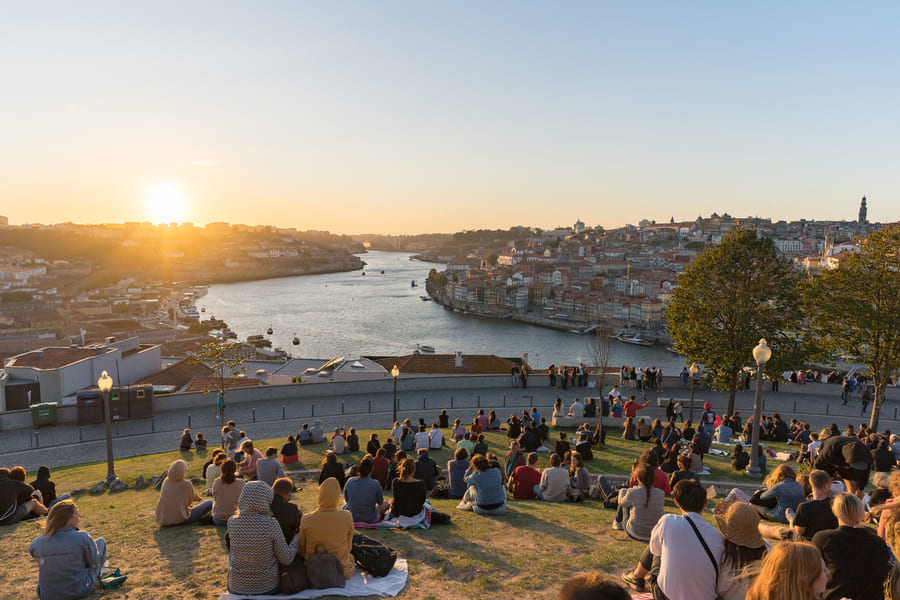
Portuguese cities are also known for their cultural landmarks and rich heritage. Examples include the Almas Chapel in Porto, the stalactite and stalagmite formations of the Mira de Aire caves and the Belém Tower in Lisbon.
Favourable climate
Portugal is a sunny country, with 300 sunny days per year. The hottest month is July, with an average temperature of +20...27°C. The coldest month is January, with +5...10°C.
The southern coast has a hotter and drier climate. The north is cooler and windier, while the border with Spain is rainier.
Portugal D7 visa requirements for the investor and family members
Investor. The main applicant must be over 18 years old, with no criminal record or legal issues.
Spouse. If the application is submitted by a married couple, the minimum income requirement is 50% higher — €435.
Children. Dependent unmarried children can be included in the application. The minimum income increases by 30% for each child, or €261.
Parents. They must also be financially dependent on the main applicant. In this case, the minimum income requirement rises by 50%.
To include family members in a D7 visa application, investors must provide proof of relationship, such as a marriage certificate or children’s birth certificates, as well as valid health insurance.
 Elena Garnitsarik
Head of the Legal Department
Elena Garnitsarik
Head of the Legal Department
How to prove financial independence to obtain a D7 Visa
When submitting documents to the AIMA [280] Source: Agency for Integration, Migration and Asylum, AIMA , the applicant must confirm the following:
- Opening a Portuguese savings account with a balance of at least €10,440.
- Proof of a passive monthly income of at least €870. Acceptable sources include rental income, dividends, royalties, pensions, or interest from deposits.
- Purchase or
long‑term rental of real estate. There is no minimum value requirement. Hotel bookings or reservations via platforms such as Airbnb are also accepted.
Additional documents may be provided, such as tax returns for the previous year or proof of purchasing shares or bonds.
Retirees must provide evidence of pension payments, such as bank statements or payslips confirming their ability to support themselves while living in Portugal.
What taxes do D7 Visa holders pay?
D7 visa holders who spend more than 183 days per year in Portugal, or have their primary residence in the country, are considered Portuguese tax residents. as such, they must pay taxes on their worldwide income.
General tax rules for residents
As tax residents, D7 Visa holders follow the same tax rules as Portuguese citizens. Main tax obligations:
- personal income tax levied at progressive rates from 14.5 to 48%;
- rental income, dividends, and interest: generally taxed at a flat rate of 28%, unless the taxpayer opts for the progressive scale;
- property tax is between 0.3 and 0.8% of the property’s taxable value;
- inheritance and gift tax: not applied between close family members.
If a D7 visa holder does not qualify as a tax resident, they are taxed only on income sourced in Portugal. This includes rental income from property located in the country.
The new IFICI regime, NHR 2.0
Since January 1st, 2024, the
Key features of IFICI:
- Duration. Benefits are granted for 10 consecutive years.
- Reduced tax rate. A flat 20% income tax on employment and
self‑employment income from certainhigh‑value professions in science, research, innovation, IT, engineering, and managerial roles. Foreign‑sourced income. In most cases exempt from Portuguese taxation, with the exception of pensions and income from blacklisted jurisdictions.- Pensions. Taxed under the standard progressive IRS rates, no exemptions under the new regime.
- Blacklisted jurisdictions. Income sourced from tax havens is taxed at 35%.
To qualify for the IFICI regime, an applicant must become a Portuguese tax resident after January 1st, 2024, and must not have been a resident in Portugal in the 5 years prior.
Eligibility depends on the applicant working in, or earning income from, recognised professions or companies that are engaged in research, innovation, or international business activities.
How to apply for a D7 Visa and residence permit
Obtaining the Portugal D7 Visa takes at least 6 months. Passportivity lawyers assist applicants at every stage, from preparing documents to receiving the Portugal passive income visa.
-
10+ day sObtaining a taxpayer number, NIF
A Portuguese tax identification number, Número de Identificação Fiscal (NIF), is needed to rent or buy property and open a bank account. It is also required for other tasks like registering with a doctor or setting up internet services.
Non-EU citizens obtain NIF through a representative in Portugal. The process can be done remotely.
-
Up to 2 months
Purchasing or renting housing
A foreigner can choose a property remotely or travel to Portugal to view apartments in person.
-
2+ week sOpening a bank account
Required documents. To open an account, one needs a Portuguese taxpayer number and a passport. In some cases, proof of legal income may also be requested.

-
Up to 4 months
Collecting documents and obtaining a D7 visa
After signing a lease agreement or purchasing property, the applicant provides the following documents to apply for a D7 visa:
- passport;
- birth certificate;
- two colour photographs;
- proof of income of at least €870 per month, such as payslips, bank statements, or other supporting documents;
- bank statement confirming savings of at least €10,440, demonstrating financial stability;
- health insurance covering medical expenses during the stay in Portugal;
- police clearance certificate;
- lease agreement or proof of property ownership;
- NIF certificate.
Consular and residence permit fees amount to about €300 per applicant.
-
1 day
Arrival in Portugal and registration with AIMA
The applicant must enter Portugal with a D7 visa within 4 months. Upon arrival, they must register with the Agency for Integration, Migration and Asylum, presenting their documents and proof of entry on a D7 visa.
-
2+ week sObtaining Portuguese residency
The residence card is valid for 2 years. It can be renewed for a further 3 years, after which the holder may apply for permanent residency or Portuguese citizenship.
Cost of living in Portugal
Portugal is considered one of the most affordable countries in Western Europe. Below are the main categories of expenses for residents and newcomers.
Rent and property
The monthly rent for a
In Lisbon, the estimated monthly cost for a single person, excluding rent, is around €755. For a family of four, it is about €2,680.
Porto is more affordable: the overall cost of living plus rent is about 11% lower than in Lisbon, and rents are nearly 34% lower.
Utilities
For an 85 m² apartment, monthly utilities such as electricity, water, heating, cooling, and garbage collection average about €111.
Groceries and food
An individual spends about €680 per month on food and essentials, while a family of four spends around €2,400.
Everyday prices include:
- meal at an inexpensive restaurant: €10 in Porto, €14 in Lisbon;
- cappuccino: €1.90 in Porto, €2.40 in Lisbon;
- chicken fillets per pound: €2.90 in Porto, €3.10 in Lisbon.
Leisure and entertainment
Excluding rent, leisure and
In Lisbon, including rent, a single person spends about €1,835 per month. For a family of four, total monthly costs are around €4,355.
Monthly cost of living comparison: single vs family of three
| Category | Single person | Family of three |
|---|---|---|
| Rent | €940 | €1,400 |
| Utilities | €110 | €150 |
| Internet | €35 | €35 |
| Groceries & essentials | €680 | €1,800 |
| Dining & leisure | €150 | €350 |
| Public transport pass | €45 | €120 |
| Total | €1,835 | €3,600 |
Attractive destinations in Portugal for relocation with a D7 Visa
Lisbon and Porto are the most popular relocation destinations among expats. However, other cities also attract foreigners with their culture and quality of life.
Sintra. A hillside town near Lisbon, known for its castles and palaces. Its medieval atmosphere and green landscapes make it a favourite for those seeking a picturesque and peaceful setting.
Évora. A historic city known for its Roman ruins, medieval streets, and iconic architecture such as the Temple of Diana. The city is a UNESCO World Heritage Site.
Faro. Ideal for those who want a mix of history, nature, and seaside relaxation. The old town, medieval walls, and pristine beaches of the Ria Formosa Natural Park attract many newcomers.
Braga. A city with a strong religious heritage, known for historic churches like the Bom Jesus do Monte sanctuary. It also offers a vibrant cultural life with festivals, museums, and a lively university atmosphere.
Madeira. Ideal for those who enjoy an active lifestyle, with dramatic coastlines, dense forests, and towering mountains. The capital, Funchal, blends traditional charm with modern amenities.
Aveiro. A coastal city known for its colourful “moliceiro” boats, canals, and charming narrow streets.
Key facts about the D7 Visa in Portugal
- The Portugal D7 visa is designed for financially independent individuals, such as entrepreneurs and retirees.
- The minimum income required is €870 per month. Applicants must also have at least €10,440 in a savings account.
- A spouse, children, and parents may join the main applicant under the D7 visa.
- The visa is issued for 4 months. During this time, the applicant must travel to Portugal and apply for a residence permit. The residence card is valid for 2 years and can then be renewed for another 3 years.
- After 5 years of holding a residence card, a foreigner becomes eligible to apply for permanent residency or citizenship.
- A foreigner who spends 183 days per year in Portugal automatically becomes a tax resident and gains access to tax benefits.
About the authors


Frequently asked questions
Financially independent individuals — such as entrepreneurs, retirees, and other applicants with proven passive income — may apply for a D7 visa in Portugal.
An applicant must show a monthly income of at least €870 and hold a savings account with a minimum balance of €10,440.
The D7 visa allows applicants to obtain Portuguese residency for 5 years. After this period, they may apply for permanent residency or citizenship.
The D7 visa itself does not grant the right to work. However, it allows applicants to obtain a residence card, which permits both employment and company formation in Portugal.
Yes, the applicant may include a spouse, parents, and unmarried children under 21. All family members must be financially dependent on the main applicant.


Contact us today
Passportivity assists international clients in obtaining residence and citizenship under the respective programs. Contact us to arrange an initial private consultation.

