
 Second citizenship

 Reading time: 14 min
Dual Citizenship for Americans: Laws, Eligible Countries, and Second Passport Options
Americans may acquire a second citizenship without renouncing their US nationality. Another passport provides additional travel opportunities, residence rights abroad, and citizenship benefits for future generations.
Some countries offer citizenship by investment with contributions starting at $90,000, while others provide routes through ancestry, marriage, or naturalization.
This guide explains which countries allow dual citizenship with the US, how much a second passport costs, and which legal and tax obligations Americans must consider.



What is dual citizenship?
Dual citizenship is the legal status of a person who holds citizenship in two countries simultaneously. Each country determines citizenship under its own laws. A person may hold two nationalities even without obtaining passports from both countries.
The United States recognizes dual citizenship and does not require Americans to renounce US citizenship when acquiring another nationality [1] Source: Dual nationality rules, U.S. Department of State . However, the second country must also permit the person to retain their original citizenship.
Dual citizenship vs. dual nationality
Dual citizenship and dual nationality have the same meaning when referring to people who are citizens of two countries. However, US legislation distinguishes citizenship from nationality.
Under Section 101(a)(22) of the Immigration and Nationality Act, all US citizens are US nationals [2] Source: Nationality legal definition, U.S. Department of State . However, some US nationals are not citizens. For example, people born in American Samoa or Swains Island may hold US nationality without citizenship.
How dual citizenship works
Dual citizenship arises automatically at birth or through acquiring another nationality later in life. Americans have four main routes to a second citizenship:
- Birth. A child born in the United States to foreign parents may inherit their parents' citizenship under the relevant country's laws.
- Descent. Americans with
foreign-born parents or ancestors may obtain citizenship if their family history meets another country's legal requirements. - Naturalization. US citizens may obtain foreign citizenship after meeting residence, language, and other requirements set by the destination country.
- Citizenship by investment. Investors obtain citizenship through
government-approved contributions, real estate purchases, or other investments after passing the required checks.
Citizenship by investment offers an alternative to
Rights and responsibilities of dual citizens
Dual citizens retain their US citizenship rights, including the right to live and work in the United States, vote in federal elections, and hold a US passport. Their second citizenship provides additional rights under the other country's legislation [3] Source: Citizenship Rights Overview, USCIS .
Dual citizens must comply with the laws of both countries. Their responsibilities may include:
- filing US tax returns and reporting foreign income;
- meeting military service obligations imposed by the second country;
- using a US passport when entering or leaving the United States;
- following the other country's entry and exit requirements.
US consular assistance may be limited when dual citizens visit the country of their second nationality. Local authorities may treat them exclusively as citizens of that country [4] Source: Dual nationality guidance, U.S. Department of State .

Can US citizens hold two passports?
US citizens may hold two or more passports if they have acquired the corresponding nationalities. US law does not set a numerical limit on foreign citizenships. Acquiring foreign citizenship does not automatically terminate American citizenship. Loss of nationality requires a legally specified act performed voluntarily with the intention of relinquishing US citizenship [5] Source: Loss of nationality, U.S. Department of State .
US citizens may obtain another nationality through birth, descent, naturalization, or investment. Applicants must follow the second country's citizenship laws, including any restrictions on retaining their original nationality.
Rules for using US and foreign passports
American dual citizens must use a valid US passport to enter and leave the United States. The requirement also applies to children holding US citizenship.
Passport rules depend on the destination:
- United States — US citizens must enter and depart using an American passport.
- Second country — local authorities may require citizens to enter and leave using their national passport.
- Third countries — dual citizens may use either passport, subject to the destination country's entry requirements.
Proposed changes to US dual citizenship laws
The Exclusive Citizenship Act of 2025 (S. 3283) proposes prohibiting dual and multiple citizenship in the United States. Senator Bernie Moreno introduced the bill on December 1st, 2025 [6] Source: Proposed citizenship legislation, U.S. Government Publishing Office .
The proposed legislation would:
- prohibit simultaneous US and foreign citizenship;
- require existing dual citizens to renounce one nationality within one year after enactment;
- treat voluntary acquisition of foreign citizenship after enactment as relinquishment of US citizenship.
As of October 2026, S. 3283 remains in the Senate Judiciary Committee. The proposal has not become law, and the United States continues to permit dual citizenship [7] Source: Senate bill status, U.S. Government Publishing Office .
Countries with citizenship by investment programs for the US citizens
Citizenship by investment offers Americans a route to a second passport without years of residence abroad. Depending on the country, applicants make a government contribution, purchase approved real estate, or invest in other designated assets.
Processing times range between 2 months and more than a year. Each country conducts background checks, and the final decision rests with its authorities.
Caribbean countries offering fast citizenship
Five Caribbean countries operate
- Grenada — $235,000. The estimated process takes at least 6 months.
- Dominica — $200,000. Applicants should allow at least 8 months.
- Antigua and Barbuda — $230,000. The process takes at least 8 months. New citizens must spend at least 5 days in the country during their first 5 years of citizenship.
- St Kitts and Nevis — $250,000. The estimated period is at least 10 months.
- St Lucia — $240,000. Applicants should allow at least 10 months.
All five countries also provide approved investment routes other than government contributions. These include real estate in selected projects. Investment amounts, holding periods, and government fees depend on the selected route.

Fastest citizenship programs
Several countries in Africa and Oceania offer investment citizenship with minimum contributions below $100,000. Processing times depend on the selected program and the applicant's background checks.
São Tomé and Príncipe. Investors obtain citizenship by investment of at least $90,000. A family of

The Chief Operating Officer of the São Tomé and Príncipe Citizenship by Investment program explains the requirements for investors and their families
Applicants must be at least 18, have no criminal record, and demonstrate a lawful source of funds. Spouses, children, parents, and grandparents may join the application under specific conditions.
No residence, language test, or visit to the country is required. Applicants who already hold three or more citizenships are currently excluded from the program.
The citizenship process takes approximately 2 months to make a decision. Passport issuance requires another
Investors make the contribution after receiving approval in principle.

Vanuatu. Investors have three investment options. The required amount and conditions for recovering part of the investment depend on the selected route:
- Development Support program: a
non-refundable contribution — $130,000; - CNO Future Fund — $157,000;
- Sustainable Development Fund — $165,000.
Both investment funds support local agricultural production and provide for a partial investment return after 5 years, subject to their terms.
Applicants must be over 18, have no criminal record, and hold at least $250,000 in their bank accounts. The application may include a spouse, children up to 25, and financially dependent parents over 50.
Under the contribution route, adding a spouse increases the investment by $20,000. Each subsequent family member adds $15,000.
The process takes at least 3 months and does not require a language or cultural knowledge test. Applicants undergo Due Diligence checks and submit biometric data for passport issuance. The biometric collection is available in Vanuatu and designated overseas offices, including Dubai and Hong Kong.

Naoero. The country requires a contribution. The standard investment is $115,000, reduced to $90,000 for applications submitted before December 31st, 2026. Adding a dependent aged 16 or older increases the contribution by $2,000. Including a sibling costs an additional $15,000.
The main applicant must be at least 18, have no criminal record, and pass background checks. Spouses, children, parents, and siblings may be included for additional fees. A single applicant also pays $5,000 for processing, $6,000 for Due Diligence, $1,200 for bank checks, and $500 for a passport.
The program office estimates
Sierra Leone. Investors have three direct citizenship options. The Solo Entrepreneur and Enterprise routes do not permit dependents:
- The Solo Entrepreneur route requires a $95,000
non-refundable contribution for one applicant. - Enterprise Citizenship costs $80,000 per person for two joint applicants.
Fast-Track Citizenship requires $140,000 and permits family applications. The first two routes became available on October 1st, 2026.
Under
Direct citizenship routes take at least 6 months and do not require relocation. Sierra Leone also offers a separate investment route involving at least 1 kg of gold and a $50,000 government fee. This option grants permanent residence first, rather than immediate citizenship. as of November 2026, the government has not published the full citizenship procedure for this route.
El Salvador. The Freedom Passport program offers citizenship through a $1,000,000 contribution in Bitcoin or USDt. The government accepts up to 1,000 investors annually. The program allows applicants to obtain citizenship without completing the standard
The application starts with a $999 registration payment, which forms part of the $1,000,000 contribution. After preliminary approval, the investor transfers the remaining $999,001. Spouses and children under 18 may join the application. Each additional family member requires a $999 administrative payment.
Applicants must be at least 18, have no criminal record, and pass sanctions and
Other countries with fast citizenship options
Türkiye grants access to citizenship through real estate purchases of at least $400,000. The investor must not sell the property for 3 years. Alternative routes include bank deposits or approved investments of at least $500,000.
The obtaining process takes at least 12 months to obtain Turkish citizenship and a passport.
The investment amount is not the total application cost. Applicants also pay government processing, Due Diligence, passport, and professional service fees. Family applications may require larger investments.
Egypt offers four investment routes with the least expensive one involving $250,000. Other options include real estate purchases of at least $300,000 and bank deposits of $500,000 for 3 years.
The Egyptian government states that obtaining citizenship takes 12 months.
Citizenship options compared: costs and processing times
| Country | Minimum investment | Estimated processing time |
|---|---|---|
| El Salvador | $1,000,000 | |
| Vanuatu | $130,000 | |
| Naoero | $90,000 | |
| São Tomé and Príncipe | $95,000 | |
| Grenada | $235,000 | |
| Sierra Leone | $95,000 | |
| Dominica | $200,000 | |
| Antigua and Barbuda | $230,000 | |
| St Kitts and Nevis | $250,000 | |
| St Lucia | $240,000 | |
| Türkiye | $400,000 | |
| Egypt | $250,000 |
5 benefits of dual citizenship by investment for US citizens
Dual citizenship expands opportunities for Americans to live, work, travel, and build a future abroad. A second passport provides access to another country's rights and benefits while allowing investors to retain their US nationality.
1. Residence and employment opportunities
Second citizenship provides the right to live and work in the country of nationality without obtaining a residence permit or work visa [8] Source: EU mobility rights, European Commission . For example, Americans with Portuguese citizenship also gain EU citizenship. They may live and work in the other 28 EU countries without a work permit, although residence registration requirements may apply.
2. Additional visa-free travel opportunities
Second passports provide alternative travel options through visa agreements between countries. Holding two nationalities allows Americans to benefit from different entry arrangements, depending on their destination.
For example, Grenada citizens may visit China without a visa for up to 30 days. American passport holders need a visa for most tourist visits to mainland China [9] Source: China entry requirements, U.S. Department of State .
3. Citizenship for future generations
Second citizenship may also benefit future children. Certain countries allow citizens to pass their nationality to children born abroad, extending citizenship opportunities to the next generation.
For example, under Section 101 of St Lucia's Constitution, children born abroad acquire citizenship at birth if a parent meets the nationality conditions. The provision covers parents who acquired St Lucia citizenship through naturalization, including investment routes [10] Source: Citizenship by descent, Government of St Lucia .
4. Access to additional citizenship pathways
Second citizenship may open access to shorter naturalization routes in other countries. For example, São Tomé and Príncipe citizens may apply for Portuguese citizenship after 7 years of legal residence, compared with 10 years for US citizens [11] Source: Portuguese nationality law, Diário da República . Americans holding both nationalities must also meet Portugal's rules on multiple foreign citizenships and other naturalization requirements.
5. Opportunity to obtain citizenship without relocating
Certain investment programs do not require relocation before or after citizenship approval. Americans may retain their primary residence in the United States while obtaining another nationality.
For example, Vanuatu does not require citizenship by investment applicants to live in or visit the country. Investors complete the application through an authorized agent and undergo mandatory Due Diligence checks.

Disadvantages of dual citizenship for US citizens
Tax obligations. Americans remain subject to US taxation on worldwide income, even when living abroad [12] Source: Overseas taxation rules, Internal Revenue Service . A second citizenship does not eliminate federal tax filing requirements. Foreign accounts with a combined value exceeding $10,000 at any point during the year also trigger FBAR reporting.
Military service. Certain countries impose compulsory military service on dual nationals. For example, South Korean men with dual citizenship become subject to military service obligations in the year they turn 18 [13] Source: Military service requirements, Embassy of South Korea . Those seeking to renounce Korean nationality must meet the March 31st deadline that year, subject to statutory exceptions.
Limited consular protection. Foreign authorities may recognize dual citizens exclusively as their own nationals [14] Source: Consular assistance limitations, U.S. Department of State . If an American is detained in their second country of citizenship, local authorities may refuse US consular access. They may also decline to notify the US embassy about the detention.
Additional compliance requirements. Dual citizens must use an American passport to enter and leave the United States. Their second country may also require a national passport for border crossings. Certain jurisdictions additionally require citizens to register their other nationalities or obtain exit permits.
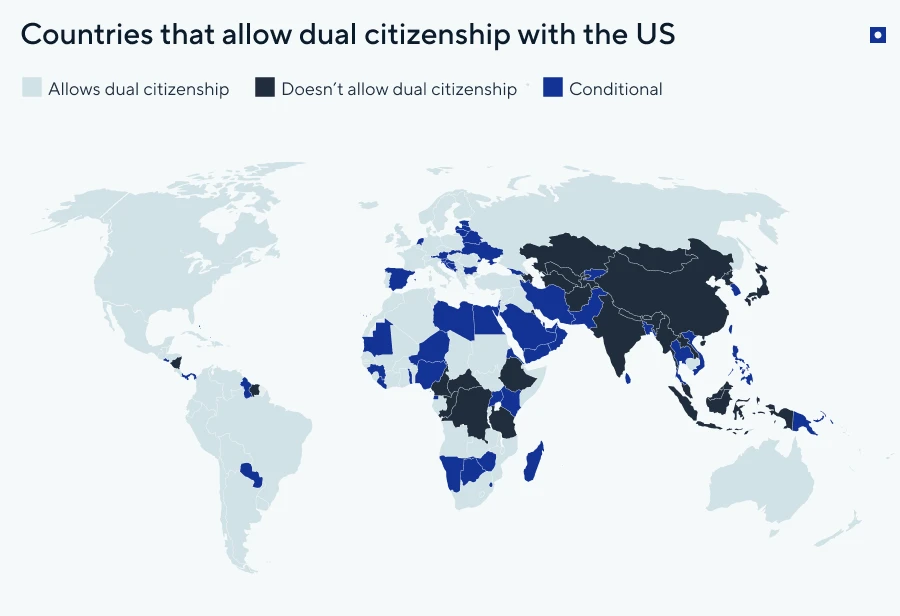
Countries that allow dual citizenship for US citizens
The United States has no official list of approved dual citizenship countries. Americans may hold another nationality if the foreign country's laws permit it. More than two citizenships are also possible, depending on the legislation of each country [15] Source: Dual nationality rules, U.S. Department of State .
Countries offering citizenship by investment provide options for Americans seeking a second passport. These include:
- Caribbean: Antigua and Barbuda, Dominica, Grenada, St Kitts and Nevis, and St Lucia;
- Africa: Egypt, Sierra Leone, and São Tomé and Príncipe;
- Oceania: Naoero;
- Asia: Türkiye.
Other countries allowing dual citizenship include Canada, the United Kingdom, Ireland, Australia, New Zealand, Germany, and Italy.
Americans may obtain citizenship in these countries through descent,
Italy also recognizes dual citizenship, although its 2025 reform restricted citizenship claims through ancestry [17] Source:Italian citizenship legislation, Italian Ministry of Foreign Affairs .
The countries listed above are examples, not an exhaustive worldwide list. Permission to retain US citizenship does not establish eligibility for another country's citizenship.
Elena Garnitsarik
Head of the Legal Department
Countries that allow dual citizenship under certain conditions
Some countries permit dual nationality only in specific circumstances. Restrictions may depend on how citizenship was acquired, the applicant's family circumstances, or their age. Four examples illustrate these differences.
Netherlands. Foreigners acquiring Dutch citizenship by naturalization must renounce their previous nationality unless an exception applies [18] Source: Dutch nationality exceptions, Government of the Netherlands . Americans married to Dutch citizens may retain their original citizenship. Recognized refugees also benefit from an exception.
Spain. Applicants obtaining citizenship by residence must declare that they renounce their previous nationality, unless a legal exemption applies
[19]
Source: Spanish naturalization requirements, Spanish Ministry of Justice
. US citizens are not among the nationalities covered by the standard exemption. A Spanish declaration does not, by itself, terminate US citizenship.
Japan. People who acquire dual citizenship before turning 18 must choose their nationality before reaching 20
[20]
Source: Nationality selection rules, Japanese Ministry of Justice
. Those who acquire multiple citizenships at age 18 or later have 2 years to make their choice. Japanese law also provides a nationality selection declaration procedure.
El Salvador. Article 91 of the Constitution protects dual and multiple citizenship for Salvadorans by birth [21] Source: Salvadoran nationality legislation, Supreme Court of Justice of El Salvador . Investors receive citizenship through naturalization, which falls under separate provisions. Article 93 addresses the retention of foreign nationality through international treaties and reciprocity.
Countries that do not allow dual citizenship
Some countries prohibit or refuse to recognize dual nationality. Americans seeking citizenship in these jurisdictions face restrictions that may prevent them from retaining both citizenships.
Examples include:
- China. Article 3 of the Nationality Law does not recognize dual nationality [22] Source: Chinese nationality law, National People's Congress . Under Article 8, foreigners approved for Chinese naturalization cannot retain their foreign citizenship.
- India. Indian law does not permit simultaneous Indian and foreign citizenship. Former Indian citizens and eligible people of Indian origin may obtain an Overseas Citizen of India card [23] Source: Indian citizenship restrictions, Ministry of External Affairs . However, OCI status does not confer Indian citizenship or voting rights.
- Singapore. Adult citizens aged 21 and over cannot retain multiple nationalities
[24]
Source: Multiple citizenship restrictions, Singapore Ministry of Home Affairs
. Singaporeans who hold foreign citizenship must renounce it to preserve Singaporean citizenship. Failure to comply may result in deprivation of Singaporean citizenship.
Restrictions require individual assessment. A prohibition on naturalization while retaining another nationality does not always prevent a child from acquiring two nationalities at birth. Applicants should verify the applicable citizenship category before starting the process.
Non-investment ways for US citizens to get a second citizenship
Americans may obtain a second citizenship without making a substantial investment. The main routes include descent, marriage, and naturalization. Eligibility depends on family history, residence, and the nationality laws of the destination country.
Citizenship by naturalization
Naturalization allows Americans to obtain citizenship after living legally in another country. Applicants must meet the residence requirements and other conditions established by national legislation.
For example, Canada requires applicants to hold permanent resident status and complete 1,095 days of credited physical presence within the preceding 5 years [25] Source: Naturalization eligibility requirements, Government of Canada .
Additional requirements include:
- filing Canadian tax returns when required;
- proving English or French language proficiency for applicants aged
18—54 ; - passing a citizenship test for applicants aged
18—54 , unless an exemption applies; - meeting criminal and security requirements.
Citizenship by descent
Citizenship by descent allows Americans to acquire another nationality through their parents, grandparents, or more distant ancestors. The permitted number of generations and documentation requirements depend on the country.
For example, Americans with a grandparent born in Ireland may obtain Irish citizenship through the Foreign Births Register. Registration costs €278 for adults and takes approximately 12 months [26] Source: Foreign birth registration, Irish Department of Foreign Affairs . Applicants must provide birth certificates and other documents establishing their family connection.
Citizenship by marriage
Marriage to a foreign citizen may provide access to a simplified naturalization process. However, marriage itself does not automatically grant citizenship. Applicants must meet the country's marriage duration and other legal requirements.
For example, Americans married to Turkish citizens may apply for citizenship after at least 3 years of marriage [27] Source: Marriage citizenship requirements, Turkish Directorate of Population . The marriage must remain valid, and the couple must maintain family unity. Applicants must also meet national security and public order requirements.
Documents required to apply for a second citizenship
The documents required for a second citizenship depend on the country and application route. Americans applying through investment, descent, marriage, or naturalization prepare different supporting records.
The main documents include:
- Valid US passport: copies of passport pages and recent
passport-sized photographs. - Birth certificate: an official document confirming the applicant's date and place of birth.
- Marriage or divorce certificates: documents confirming marital status and legal name changes, if applicable.
- Police clearance certificates: criminal record checks issued by the relevant authorities, when required.
- Proof of eligibility: ancestral records, residence documents, marriage evidence, or investment agreements, depending on the citizenship route.
- Financial documents: bank statements, proof of income, and evidence of the lawful source of investment funds, when required.
- Medical certificates: examination reports and health declarations for programs that require medical screening.
Documents issued in a foreign language may require certified translations. Authorities may also request notarized copies, apostilles, or consular legalization.
How to obtain citizenship by investment: step‑by‑step process
São Tomé and Príncipe offers one of the fastest
Based on Passportivity's experience, the procedure may take around 6 months, provided all documents are submitted correctly and no additional checks are required.
-
1 day
Preliminary Due Diligence
Passportivity runs a confidential preliminary Due Diligence check to identify any circumstances that could prevent participation in the program.
-
2+ week sCollecting documents and filing the application
An assigned Passportivity lawyer guides the applicant through collecting the required documents and preparing the application forms.
Once the file is complete, the full application package is sent to the CIU by email. The CIU reviews it for completeness and issues an application invoice, which must be paid before formal processing starts.
-
Up to 2 months
Government Due Diligence and decision
The CIU coordinates a Due Diligence process to verify the background, security, and eligibility of the main applicant and each family member. Based on the results, a recommendation is prepared and submitted to the Ministry and Cabinet, which take the final decision.
The CIU then issues either an approval letter or a rejection letter, which is communicated to the applicant via Passportivity.
-
Up to 90 days
Contribution and issuance arrangements
After approval, the applicant has up to 90 days to make the required contribution and pay fees for the passport and other citizenship documents. Once payments are completed, proof of payment, signed Oath of Allegiance forms, and passport application forms are provided to the CIU.
The CIU initiates issuance of the Certificate of Registration and applies for the national ID card and passport.
-
1+ week sDelivery of citizenship documents
The Certificate of Registration, national ID card, and passport are issued and sent to Passportivity as the authorized representative. The documents are then delivered to the applicant using the agreed method, usually without the need to travel to São Tomé and Príncipe in person.
Voluntary renunciation of US citizenship
US citizens have the legal right to renounce their citizenship voluntarily [28] Source: Citizenship renunciation rules, U.S. Department of State . However, obtaining a second nationality does not require Americans to renounce their US citizenship.
Renunciation is an irreversible decision, except in limited circumstances established by law. Americans without another nationality risk becoming stateless and losing the protection of any government.
The renunciation process takes place at a US embassy or consulate abroad and involves:
- Reviewing the Department of State's information on citizenship loss.
- Attending 2 consular interviews, at least one of which must be in person.
- Completing the required forms and taking the oath of renunciation in person.
- Paying the government processing fee of $450.
The fee decreased from $2,350 to 450 on April 13th, 2026. The Department of State must approve a Certificate of Loss of Nationality to confirm the renunciation.
Former US citizens lose their automatic right to live and work in the United States. They must meet the entry requirements for foreign nationals, including visa or Visa Waiver Program rules.
Renunciation also carries tax implications. Former citizens must address applicable US tax obligations and file IRS Form 8854. Certain individuals face an expatriation tax based on their assets, previous tax liabilities, and tax compliance history.
Tax implications of dual citizenship for US citizens
US citizens remain subject to American tax laws after obtaining a second citizenship. Tax obligations depend on income sources, tax residence, and the laws of both countries. Understanding these rules helps dual citizens avoid unnecessary payments and comply with reporting requirements.
Do dual citizens have to pay taxes in both countries?
Dual citizenship does not automatically mean paying taxes twice [29] Source: Worldwide taxation rules, Internal Revenue Service . Americans remain liable for US federal income tax, while obligations in the second country depend on its tax legislation.
For example, obtaining citizenship in Grenada or Dominica does not automatically establish tax residence there. Local income tax obligations depend on applicable residence rules and income sources.
US worldwide income taxation rules
The United States taxes citizens on worldwide income, regardless of where they live or earn money. Americans must report taxable foreign income on Form 1040 when they meet federal filing requirements [30] Source: Foreign income reporting, Internal Revenue Service .
Income subject to reporting includes:
- salaries and
self-employment earnings; - rental income from overseas properties;
- interest and dividends from foreign accounts;
- capital gains from investments.
US citizens must also meet applicable tax filing obligations even when foreign tax credits or exclusions eliminate their federal income tax liability.
How to avoid double taxation
Americans have several legal mechanisms to reduce double taxation. These include foreign tax credits, income exclusions, and benefits available under international tax treaties.
The United States has income tax treaties with countries including Türkiye and Egypt [31] Source: International tax treaties, Internal Revenue Service . However, most treaties contain a saving clause that preserves the US government's right to tax American citizens.
Foreign tax credit and foreign earned income exclusion
Foreign Tax Credit, FTC, allows Americans to reduce US income tax using eligible income taxes paid to another country
[32]
Source: Foreign tax credits, Internal Revenue Service
. The credit applies to
Foreign Earned Income Exclusion, FEIE, allows eligible Americans living abroad to exclude up to $132,900 of foreign earned income for the 2026 tax year.
Applicants must have a foreign tax home and meet one of two conditions:
- maintain bona fide residence abroad for an uninterrupted period covering an entire tax year;
- spend at least 330 full days in foreign countries during 12 consecutive months.
The exclusion applies to earned income, not investment income such as interest or dividends. Applicants claim it through IRS Form 2555. Foreign taxes attributable to excluded income cannot also receive a foreign tax credit.
FATCA and FBAR reporting requirements
FATCA and FBAR require Americans to disclose certain foreign financial assets and accounts. Reporting obligations apply regardless of whether those assets generate taxable income.
FBAR. US citizens must submit FinCEN Form 114 if the combined value of their foreign financial accounts exceeds $10,000 at any point during the calendar year. The report is filed separately from the federal income tax return [33] Source: Foreign account reporting, FinCEN .
FATCA. Americans must file IRS Form 8938 when specified foreign financial assets exceed applicable thresholds.
For unmarried taxpayers living in the United States, the thresholds are $50,000 at
Does obtaining a second citizenship reduce US tax obligations?
No. A second citizenship does not remove US federal tax obligations. Americans remain subject to worldwide income taxation even after obtaining citizenship in a country with low or no personal income tax.
For example, acquiring a Caribbean passport by investment does not eliminate US tax reporting requirements. Any reduction in the final US tax liability depends on applicable credits, exclusions, deductions, and individual financial circumstances.
Final thoughts on dual citizenship for US citizens
- Dual citizenship allows Americans to expand their opportunities abroad while retaining their US nationality.
- Americans may hold two or more nationalities without automatically losing US citizenship.
- Americans may obtain another nationality through descent,
marriage-related naturalization,residence-based naturalization, or investment. - Investment programs offer faster options. Countries such as São Tomé and Príncipe, Nauru, Vanuatu, and Grenada offer citizenship without years of prior residence. Minimum investments start at $90,000, excluding additional fees.
- A second passport provides additional opportunities, including
visa-free travel, residence and employment rights abroad, and citizenship opportunities for future generations. - Americans remain subject to worldwide income taxation after acquiring another citizenship.
About the authors


Frequently Asked Questions
Yes. US law allows Americans to hold three or more citizenships without renouncing their US nationality. Each additional country must also permit the person to retain their existing citizenships.
No. Acquiring foreign citizenship does not automatically terminate US citizenship. Under Section 349 of the Immigration and Nationality Act, loss of nationality requires a legally specified act performed voluntarily with the intention of relinquishing US citizenship.
Yes. The United States recognizes dual and multiple citizenships. Americans may obtain another nationality through birth, descent, naturalization, or investment without obtaining permission from US authorities.
Countries allowing Americans to retain US citizenship include Canada, the United Kingdom, Ireland, Australia, Germany, Italy, Grenada, and Dominica.
Citizenship requirements differ by country. Some offer citizenship by investment, while others require family connections or years of legal residence.
No. US citizens do not have a separate obligation to notify the Department of State when acquiring another nationality. They also do not need government permission to apply for foreign citizenship.
Americans must continue using their US passports to enter and leave the United States.
All three countries permit dual citizenship without requiring Americans to renounce their US nationality.
Portugal allows multiple citizenships through descent, marriage, or naturalization. Ireland also permits multiple nationalities, including citizenship obtained through the Foreign Births Register.
Italy recognizes dual citizenship, but Law No. 74/2025 introduced restrictions on citizenship by descent for people born abroad who already hold another nationality.
Germany's citizenship reform took effect on June 27th, 2024. Americans acquiring German citizenship no longer need to renounce US citizenship.
The reform also reduced the standard residence requirement for naturalization from 8 to 5 years. German citizens may obtain foreign citizenship without prior permission to retain their German nationality.
Austria, the Netherlands, and Estonia require applicants to renounce their previous citizenship in most standard naturalization cases. Each country provides specific exemptions.
Spain requires most American applicants to declare renunciation of their former nationality. However, this declaration does not automatically terminate US citizenship under American law.
Citizenship by descent allows Americans to obtain foreign nationality through parents, grandparents, or other ancestors under the relevant country's legislation.
For example, Americans with an
No. Americans remain subject to US federal taxation on worldwide income regardless of their second citizenship or country of residence.
Foreign tax credits, income exclusions, and tax treaty provisions may reduce the amount payable. Citizenship in a
FBAR reporting is required when the combined value of foreign financial accounts exceeds $10,000 at any point during the calendar year. Americans submit FinCEN Form 114 separately from their tax returns.
FATCA reporting requires IRS Form 8938 when specified foreign financial assets exceed applicable thresholds. For unmarried Americans living in the US, these are $50,000 at
Yes. Children born abroad may acquire US citizenship at birth while also receiving another nationality. For a child born in wedlock to one American and one foreign parent on or after November 14th, 1986, the US parent must meet specific physical presence requirements. These include at least 5 years in the United States before the child's birth, with 2 years after age 14.
Parents may document the child's citizenship through a Consular Report of Birth Abroad. Different requirements apply to other parental circumstances.
The United Kingdom, Canada, and Australia recognize dual citizenship. Americans who acquire citizenship in these countries may retain their US nationality.
Dual citizens gain residence and employment rights in their second country. They must also follow its national laws and continue meeting applicable US passport and tax obligations.
Dual citizens remain subject to military service laws in both countries. The United States requires most male citizens aged
Some countries impose compulsory military service on their citizens. Dual nationals must check the requirements of their second country before traveling or relocating there.
No. Americans retain their right to vote in US federal elections after acquiring another citizenship. US citizens living abroad may register and request absentee ballots under the Uniformed and Overseas Citizens Absentee Voting Act. Voter eligibility and registration procedures depend on the relevant US state's election laws.
Americans may voluntarily renounce their citizenship under Section 349(a)(5) of the Immigration and Nationality Act. The procedure involves two consular interviews, completing the required forms, and taking an oath of renunciation in person at a US embassy or consulate abroad.
The official government fee is $450, reduced from $2,350 on April 13th, 2026. The Department of State must approve the Certificate of Loss of Nationality to confirm the renunciation.
Former citizens must also address their US tax obligations, including IRS Form 8854 and any applicable expatriation tax.
Read also









Contact us today
Passportivity assists international clients in obtaining residence and citizenship under the respective programs. Contact us to arrange an initial private consultation.