Research
How artificial intelligence is changing compliance in residence and citizenship applications

 Share
Share  Telegram
  Facebook
 LinkedIn
 X
X

 Print
Print  Share Telegram
Facebook
LinkedIn
X
Print
Share Telegram
Facebook
LinkedIn
X
Print Summary
Due Diligence, or a background check, is a mandatory stage when obtaining a residence permit or citizenship by investment.
Compliance specialists study an investor’s background, analyse their financial activity, digital footprint, and media mentions to rule out risks to national security and the reputation of the programme.
Artificial intelligence is being actively introduced into the Due Diligence process. Law firms and government authorities are beginning to use neural networks to screen investors. This affects both the speed and the depth of the review. According to experts, the use of artificial intelligence can reduce screening time by
States are tightening control over investment programmes in parallel with the introduction of artificial intelligence technologies. The main goal is to prevent unreliable foreigners from obtaining residence permits and citizenship. as a result, checks are becoming stricter and modern biometric systems are being launched, while
Artificial intelligence remains only a tool, despite the advantages of new technologies. The final decision is made by a compliance specialist.
Lawyers advise investors to prepare for Due Diligence in advance. Applicants should monitor their digital reputation. Social media activity must be managed carefully. A preliminary check with a licensed agent is recommended. Such companies employ international lawyers and compliance specialists.
How a Due Diligence is conducted
Due Diligence, or a background check, is a mandatory stage when obtaining a residence permit or citizenship by investment. A compliance specialist studies an investor’s background to rule out risks to national security and the reputation of the investment programme.
Licensed agents conduct a preliminary Due Diligence to assess in advance the chances of their client’s residence permit or citizenship application being approved.
The check helps avoid cooperation that could damage a company’s reputation, for example, cooperation with criminals and fraudsters.
As artificial intelligence has developed, compliance specialists have also found ways to use it in the legal field. These technologies are being introduced into the process of collecting, systematising, and analysing information.
Analysis of open sources
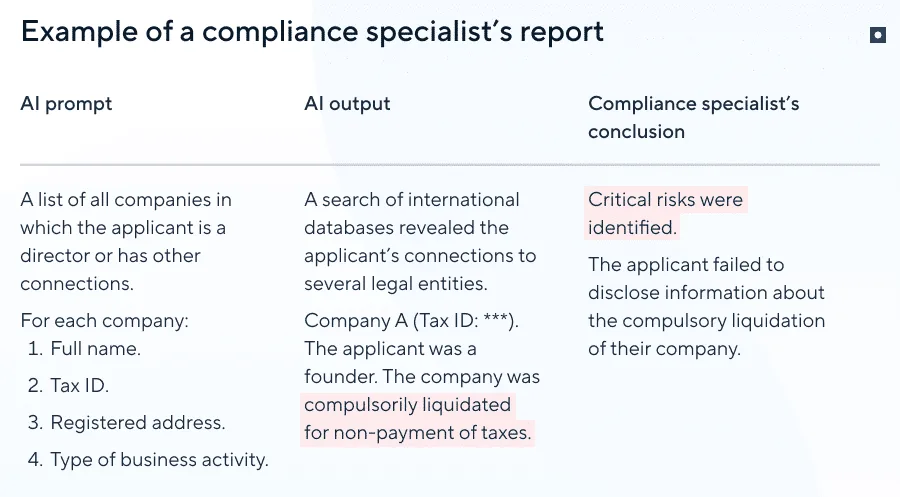
A compliance specialist searches for information about an investor in open databases, such as the register of criminal cases and the register of legal entities.
Sanctions lists are publicly available from the United States, the United Kingdom, and the European Union. During Due Diligence, the investor is checked against such lists.
Technology based on Optical Character Recognition, or OCR, helps the compliance specialist search for information. It makes it possible to read information not only from text documents, but also from scans and photographs.
OCR technology speeds up the check by removing the need for manual data entry, for example, from passport scans, employment record books, and contracts. Artificial intelligence analyses not only the presence of keywords, but also the meaning of the text.
Analysis of media and social media
A modern person leaves a digital footprint everywhere: photographs, comments, reactions, and reposts. This footprint can be used to build a profile of a person, from their favourite food to their political views.
Social media helps assess an investor’s reputation. A specialist reviews not only the overall appearance of the profile, but also the investor’s posts, comments, friend lists, and photographs.
Questions may arise if the investor’s social media shows contacts with politically exposed persons or if the profile contains aggressive posts.
Media coverage about the investor is another area reviewed during Due Diligence. The risk of a residence permit refusal increases if the applicant has been involved in scandals or court proceedings covered by the media.
Natural Language Processing, or NLP, helps with the analysis of social media. It reads unstructured text from open internet sources, including posts on the investor’s personal account and news reports about them in local communities.
Transaction analysis
A compliance specialist studies the investor’s bank statements and analyses:
- where the money comes from;
- how the capital was formed;
- whether the income matches the amount of investment;
- whether
low-tax jurisdictions are used.
Red flags may include links to suspicious jurisdictions, large cash transactions, and illogical transfers. The latter may include, for example, a payment for services not covered by a contract.
At every stage of the review, artificial intelligence helps find and systematise information. But the final word remains with a human. Only a compliance officer analyses the data and concludes whether the investor meets the requirements of the chosen programme and whether the identified risks are acceptable.
It is important to understand that artificial intelligence only complements, but does not replace, the work of the compliance specialist, who decides whether they are prepared to vouch for this client.
Irina Rodriguez
Lawyer, Compliance Specialist
How compliance has changed over the past 5 years
Since 2021, two trends have shaped the investment immigration industry. The first is the introduction of artificial intelligence into processes. The second is the tightening of Due Diligence when obtaining a residence permit or citizenship.
States approach investment programmes with due caution. This helps prevent situations in which criminals, fraudsters, and other persons who pose a threat to national security are able to obtain status. This approach does not imply abandoning such programmes, but it does underline the importance of strict and detailed Due Diligence.
To preserve their reputation and avoid creating security threats, programme units are strengthening checks, and artificial intelligence is one of the tools used for this purpose. Below, we explain how compliance checks have changed, using examples most often discussed in the media.
Caribbean countries
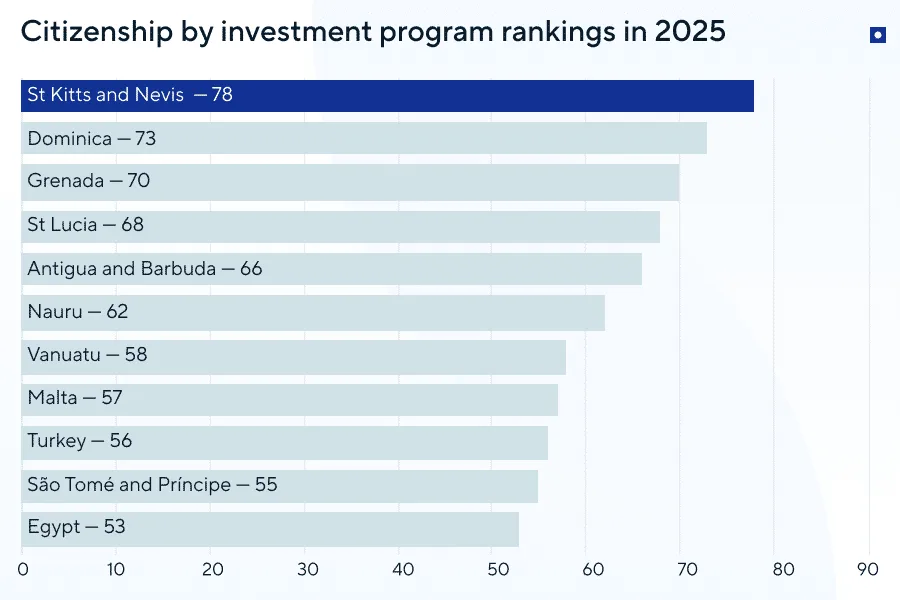
Citizenship programmes in the Caribbean consistently rank among the top five in the world, according to the independent CBI ranking. Under the Due Diligence criterion, these countries receive 8 to 10 points out of 10 every year.
An investor screening takes from three to 6 months. After that, all applicants over the age of 16 undergo a mandatory online interview, where they are asked questions about their background and their reasons for obtaining citizenship.
One of the factors behind stricter Due Diligence is biometric identity verification. It can be used to find a person in an international database by fingerprints and to recognise their face and voice during an online interview.
Artificial intelligence technologies help prevent fraud involving personal data by identifying inconsistencies in biometric information more effectively. For example, this may happen if an applicant is wanted by law enforcement authorities and applies for citizenship using forged documents.
Portugal
Portugal’s immigration service is developing initiatives that will reduce queues for obtaining residence permits and citizenship in the country. One example is a system for processing citizenship applications.
According to preliminary data, the new system may reduce the processing time for each application from two hours to 30 minutes. In addition to speed,
US
US compliance specialists are actively introducing artificial intelligence into social media analysis. Every applicant for a US visa undergoes this screening.
Checking and monitoring personal accounts is one of the US president’s initiatives aimed at ideological screening. Such checks are carried out for travellers, applicants for US visas, and their American contacts.
Artificial intelligence makes it possible to monitor an investor’s social media in real time while the immigration process is underway.
Benefits of introducing artificial intelligence into compliance
In 2024, 74% of law firms in Europe and North America already used artificial intelligence for comprehensive checks. These figures are reported by Wolters Kluwer, a Dutch software company.
Artificial intelligence technologies offer a number of advantages that make the use of AI not a privilege, but a necessity. Below, we look at each of them.
Speed
Artificial intelligence collects and processes large volumes of information in a matter of minutes. A person would need hours or even days to complete the same procedure.
According to approximate estimates, a company that manually screens about 50 clients a week spends 20 to 40 hours on this work. Artificial intelligence reduces this time by 20 to 80% and can save up to 30 hours, according to calculations by researchers at Cornell University.
High accuracy
Artificial intelligence not only collects information, but also analyses and systematises it. A neural network identifies the smallest inconsistencies and patterns that are difficult for a human to process and detect.
One of Denmark’s largest banks, Danske Bank, reduced the number of errors in customer screening by introducing artificial intelligence. Neural networks identified cases of financial fraud after being trained on
Artificial intelligence technologies eliminate the human factor, and with it errors and subjectivity. For example, when an investor is screened manually by an immigration authority, the outcome may depend on the compliance officer’s personal views or state of mind. On one day, the same information may seem negative; on another, neutral.
Artificial intelligence conducts checks according to the same standards and with the same level of scrutiny. The facts of investors’ backgrounds are assessed in the same way regardless of surrounding circumstances.
Processing large volumes of complex information
Artificial intelligence finds mentions of an investor not only in major media outlets and on popular websites, but also in niche publications and brief local news items. Such publications are usually difficult to find through manual searches.
Publications that have already been deleted may also be included in the data set for analysis, so hiding a digital footprint from artificial intelligence is extremely difficult.
Fast adaptation to new rules
Immigration legislation changes regularly. Compliance specialists face new rules and have to adjust the process accordingly.
Artificial intelligence is easier to train: it is enough to upload a rule once, and all subsequent checks will be carried out in line with the updated requirements. A person may forget details or become confused.
Lower operating costs
The use of neural networks reduces not only the time required, but also costs. The main factor is the reduction in manual work. To screen dozens of investors, a company would need not ten compliance officers, but one AI agent and one specialist to monitor the results and review disputed cases.
A company’s costs may fall by up to 30% after the introduction of artificial intelligence technologies. These expenses were calculated by the authors of an article published in the international scientific journal GSC Advanced Research and Reviews.
Risks and limitations of artificial intelligence in compliance checks
Artificial intelligence is not a substitute for compliance specialists, but an additional tool. Neural networks have appeared relatively recently and continue to evolve, so their use raises a number of issues.
Algorithm errors
Artificial intelligence algorithms can make mistakes, so the data must be
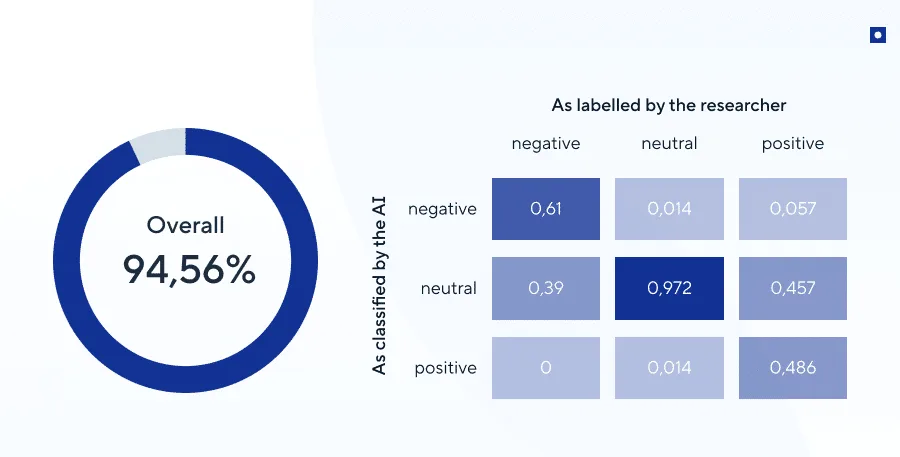
The role of a compliance specialist is to document and refute algorithm errors and correct them. For example, the specialist may
Data confidentiality
During the review, artificial intelligence processes a large amount of the investor’s personal information: personal data, criminal records, bankruptcies, and conflicts. When this data is transferred to a neural network, there is a risk of a data leak.
Large banks prohibit employees from using artificial intelligence tools such as ChatGPT in their work because they are concerned about data leaking outside the organisation. These banks include JPMorgan and Goldman Sachs.
To reduce the risk of data leaks, companies develop and use local neural networks. Access to such systems is granted only to the organisation’s employees.
High initial costs
In the long term, artificial intelligence optimises a company’s costs, but launching a local neural network is expensive. The cost of a standard neural network with the minimum required functionality starts at $50,000. Servers and cloud storage are paid for separately.
No clear legal framework
Many countries have not yet regulated the use of artificial intelligence at the legislative level. For example, in the US, recommendations, codes, and executive orders are in force, but they are not legally binding.
Because of the lack of a legislative framework, a number of practical issues arise, for example:
- who is responsible for algorithm errors;
- whether the investor’s data security is compromised after the data is uploaded to a neural network;
- how to audit artificial intelligence and prove that it works correctly.
The European Union has had an Artificial Intelligence Act in force since 2024. It classifies neural networks according to their level of risk. For example,
Forecast for changes in compliance checks in residence and citizenship applications
Anthropic released plugins for the Claude neural network in free access in January 2026. One of them, the legal plugin, had a critical impact on the legal industry.
The plugin can analyse databases, review documents, and generate reports. In effect, it automates the work of an entire legal sector that earns money by providing access to specialised platforms with databases and tools for analysing them.
The news caused the shares of a number of major legal companies, including Thomson Reuters and LegalZoom, to fall sharply. The latter experienced the biggest drop in its history.
The free plugin did not replace established tools, but it showed that, in the future, a range of tasks could be handled with a single neural network, without a separate platform. Under the influence of artificial intelligence, several trends have already emerged in the industry.
Faster checks
The performance of artificial intelligence is growing every year, while businesses and governments are actively introducing neural networks into their workflows. These conclusions were reached by artificial intelligence researchers at Stanford University. Checks will become faster as a result of improvements in artificial intelligence and its wider adoption.
The time saved will lead not only to shorter queues for residence permits and citizenship, but also to a more detailed review of the applicant’s background.
More in-depth Due Diligence
Artificial intelligence systems make it possible to cover more sources of information than manual screening. Compliance specialists will have more opportunities to examine an investor’s background in detail.
Concealing negative facts from one’s background will become impossible: neural networks will be able to detect the smallest inconsistencies in data. Government authorities will gain the ability to monitor information about an investor continuously.
Stricter requirements
Countries with investment programmes seek to preserve their reputation and, as a result, will continue to tighten requirements for investors. This is necessary to prevent potentially dangerous foreigners, such as fraudsters and criminals, from obtaining residence permits and citizenship.
The immigration industry has seen cases where residence permits and citizenship by investment were used as a way to launder money. One of the most widely discussed cases in the media involved Cyprus citizenship by investment. In 2020, Al Jazeera published an investigation into a fraudulent scheme. Cypriot officials were helping convicted foreigners obtain passports.
Over the years, financial crimes have become more sophisticated and better concealed. Detecting them manually is difficult or
Migration authorities are introducing artificial intelligence algorithms to carry out Due Diligence. This is changing the rules of the game: checks are becoming deeper, faster, and capable of covering volumes of data that previously took months to process.
A digital footprint is now fully visible. Algorithms analyse not only official registers, but also media mentions, social media connections, and even indirect transactional markers. In such an environment, an attempt to hide an inconvenient fact from one’s background becomes a critical risk that will almost certainly lead to a refusal of a residence permit or citizenship.
Irina Rodriguez
Lawyer, Compliance Specialist
How investors can prepare for compliance checks today
Every person leaves a digital footprint: in personal profiles and comments, in media mentions, or on the website of the company where they work. It is not always possible to predict which traces reviewers will see. The following steps can improve the chances of passing the check successfully.
Manage the digital footprint to maintain a good reputation. For example, an investor may respond to and refute negative publications or request the removal of defamatory content.
Create a digital footprint proactively. This can be done by setting up professional profiles on platforms such as LinkedIn, taking part in conferences, and contributing expert comments to media articles.
Use social media thoughtfully. This also helps build a positive digital footprint. For example, an investor may choose to avoid aggressive statements online.
Undergo a preliminary Due Diligence. This is usually carried out by law firms and consulting companies that assist with obtaining residence permits and citizenship.
Compliance specialists use international databases in line with the standards of the country where the investor plans to obtain status. as a result, the review can reveal background details that may lead to a refusal.
At Passportivity, we rely on the official requirements of each programme and use similar international legal databases and
We do not simply review documents, we help the investor see their case through the eyes of an immigration officer in the age of digital technologies. After that, lawyers help address these issues with additional documents and prepare a rebuttal or explanation.
We do not recommend trying to conceal negative facts from one’s background. Modern technologies will detect them, and concealment will most likely lead to a refusal of status.
Irina Rodriguez
Lawyer, Compliance Specialist
Key takeaways on compliance checks in the age of AI
- Foreign nationals undergo comprehensive checks when applying for residence permits and citizenship by investment.
- Compliance specialists are beginning to use artificial intelligence technologies actively.
- In addition to sanctions lists and international databases, modern screening includes analysis of the digital footprint — all information about the applicant available in open sources.
- Speed, high accuracy, and the ability to process large volumes of information are the main advantages of artificial intelligence in compliance checks.
- The weak points include algorithm errors, the risk of data leaks, and the absence of a clear legal framework.
- Artificial intelligence is a tool for comprehensive checks, but the final decision remains with a human.
- Investors are advised to prepare for the review in advance and manage their digital reputation.
Sources
- Wolters Kluwer report on artificial intelligence in the legal industry, 2024.
- Directive (EU) 2018/1673 on combating money laundering by criminal law.
- FATF report on the misuse of citizenship and residence permit programmes by investment.
- Stanford University’s AI Index Report 2025.
- Decision of the German Federal Cabinet on the use of artificial intelligence in visa processes.
- European Union Artificial Intelligence Act 2024/1689.
- CBI Index 2025 by the Private Wealth Management experts of the Financial Times.
- Article in the scientific journal GSC Advanced Research and Reviews on the role of artificial intelligence in preventing financial fraud.
- Schengen.News article about the launch of a new
AI-based platform for processing Portuguese citizenship applications. - Artificial Lawyer article about a new plugin for the Claude neural network.
- TechCo article about the ban on the use of artificial intelligence in Wall Street banks.
- Danske Bank case study on the introduction of artificial intelligence into customer screening.
- Al Jazeera investigation into the fraudulent scheme involving Cyprus citizenship by investment.
Note
This report has been prepared for educational and informational purposes. It does not constitute advertising or a recommendation regarding investment decisions.
The materials may be used as reference information, provided that the source and a link to the report are included. We hope the data collected will serve as a useful guide for further research into the investment immigration market.
Request Expert Commentary or Custom Research
Are you a journalist or an analyst, or do you work with high-net-worth individuals and need verified data, expert comments on investment migration, or market research for a specific task? We are ready to help.

Elena Dukach
Chief Executive Officer
Frequently asked questions
Artificial intelligence makes it possible to process large volumes of information within a relatively short period of time. The time saved is driving two trends: faster checks and stricter scrutiny.
A neural network analyses information that may be missed during a manual search. as a result, compliance specialists will be able to examine an investor’s background in greater depth and, consequently, will be more likely to identify grounds for refusing to grant status.
A compliance check will remain a manageable stage if an investor prepares for it properly. For example, they can monitor their digital footprint and provide explanations for negative facts from their background.
The results of the check are analysed by a compliance specialist, who may notice an error and carry out additional research. This significantly reduces the risk of an unfounded refusal to grant a residence permit or citizenship.
Algorithm errors remain one of the disadvantages of artificial intelligence. Despite the generally high accuracy of the results, a neural network may sometimes provide incorrect data or draw the wrong conclusion, for example, by identifying the investor’s namesake on a sanctions list.
An investor has the right to refute false information, request the removal of defamatory content, or comment on negative publications. They may also create a digital footprint proactively by setting up a personal website, maintaining a professional LinkedIn profile, and acting as an expert contributor in articles.
An investor risks failing the Due Diligence if they have been placed on a sanctions list, have a criminal record, or have undergone bankruptcy proceedings.
The grounds for refusal may vary depending on the type of status and the country. For example, Caribbean countries refuse applicants who have undergone bankruptcy proceedings within the 10 years preceding the citizenship application. For applicants seeking
An investor may contact a law firm and undergo a preliminary Due Diligence. Compliance specialists review the investor’s background in line with all current requirements of the migration authority.
A preliminary Due Diligence identifies in advance the facts that may become obstacles to obtaining a residence permit or citizenship. Lawyers then help prepare additional documents or choose an alternative solution.