

 Residency
 Reading time: 11 min
 Malta permanent residence programme MPRP: complete guide to Malta residency by investment
Malta offers a
Total programme costs on the rental route start at €169,000, while the final budget depends on family composition and the chosen accommodation option.

 Share
Share  Telegram
  Facebook
 LinkedIn
 X
X

 Save
Save 

What is the Malta Permanent Residence Programme?
Malta Permanent Residence Programme, MPRP, is a
The programme rules and eligibility criteria are set out in Regulations S.L. 217.26 of 2021 [387] Source: MPRP regulations, Subsidiary Legislation 217.26 , as amended by Legal Notice No. 310 of 2024 [388] Source: Legal amendment, Legal Notice 310 of 2024 and Legal Notice No. 146 of 2025 [389] Source: Legal amendment, Legal Notice 146 of 2025 .
To qualify, applicants must meet four mandatory conditions:
- secure qualifying accommodation in Malta, either through rent or purchase;
- make a
non-refundable government contribution; - pay an administrative fee;
- donate to a Maltese NGO.
The main applicant must also prove financial solvency: at least €500,000 in capital with €150,000 in liquid assets, or €650,000 in capital with €75,000 in liquid assets.
Applications are submitted through a licensed agent, and the programme is built around a structured Due Diligence process before approval [390] Source: Official legal framework, Residency Malta Agency .
7 benefits of Malta permanent residence
Malta Permanent Residence Programme can suit investors who want a stable EU base for family life, travel, and
1. Life-long residency with residence card renewal every 5 years
MPRP grants permanent resident status valid for life; only the residence card is renewed every 5 years. Families often use the status as a
2. Visa-free travel across Schengen Area: 90 days out of 180
Malta permanent residents may visit other Schengen member states
3. International business setup in Malta
Maltese residents may register companies in Malta, which can strengthen credibility with partners and make
4. Access to healthcare in Malta and wider EU
With national health insurance, residents can access public healthcare in Malta and also use private clinics; the programme is often chosen by families who prioritise healthcare access in the EU.
5. Education in English and internationally recognised diplomas
Many schools and universities teach in English, and qualifications are typically recognised internationally. The University of Malta has improved its position in the QS World University Rankings 2026, placed in the
6. EU location and strong economic indicators
As an economic snapshot, Eurostat’s latest comparison for 2024 places Malta among EU countries above the EU average for GDP per capita in PPS, and Malta’s value is shown as 110 where the EU equals 100.
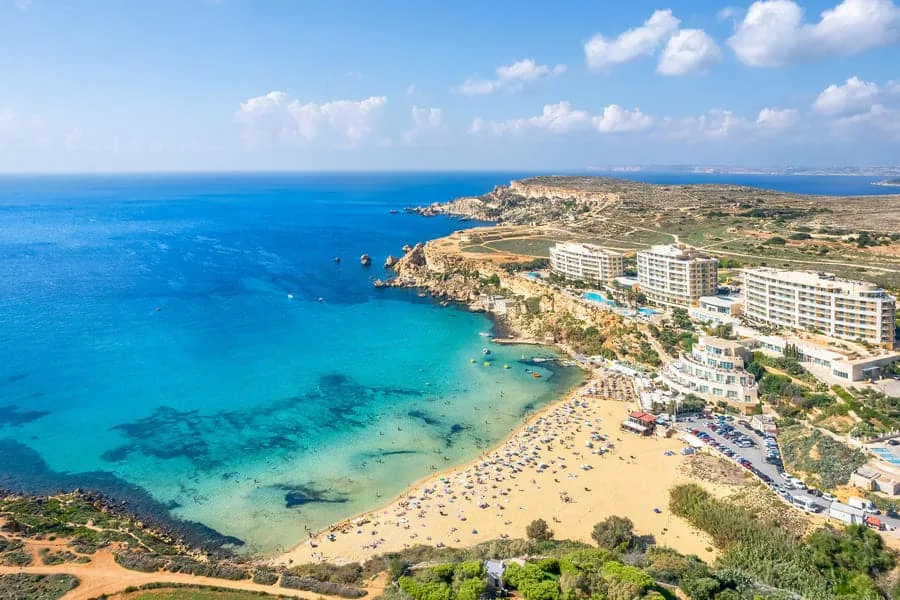
7. Coastal lifestyle: beaches, nature, and a Mediterranean climate
Malta combines a compact island scale with easy access to the sea. The climate is Mediterranean, with hot, dry summers and mild winters. Average daytime highs reach about 28°C in August and about 16°C in February.
Rainfall is seasonal: almost
For beach time, sea temperatures are usually most comfortable in summer. Average sea temperature reaches about 26°C in August, while February averages around 14°C.
In 2025, 13 beaches across Malta and Gozo received Blue Flag certification, which assesses factors such as water quality, safety, environmental management, and visitor services [393] Source: Blue Flag awards, Government of Malta .
Spring and early autumn often work well for combining outdoor activities and sightseeing with occasional swim days, while
Malta PR requirements and eligibility criteria
Before starting the application process, it is worth checking two things: whether the main applicant meets the programme’s admissibility and financial thresholds, and whether each family member qualifies as a dependant under the rules.
Requirements for main applicant
To apply under the Malta Permanent Residence Programme, the main applicant must be an investor aged 18+ and meet standard admissibility checks:
- no criminal record, prosecutions, or charges;
- not be under sanctions;
- have no visa denials to countries that have a
visa-free regime with Malta; - have provable legal income and assets.
The main applicant must also prove financial solvency by showing capital of at least €500,000 with at least €150,000 in liquid financial assets, or €650,000 with at least €75,000 in liquid financial assets.
Eligibility for family members
MPRP allows a family application that can include the following dependants:
- spouse or partner in officially registered marriage or partnership, or a
de-facto partnership that can be proven with documents;same-sex couples are included; - children under 18, including children from previous marriages of either the main applicant or spouse or partner;
- children aged 18 to 29 must be unmarried and wholly or substantially financially dependent on the main applicant;
- parents and grandparents without age limit, but they must be financially dependent on the main applicant.
Restrictions for applicants
Investment options under malta residence by investment
Under MPRP, the investment framework is built around four mandatory elements: qualifying accommodation in Malta, a
The only part that changes between applicants is the accommodation route. Everything else applies in both scenarios.
Option 1. Renting property
This route is based on a
The minimum rent is €14,000 per year, and the property must be maintained for the required period as part of compliance.
Option 2. Purchasing property
This route is based on ownership rather than a lease. The applicant purchases residential property in Malta that meets the minimum value threshold and keeps it for at least five years.
The minimum purchase value is €375,000. After the
Mandatory payments in both routes
Regardless of whether accommodation is rented or purchased, the programme includes three fixed payment components:
- Government contribution: €37,000.
- Administrative fee: €60,000 for the main applicant, plus €7,500 per dependant aged 18 or over, excluding the spouse.
- Charitable donation: €2,000 or more to a Maltese NGO chosen by the applicant.
The programme’s NGO donation is defined as a contribution to a local voluntary organisation, with the donation purpose categories set out in the official programme materials [394] Source: Programme brochure, Residency Malta Agency .
A property purchased under the permanent residence programme may be used for
A rented property may be sublet only if the lease has been in place for more than five years and the landlord has provided written consent. These rules came into force on 22 July 2025.
Elena Garnitsarik
Head of the Legal Department
What is the total cost of Malta PR by investment?
Total cost depends on two variables: accommodation route (rent or purchase) and family composition. Beyond the core programme payments, applicants usually budget for residence card fees, document translation and certification, and health insurance.
Core programme payments include an administrative fee of €60,000 for the main applicant plus €7,500 per dependant aged 18 or over, excluding spouse, a charitable donation of €2,000+, and a government contribution fee of €37,000.
Accommodation costs differ by route: renting starts at €14,000 per year and is required for at least five years, while purchasing starts at €375,000+ with a
Estimated Malta MPRP costs: renting vs purchasing
| Route | Accommodation | Contribution | Administrative fee | Donation | Residence card fee | Translation, apostille | Health insurance | Total |
|---|---|---|---|---|---|---|---|---|
| Single applicant | ||||||||
| Renting | €70,000+ | €37,000 | €60,000 | €2,000+ | €500 | €5,000+ | €700+ | €175,200+ |
| Purchasing | €375,000+ | €37,000 | €60,000 | €2,000+ | €500 | €5,000+ | €700+ | €480,200+ |
| Couple | ||||||||
| Renting | €70,000+ | €37,000 | €60,000 | €2,000+ | €1,000 | €5,000+ | €1,400+ | €176,400+ |
| Purchasing | €375,000+ | €37,000 | €60,000 | €2,000+ | €1,000 | €5,000+ | €1,400+ | €481,400+ |
| Family of 3+ | ||||||||
| Renting | €70,000+ | €37,000 | €60,000+ | €2,000+ | €1,500+ | €5,000+ | €2,100+ | €177,600+ |
| Purchasing | €375,000+ | €37,000 | €60,000+ | €2,000+ | €1,500+ | €5,000+ | €2,100+ | €482,600+ |
List of required documents for Malta Permanent Residence Programme
Document requirements apply both to the main applicant and to each family member included in the file. In addition to standard identity and financial documents, dependants must provide paperwork confirming the family relationship and, where relevant, financial dependency.
Below is a consolidated checklist of the documents typically required for an MPRP application:
- Covering letter.
- Power of attorney.
- Passport copies for all applicants.
- Birth certificates.
- Police conduct certificates for applicants aged 14+.
- Health insurance.
- Purchase or lease agreement for residential property in Malta.
- Bank statements.
- Proof of assets meeting the required threshold.
- Completed government forms.
- Malta permanent residency.
Documents not in English are usually translated in Malta. If translations are prepared in the applicant’s country of residence, they must be apostilled or legalised.
Application process for obtaining Malta permanent residence: step-by-step
In most cases, the full process takes around six or more months from submitting the permanent residence application to receiving residence cards, mainly due to the agency's Due Diligence stage, which can take three months, plus card printing time of four weeks after biometrics.
-
2 days
Preliminary Due Diligence
Due Diligence is essential for obtaining Malta permanent residency by investment.
Passportivity’s
in-house Compliance Department checks documents against international databases to identify rejection risks in advance. If there are any risks, we offer solutions like providing additional documents. -
1+ month sObtaining a temporary residence permit (optional)
Before submitting the full MPRP application, the main applicant and their dependants may get a
1-year temporary residence permit.The temporary residence permit application requires:
- covering letter;
- power of attorney;
- passport copies;
- health insurance;
- purchase or lease agreement for a residential property in Malta;
- bank statements;
- completed government forms.
Applicants must visit Malta to submit biometrics. A fee of €100 per temporary residence card and the first part of the administrative fee of €15,000 are paid.
Once submitted, the temporary residence application is processed within approximately 4 weeks. The cards must be collected in person from the Residency Malta office, either by our team or the applicant.
The full permanent residency application must be submitted within 6 months of receiving the temporary permit. If the MPRP application is refused, the temporary residence permit will be revoked within 15 days.
-
3+ week sPreparing documents
Passportivity lawyers guide the applicant through collecting and certifying documents and arranging translations, which are typically done in Malta to meet the required standards. If the investor prefers to translate documents in their country of residence, the translations must be apostilled or legalised.
The required standard documents include:
- passport copies;
- birth certificates;
- police conduct certificates for applicants aged 14 and over;
- bank statements;
- proof of assets in the required amount.
-
1 week
Applying for permanent residency
Once all the documents are gathered, the application is submitted to the Residency Malta Agency. At this stage, the investor’s presence in Malta is not required, as all necessary forms are signed remotely and couriered to Malta.
If the investor did not opt to get a temporary residence permit, the Residency Malta Agency issues an invoice for the first part of the administrative fee of €15,000 within
2—5 business days. The invoice must be paid within one month of issuance. -
3—6 monthsDue Diligence
The Residency Malta Agency processes the application for 3 to 6 months, assuming all required documents were submitted initially. In practice, this period may be longer if there are internal delays at the Agency or additional documents are requested.
After completion of the checks by the Agency, a letter of approval in principle or rejection is issued.
-
Within 8 months after approval
Fulfilling investment conditions
Upon receiving the Letter of Approval in Principle, the applicant must fulfil the investment requirements:
- pay the remaining €45,000+ of the administrative fee;
- rent or buy a residential property in Malta;
- pay the government contribution;
- donate to a Maltese NGO.
When the investment requirements are fulfilled, the Residency Malta Agency issues a certificate of permanent residence.
-
1 day
Submitting biometrics
Biometrics must be taken in Malta. The applicant and all dependents are required to visit the Residency Malta Agency's office; only infants up to the age of 2 are exempt from biometrics.
-
4+ week sReceiving residence cards
Once the biometrics are submitted, the application is sent to the residence department for printing, which typically takes at least 4 weeks per application.
Passportivity lawyers collect the residence cards and permanent residence certificates on behalf of the applicants.
The Residency Malta Agency checks compliance with the conditions every year for the first 5 years after granting permanent residency. The licensed agent submits a special Compliance Form for the applicant each year on the date of receiving the Permanent Residence certificate.
How to maintain Malta permanent residency?
Permanent resident status is granted for life, but the residence card is renewed every five years. Maintaining Malta permanent residence under MPRP is mainly about ongoing compliance: keeping qualifying accommodation in Malta, holding valid health insurance, and passing annual checks in the first five years.
Keep qualifying accommodation in Malta
A residential address in Malta is required throughout. The qualifying property must be held for at least five years, whether it is rented or purchased. After five years, it is possible to sell or change the property, but accommodation in Malta remains mandatory to keep permanent residence.
Maintain health insurance
Applicants are expected to keep health insurance covering risks in Malta and other European countries as part of the programme’s compliance requirements.
Pass annual compliance checks for the first 5 years
After the residence cards are issued, the Residency Malta Agency conducts annual compliance checks for the first five years. A Compliance Form must be submitted each year on the anniversary date of the permanent residence certificate.
Path from Malta MPRP to citizenship
MPRP is a permanent residence programme, not a citizenship route. It can provide a legal basis to live in Malta, but citizenship is governed by separate rules and is assessed independently. The core legal framework is the Maltese Citizenship Act, Chapter 188 [395] Source: Citizenship law, Maltese Citizenship Act .
For “ordinary” naturalisation, the law sets out a residence pattern that is often summarised as 5 years:
- 12 months of residence in Malta immediately before the application;
- at least 4 years of residence in total during the 6 years preceding those 12 months.
Even if the residence requirement is met, naturalisation is not automatic. The decision is discretionary and also depends on factors such as:
- continuity of residence and physical presence that supports the statutory residence test;
- adequate knowledge of Maltese or English;
- good character and overall suitability as a citizen.
MPRP can support a
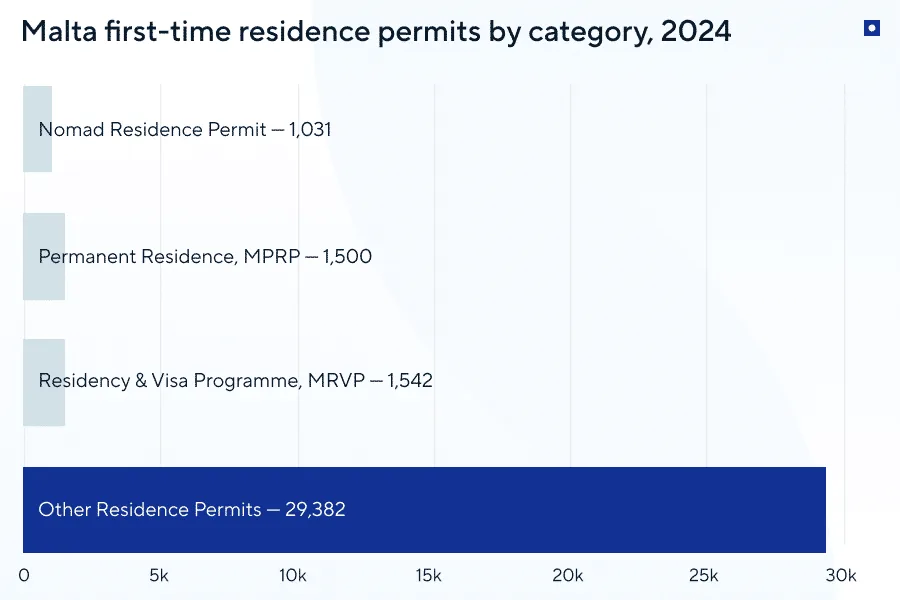
Malta remains a popular relocation destination. In 2024, Malta issued 33,455
Tax considerations for Malta residency
Tax outcomes in Malta depend on a person’s tax residence status, domicile, and where income is sourced and received. This section explains how tax residence is typically determined, then outlines the main taxes for individuals and companies, special regimes, and how double taxation is usually addressed.
How to become a Malta tax resident
An individual who is physically present in Malta for more than 183 days in a calendar year is considered a tax resident in Malta for that year [396] Source: Tax residency rules, Malta Tax and Customs Administration . An individual who moves to Malta to establish residence may be treated as a resident from the date of arrival, regardless of the number of days spent in Malta in that year.
Malta also distinguishes between “residence” and “ordinary residence”. Living in Malta on a permanent or indefinite basis generally points to ordinary residence, while repeated long stays over several years and building personal and economic ties may also lead to ordinary residence.
Main taxes for individuals
The tax outcome depends heavily on whether a person is resident and domiciled in Malta or resident but not domiciled. Residents who are ordinarily resident and domiciled are generally taxed on a worldwide basis.
Individuals who are not domiciled or not ordinarily resident are generally taxed on the remittance basis:
Income tax rates. Malta uses progressive income tax bands with different tables for single, married, and parent rates. For 2025, the top marginal rate shown in the official tables is 35%, with lower bands starting at 0% and 15% depending on the category and chargeable income.
Minimum tax for
VAT and
Taxes for companies
Corporate income tax. Malta’s headline corporate income tax rate is 35%. In practice, Malta’s full imputation system and shareholder refund mechanisms are often used in international structures.
Optional 15% election in certain cases. Recent commentary notes that entities may be able to elect a 15% tax on chargeable income under the “Final Income Tax Without Imputation” regulations (details and eligibility should be checked case by case).
VAT. Businesses making taxable supplies in Malta generally deal with VAT at the standard 18% rate unless a reduced rate or exemption applies.
Special tax regimes
Malta has special schemes that allow eligible individuals and their families to pay tax at a flat 15% on
Separately, Malta has guidelines for special tax treatment for highly qualified persons, including a 15% tax rate on qualifying employment income for a limited consecutive period, subject to conditions.
Double taxation and relief
Malta’s rules recognise that dual tax residence can happen and may create conflicts. In practice, double taxation is typically addressed through Malta’s treaty network and domestic relief mechanisms.
For individuals taxed on the remittance basis, treaty provisions can affect whether employment or business income is taxable in Malta, depending on the facts. Where foreign tax is paid on income that is also taxable in Malta, relief is generally approached through foreign tax credit mechanisms, subject to limits and evidence requirements.
Are there alternatives to Malta Permanent Residency Program in Europe?
Malta is not the only European country offering residence status in exchange for investment. Cyprus also has a programme that grants permanent residence for qualifying investors. In other EU destinations, investment routes are usually structured as renewable residence permits rather than immediate permanent residence.
The qualifying investment often takes the form of a real estate purchase, capital investment, or business activity, depending on the country’s rules and the specific route.
EU residence permits by investment comparison
| Country | Minimum investment | Physical stay requirement | Obtaining period | Residence validity | Time to citizenship |
|---|---|---|---|---|---|
| Malta | €169,000 | No minimum stay | Permanent residence | Citizenship by separate legal route | |
| Cyprus | €250,000 | No minimum stay | Permanent residence | 8 years | |
| Hungary | €250,000 | No minimum stay | 10 years | 11 years | |
| Greece | €250,000 | No minimum stay | 5 years | 7 years | |
| Portugal | €250,000 | 7 days per year | 2 years | 5 years | |
| Italy | €250,000 | No minimum stay | 2 years | 10 years |
Life in Malta
Malta is a compact Mediterranean archipelago of 316 sq km. The main inhabited islands are Malta, Gozo, and Comino, and the country sits on major regional routes 93 km south of Sicily. The small scale is part of the appeal: most places are reachable within a short drive, and the coastline is never far away.
Economy
Malta is a
Politics
Malta is a parliamentary republic within the EU framework. It has a
Language
Malta has two official languages: Maltese and English. English is widely used in everyday life, business, and education, which can make settling in and dealing with administration more straightforward for international families.
Population
Malta’s population is estimated at 574,250 at the end of 2024, up 1.9%
Final thoughts on Malta permanent residency by investment
- Malta grants permanent resident status for eligible
non-EU investors, valid for life, with the residence card renewed every 5 years. - Core eligibility includes financial solvency and the four mandatory programme conditions: qualifying accommodation, government contribution, administrative fee, and NGO donation.
- For accommodation, the investment thresholds are €14,000+ per year for at least 5 years in case of renting, or €375,000+ with a
5-year holding period in case of purchasing. - Fixed payments include a €37,000 contribution, a €60,000 administrative fee plus €7,500 for each dependant aged 18+ excluding spouse, and a €2,000+ donation.
- The typical timeline is
6+ month s overall, driven by Agency Due Diligence that can take3—6 months and residence card printing that takes4+ week s after biometrics.
About the authors


Frequently asked questions
A minimum budget for a single applicant starts at €169,000 on the rental route, made up of €70,000+ rent over 5 years, a €37,000 government contribution, a €60,000 administrative fee, and a €2,000+ donation, plus additional ancillary costs such as cards, document preparation, and insurance.
The Malta Permanent Residence Programme, MPRP, is a
Buying property can be the accommodation component of MPRP, but it is not enough on its own. The programme also requires the government contribution, administrative fee, and NGO donation, and the property must meet the minimum value threshold and be held for at least 5 years.
Yes. Malta permanent residents under MPRP may live in Malta and can work, study, and run a business there without additional permits.
Yes. The qualifying property must be kept for at least 5 years. After that, it can be sold or changed, but maintaining an address in Malta remains a requirement to stay compliant with permanent residence conditions.
Yes. Malta’s
Read also




Contact us today
Passportivity assists international clients in obtaining residence and citizenship under the respective programs. Contact us to arrange an initial private consultation.