
 Residency

 Reading time: 15 min
All Ways to Obtain a Malta Residence Permit
Malta provides several routes to residence for foreign nationals, including family reunification, studies, employment, and business establishment. Separate residence options are available for digital nomads and investors.
Each route has its own requirements, processing times, and costs. For example, investors can obtain residence in at least 3 months, with expenses starting at €30,000.

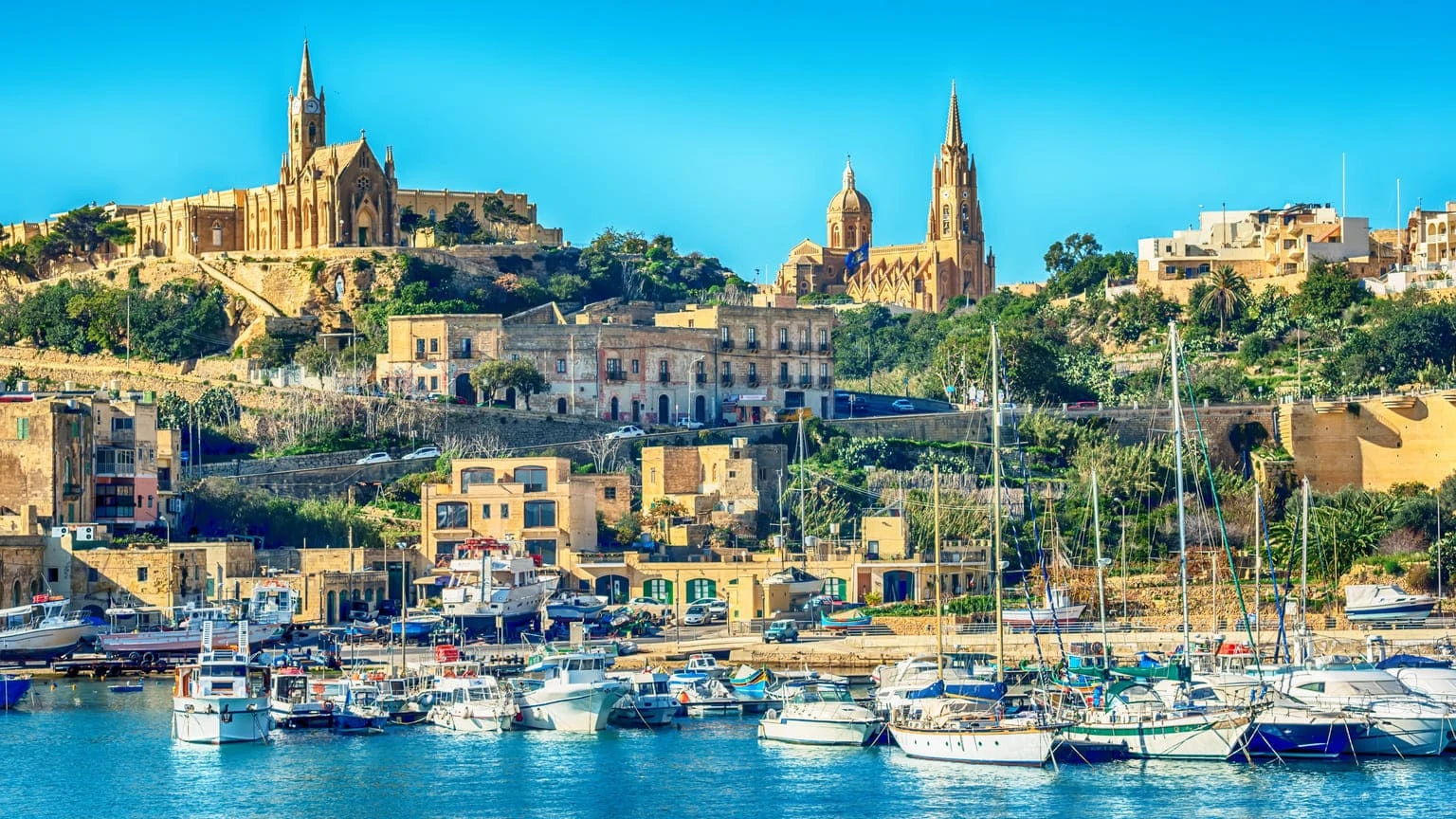

7 benefits of a Malta residence permit
A Malta residence permit opens up opportunities for tax optimisation,
1. Residence for the whole family
In some cases, family members of foreign nationals can also obtain residence permits. For example, investors can include their spouse and children aged 24 or younger in their initial residence application.
Foreign nationals who already hold a Malta residence permit can also apply for family reunification.
2. Opportunity to become a tax resident
Foreign nationals who spend more than 183 days a year in Malta become subject to taxation in the country. Personal income tax rates range from 0 to 35% [1] Source: Malta’s income tax rate is listed on the website of the Malta Tax and Customs Administration .
Companies in Malta pay corporate income tax at a rate of 35%
[2]
Source: Malta’s corporate income tax rate is listed on the website of the Malta Tax and Customs Administration
and
Investors who obtain residence under a government programme also become Maltese tax residents. They can benefit from a special tax regime with a 15% tax rate on foreign income remitted to Malta. The minimum annual tax liability is €15,000 per family.
3. Visa-free travel
Malta residence permit holders can travel to other countries in the Schengen Area without a visa and stay for up to 90 days in any
4. Path to permanent residence and citizenship
Foreign nationals can apply for permanent residence after living in Malta with a temporary residence permit for 5 years.
Foreign nationals can apply for citizenship after 4 years of residence in Malta, including at least 1 continuous year immediately before submitting the application.
Applicants must demonstrate proficiency in Maltese or English and take an oath of allegiance to the Republic of Malta.
5. Opportunity to work and run a business
Some types of Malta residence permits allow foreign nationals to work, start a business, or become
6. High quality of life and safety
The cost of living in Malta is lower than in other developed European countries, such as Switzerland or Germany. At the same time, the country offers high standards of healthcare, banking services, and education.
Malta is also one of the major centres for learning English, with colleges and universities offering
Malta is considered a relatively safe country. According to Numbeo [5] Source: Crime indices for Malta, Italy and France are listed in Numbeo’s 2026 ranking of European countries , the country has a low crime index of 43 out of 100. By comparison, the index is 47 in Italy and 55 in France. One contributing factor is the police presence, with approximately 400 police officers per 100,000 residents [6] Source: Data on the number of police officers in European countries is published on the Eurostat website .
7. Warm climate
Malta has a hot Mediterranean climate with dry summers. The country enjoys around 300 sunny days a year, and temperatures can reach +35°C in July.
Winters in Malta are mild, with relatively little rainfall and almost no snow. The average winter temperature is +14°C, while November is the wettest month of the year.
Malta residence by investment
Investors can get residence through the Malta Global Residence Programme. The process takes at least 3 months, with minimum costs of €30,000.
Eligibility requirements
Investors from
Investors are not required to live in Malta permanently. However, they must not spend more than 183 days a year in any other country.
Investment requirements
Malta grants residence permits to investors who:
- rent or purchase a property in Malta for 5 years;
- pay an administrative fee;
- undertake to pay tax on income remitted to Malta, with a minimum annual tax liability of €15,000.
The total investment amount depends on the region where the investor rents or purchases a property.
In southern Malta and on the island of Gozo, the minimum annual rental cost is €8,750, while the minimum property purchase price is €220,000. The administrative fee is €5,500.
In other regions of Malta, investors must rent a property for at least €9,600 per year or purchase one for at least €275,000. The administrative fee is €6,000.
Additional costs for investors include health insurance starting at €400 per person, as well as translation and notary fees of approximately €4,000.
Required documents
The exact list of documents depends on the investor’s country of residence, source of income, and the type of property they choose, but usually they submit:
- valid passport;
- birth certificate;
- marriage certificate, if the application includes a spouse;
- bank statements for the last
6—12 months; - proof of assets, such as property ownership documents, investment portfolios or shares in companies;
- declaration on the source of funds, with documents confirming that they were obtained legally;
- criminal record certificates from every country where the applicant has lived;
- health insurance valid in Malta and the Schengen Area;
- property purchase or lease agreement that meets the programme’s requirements.
Validity and renewal
The residence permit is granted for 2 years and can be renewed indefinitely. Programme participants must maintain their investments to keep their residence status, for example by continuing to rent a property. They must also pay at least €15,000 in tax each year and make sure their health insurance remains valid.
Malta residence permit for digital nomads
Digital nomads can obtain a Malta residence permit if they work remotely for a company based abroad.
Eligibility requirements
To be eligible for the Nomad Residence, applicants must earn at least €3,500 per month. They must also rent or purchase residential property in Malta for the entire duration of their residence permit.
Digital nomads can include their immediate family members, such as spouses and minor children, in their applications. The minimum income requirement remains the same regardless of family size.
Required documents
The main applicant must submit:
- application form;
- valid passport;
- CV covering their work history and education
- motivation letter explaining why they are applying and what their sources of income are;
- employment contract that allows remote work, or service agreements with clients;
- bank statements for the last 3 months;
- police clearance certificate issued no more than 6 months before the application;
- health insurance.
Family members need documents confirming their relationship to the main applicant, such as marriage or birth certificates.
A
Validity and renewal
The initial residence permit is valid for 1 year and can be renewed 3 times, each for another year. To qualify for renewal, digital nomads must spend at least 5 months a year in Malta.
The Nomad Residence Permit does not provide a pathway to permanent residence or Maltese citizenship.
Malta residence permit by establishing a startup
Entrepreneurs can obtain a Malta residence permit by establishing an innovative company in the country.
Eligibility requirements
Applicants must be over 18, have no criminal record, and hold valid health insurance. To be eligible, they must invest at least €25,000 in the startup’s shares. If the company has more than 4 founders, the required investment increases by €10,000 for each additional founder. The maximum number of founders is 6.
Entrepreneurs who have already established a startup in any country, including Malta, are also eligible, provided the company was founded no more than 7 years ago.
Required documents
Entrepreneurs first submit an online application to Malta Enterprise, the agency that assesses startups, and attach a business plan. The plan should describe the company, the project in Malta, and the financial forecast for 3 years ahead. The residence permit application can only be filed once Malta Enterprise has approved the plan.
At the application stage, the entrepreneur submits the following:
- proof of an investment in the company’s share capital;
- company’s cap table and, if needed, documents confirming the applicant’s status as
co-founder ; - bank statements showing they have enough funds to support themselves and their family;
- criminal record certificate;
- health insurance;
- declarations stating that they intend to make Malta their main place of residence and that they have never been refused residence or citizenship in any country.
Validity and renewal
The initial residence permit is valid for 3 years and can be extended for another 5 years, provided the startup continues to meet the requirements of Malta’s immigration legislation.
Startup founders must spend more than 183 days a year in Malta and pay taxes in the country.
Malta residence permit by employment
Foreigners who receive a job offer from a Maltese company can obtain a residence permit through employment, known as a Single Permit. The application is reviewed for up to 4 months.
Eligibility requirements
To be eligible, applicants need a job offer from a Maltese employer for a position that could not be filled locally or by EU, EEA or Swiss citizens. To prove this, the employer must advertise the vacancy on the Jobsplus and EURES portals for at least 3 weeks in the 2 months before applying.
Foreign nationals must complete a
Permit holders may bring their families but only after 12 months in Malta. To do so, they must earn more than the median wage plus 20% for each family member and demonstrate reasonable prospects of permanent residence.
Required documents
The applicant submits:
- application form;
- passport valid for more than 8 months;
- employment contract stating the salary and duration of employment;
- job description signed by the employer and the applicant;
- certificate proving completion of the
pre-departure course.
Those taking jobs in tourism and hospitality also need a Skills Pass confirming their professional qualifications. Some professions, such as electricians, nurses and security officers, require a professional licence.
The employer also submits proof that the vacancy was advertised and a declaration confirming the candidate’s suitability for the position.
After arriving in Malta, the applicant submits proof of a completed health screening, a rental or purchase agreement for accommodation, and health insurance.
Validity and renewal
The residence permit is usually issued for 1 year and renewed annually. After 5 years of continuous residence in Malta, permit holders can apply for
Malta residence permit under the Key Employee Initiative
Foreigners can obtain a Malta residence permit through the Key Employee Initiative. Under this programme, applicants receive the same work and residence permit as other employees, known as a Single Permit, but their applications are
Eligibility requirements
Applicants must have a job offer for a managerial or highly technical position with a gross annual salary of at least €45,000. They must also confirm their qualifications with a diploma, a professional licence or proof of relevant work experience.
Before hiring a foreign specialist, the employer must advertise the vacancy in local media for at least 2 weeks within the 2 months before the application.
Unlike other Single Permit holders, key employees can bring their families to Malta without waiting 12 months. To do so, they must earn at least €50,000 a year for themselves and one family member, plus €6,000 for each additional family member.
Required documents
The application must include:
- employee’s valid passport;
- employment contract confirming a salary of at least €45,000 a year;
- employee’s diploma, professional licence or proof of work experience;
- proof that the vacancy was advertised;
- health insurance with coverage of at least €100,000.
Validity and renewal
The initial residence permit is valid for 1 year. It can then be renewed for up to 3 years if the holder provides a valid employment contract and a tax return stamped by the tax authority.
Malta residence permit for highly qualified professionals
Highly qualified foreign specialists can live and work in Malta with an EU Blue Card. It is a residence permit for employees whose salary is well above the national average.
Eligibility requirements
Applicants must have a higher education degree recognised in Malta and an employment contract with a Maltese company for at least 6 months. Their gross annual salary must be at least 1.5 times the national average.
Before hiring a foreign specialist, the employer must advertise the vacancy in local media for at least 2 weeks within the 2 months before the application.
Blue Card holders can bring their immediate family to Malta. Family members can apply together with the main applicant, without waiting the 12 months required for Single Permit holders.
Required documents
The employer submits the application on behalf of the employee. It includes:
- employee’s passport;
- employment contract for at least 6 months;
- diploma of higher education and its recognition in Malta;
- proof that the vacancy was advertised;
- health insurance with coverage of at least €100,000.
Validity and renewal
The Blue Card is issued for up to 2 years, depending on the length of the employment contract. It can be renewed as long as the holder keeps working and meets the requirements. Blue Card holders can change employers, but during the first year they must notify the authorities and may have to wait up to 30 days for approval.
After 5 years of legal residence in the EU, including at least 2 years in Malta, Blue Card holders can apply for EU
Malta residence permit for entrepreneurs and self-employed professionals
Foreign entrepreneurs and
Eligibility requirements
Applicants must meet at least one of the following criteria:
- invest at least €500,000 in fixed business assets in Malta, such as property or equipment, within 6 months of receiving the licence;
- present a viable business plan and commit to hiring at least 3 citizens of Malta, the EU, the EEA or Switzerland within 18 months;
- lead a project approved by Malta Enterprise, the national business development agency;
- be the sole representative of a foreign company opening a branch in Malta.
Renting property or equipment does not count as an investment. The licence is issued only to individuals, not companies, and applicants must already be legally resident in Malta when they apply.
Required documents
To obtain the
- application form;
- CV;
- description of the planned activity;
- business plan;
- for the investment option, a reference letter from a Maltese bank confirming the applicant can raise the required capital.
After receiving the licence, the entrepreneur submits a residence permit application with their passport and the licence. Those who qualify through investment must also provide receipts in their own name confirming the purchase of business assets.
Validity and renewal
The residence permit is valid for the same period as the
Malta residence permit through family reunification
Foreign spouses and children of Maltese citizens can obtain a Malta residence permit under simplified rules. Family members of foreign nationals living in Malta can also join them, but the requirements are stricter in this case.
Eligibility requirements
Spouses of Maltese citizens can obtain a residence permit if their marriage is registered in Malta and they live together. Children under 21 and fully dependent relatives of Maltese citizens are also eligible. They don’t need to meet income requirements, and there is no application fee.
Foreign residents of Malta can bring a spouse aged 21 or over, unmarried children under 18 and adult children who depend on them. They can apply only after holding a residence permit for at least 12 months. They must earn more than the median wage, which is currently €18,940, plus 20% for each family member [8] Source: The income requirements for a family member residence permit are listed on the Identità website .
Required documents
Family members submit:
- copy of their passport;
- copy of the sponsor’s passport and ID card or residence card;
- marriage certificate or a birth certificate confirming their relationship to the sponsor;
- divorce certificate, if either spouse was married before;
- proof of address in Malta, such as a lease agreement or utility bills;
- proof of the sponsor’s income — for family members of foreign residents.
Validity and renewal
Residence permits for family reunification are usually issued for 1 year and can be renewed annually as long as the family ties remain.
Relatives of foreign residents hold permits that depend entirely on the sponsor’s status. If the sponsor loses their permit or leaves Malta, they lose the right to stay as well.
Malta residence permit for retirees
Malta offers the Malta Retirement Programme for retirees, receiving most of their income from a pension. It is open to both EU and
Eligibility requirements
Applicants’ pensions must make up at least 75% of their taxable income and be paid into Malta, where they are taxed at a flat rate of 15%. Participants cannot work, but they may sit on the board of a Maltese company as a
The requirements for retirees are similar to those of the Malta Global Residence Programme. Applicants must rent a property for at least €8,750 per year or purchase a residential property for at least €220,000 in southern Malta or on the island of Gozo. In other regions of Malta, the minimum annual rental cost is €9,600, while the minimum property purchase price is €275,000.
Required documents
Applications are submitted to the Maltese tax authority through an authorised representative and must include the following documents:
- valid passport;
- proof of pension income;
- property purchase or lease agreement;
- health insurance policy.
Validity and renewal
The status granted under the Malta Retirement Programme has no fixed term and remains valid as long as the participant meets the programme’s requirements.
Malta residence permit for students
Around 8,000 international students study in Malta [9] Source: The number of international students in Malta is given in a report by the National Statistics Office . Foreign nationals also come to the country to learn English, with language courses available for both schoolchildren and retirees.
Foreign nationals taking courses that last less than 90 days need only a Schengen visa to enter Malta, or no visa at all if they come from
Eligibility requirements
The residence permit is available to students enrolled
Applicants must also have:
- enough money to support themselves throughout their studies;
- health insurance with coverage of at least €100,000;
long-term accommodation in Malta.
International students may work
Required documents
To apply for a residence permit, students submit:
- valid passport;
- letter from the educational institution confirming their enrolment in a
full-time course; - proof of sufficient funds, such as bank statements;
- health insurance covering the entire period of study;
- lease agreement registered with the Malta Housing Authority;
- medical certificate confirming that they have passed a health screening.
Validity and renewal
The residence permit is issued for the duration of the course, usually for up to 1 year. To renew it, students must confirm that they are still studying and attending classes regularly.
Graduates of Maltese universities can extend their stay after completing their studies to look for work.
Step-by-step process: how to obtain a Malta residence permit
The process of obtaining a Malta residence permit varies slightly depending on the grounds for application. The following steps explain how investors can obtain residence in Malta.
-
2 days
Preliminary Due Diligence
Applicants for Malta residence by investment must apply through a licensed agent, such as Passportivity.
A specialist from the Compliance Department conducts a preliminary review of the investor’s financial background. This check helps reduce the risk of residence permit rejection to 1%.
-
At least 4 weeks
Document preparation and application submission to the tax authorities
Passportivity lawyers prepare a list of required documents, and the investor provides the originals. The documents are then translated and notarised, and the necessary government forms are completed.
The document package must also be certified by the Maltese Consul or a local notary.
-
3—4 monthsDue Diligence
The completed document package is submitted to the Maltese tax authorities, which review the investor’s application and make a decision.
Once the documents are approved, the investor proceeds to an interview with the Maltese tax authorities.
-
At least 2 weeks
Interview with the tax authorities
The interview is conducted by the Director of the Maltese tax authorities, who personally explains the programme conditions and approves the investor’s participation.
A tax identification number is issued within 2 weeks after the investor pays the minimum annual tax of €15,000.
-
At least 6 weeks
Obtaining residence permit cards
The investor and their family members visit Identity Malta to provide biometric data and submit their residence permit applications.
The agency reviews the applications within
5—6 weeks. If the applications are approved, the agency sends a notification by post confirming that the residence permit cards are ready. Applicants must collect their cards in person.
How Malta residence by investment differs from other residence options
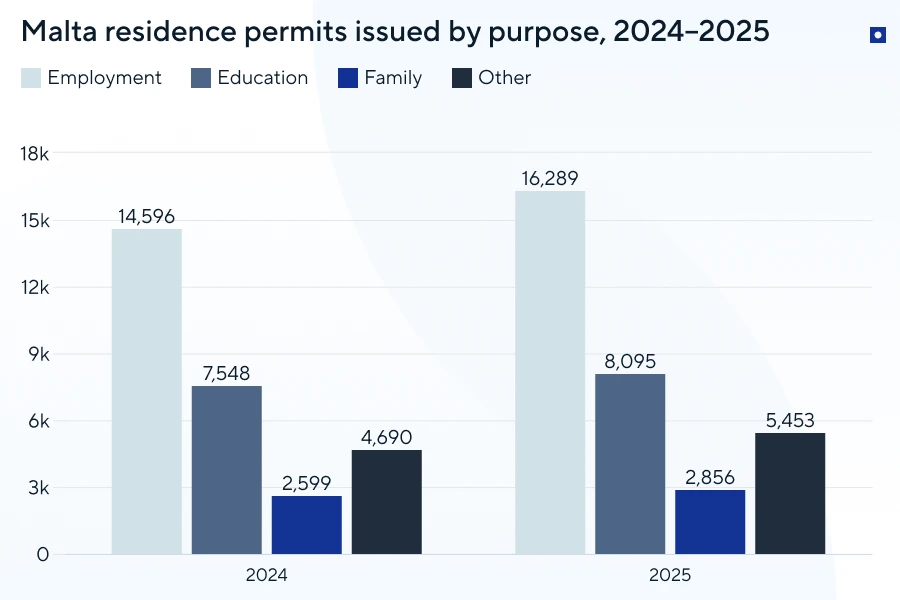
In 2025, Malta issued 32,693 first residence permits, an increase of 11% compared to the previous year, according to Eurostat [10] Source: The number of first residence permits issued by Malta is given on the Eurostat website . Relative to its population, this is the highest figure in the EU: 57 permits per 1,000 residents, compared with an EU average of 9 [11] Source: The number of first residence permits per 1,000 residents in EU countries is given on the Eurostat website . Employment was the most common reason for obtaining residence.
Most permits in Malta depend on the reason they were issued for. If the holder loses their job, finishes their studies, or their sponsor leaves the country, they lose the right to stay. Residence by investment is not tied to any of these circumstances. Investors do not need a job offer, a place at a university, or relatives in Malta, and they do not have to move to the country permanently.
However, the flexibility comes at a cost: residence by investment requires a larger upfront outlay than most other routes.
Comparison of Malta residence permit options
| Residence route | Costs | Processing time |
|---|---|---|
| Investment | At least €30,000 | At least 3 months |
| Nomad Residence Permit | Monthly income of at least €3,500 | At least 2 months |
| Employment | €300+ | |
| Family reunification | €27.50+ | |
| Studies | €27.50+ | |
| Startup incorporation | €25,000+ | |
| Retirement | €16,000+ |
Reasons for Malta residence permit rejection
Maltese authorities may reject a residence permit application if the applicant:
- provides false information or fraudulent documents, such as a fictitious employment contract, a forged work permit, university admission letter, or marriage certificate;
- fails to prove the legal origin of their funds;
- has previously been refused Schengen visas or violated EU visa regulations;
- attempts to conceal an unspent criminal conviction;
- poses a potential threat to Malta’s security or reputation;
- applies for political asylum without valid grounds.
An application may also be rejected if the authorities determine that the applicant does not meet the residence permit requirements. For example, an applicant for family reunification may be refused if the sponsor’s income falls below the minimum income threshold required in Malta.
How to renew a Malta residence permit
The requirements and timelines for renewing a Malta residence permit depend on the grounds for obtaining residence. For most
Residence by investment. Applicants must prove that they maintain accommodation in Malta and valid health insurance. They must also provide an
Nomad Residence Permit. Renewal applications must be submitted
Digital nomads must prove that they have spent at least 5 months in Malta during the previous 12 months, continue to earn income remotely, and do not work for Maltese companies.
Residence for startup founders. The company must remain operational, and the applicant must continue living in Malta. Renewal applications are reviewed by the Residency Malta Agency and Malta Enterprise.
Residence through employment. Foreign nationals must continue working for the employer and in the position specified in their work permit. The employer submits the renewal application through the Single Permit online portal.
Foreign nationals who change companies must obtain separate authorisation to change employers.
Residence through family reunification. Residence permits can be renewed if the sponsoring resident maintains their Malta residence status, meets the minimum income requirement, and provides suitable accommodation.
Residence for students. Renewal applications should be submitted approximately 1 month before the current permit expires. Students must confirm their continued enrolment and provide evidence of attendance and academic progress. They must also submit proof of tuition fee payment and accommodation.
Residence for retirees. Applicants must prove that they maintain their special tax status, accommodation in Malta, and valid health insurance. An
Renewal applications for
How foreigners can obtain permanent residence and citizenship in Malta
Foreign nationals can apply for permanent residence after living in Malta with a temporary residence permit for 5 years. Investors can also obtain permanent residence without a minimum stay requirement by investing at least €99,000 under the Malta Permanent Residence Programme.
A Qatari investor wanted to secure European residence for himself, his wife and their 3 children. The family had no intention of leaving Qatar, so they needed a programme that wouldn’t require them to relocate.
Eventually, the family chose the Malta Permanent Residence Programme, which grants permanent residence from the outset and has no minimum stay requirement. With Passportivity’s support, all 5 family members received their permanent residence cards in December 2025.
 Fahad
Malta grants permanent residence to investors who:
- rent a property for at least €14,000 per year or purchase a residential property for at least €375,000 — real estate must be rented or owned for at least 5 years;
- make a contribution of €37,000 to a government fund;
- donate €2,000 to a charitable organisation;
- pay an administrative fee of €60,000.
Investors must also hold capital of at least €500,000, including at least €150,000 in financial assets. Alternatively, they can hold €650,000, including at least €75,000 in financial assets.
Maltese citizenship by naturalisation can be obtained after at least 4 years of residence in the country [12] Source: The requirements for obtaining Maltese citizenship are listed on the website of the government agency Aġenzija Komunità Malta . Applicants do not need to obtain permanent residence beforehand. A temporary residence permit is sufficient, provided it allows them to legally reside in Malta for the required period.
Applicants for Maltese citizenship by naturalisation must have lived continuously in Malta for 1 year immediately before submitting their application and for at least 4 years in total during the preceding 6 years. They must also demonstrate proficiency in Maltese or English and take an oath of allegiance to the Republic of Malta.
Elena Garnitsarik
Head of the Legal Department
Taxes for Malta residence permit holders
A residence permit doesn’t by itself determine how much tax its holder pays in Malta. Personal income tax depends on the route through which the permit was obtained, while taxes on business and property are the same for everyone.
Malta has no wealth, inheritance, or gift tax. However, heirs pay a stamp duty of 5% on inherited property.
Personal income tax
Employees and
Employees also pay social security contributions of 10% of their salary, and their employer pays the same amount.
Highly qualified specialists in financial services, gaming, aviation, healthcare, and technology can apply for a flat rate of 15% instead of the progressive scale. The rate applies to annual salaries of at least €65,000 and lasts for 5 years, with the option to extend it twice for another 5 years each time.
Digital nomads pay no income tax in Malta for the first 12 months after receiving their permit. After that, income from remote work is taxed at a flat rate of 10%. Any other income, such as rental income or income from Maltese clients, is taxed under the general rules.
Retirees under the Malta Retirement Programme pay 15% on their pension transferred to Malta, but at least €7,500 a year, plus €500 for each dependant.
Participants in the Global Residence Programme pay 15% on foreign income transferred to Malta, but at least €15,000 a year. Income kept abroad is not taxed in Malta.
Business taxes
The standard corporate income tax rate in Malta is 35%. However, shareholders of Maltese companies usually pay much less: after dividends are distributed, they can claim back most of the tax paid by the company, so the effective rate drops to about
Since 2025, companies can opt for an alternative regime instead: a flat rate of 15% with no refunds. It suits businesses that prefer predictable taxes without the refund procedure, but once chosen, the company must keep it for at least 5 years.
The standard VAT rate in Malta is 18%.
Property taxes
Malta has no annual property tax, so owners pay taxes only when they buy, rent out or sell a property.
When buying, purchasers pay a
Owners who rent out their property can choose to pay a flat 15% on their gross rental income instead of tax at progressive rates.
When selling, owners pay a final tax calculated on the sale price rather than on the profit. The standard rate is 8%. It falls to 5% if the property is sold within 5 years of purchase and rises to 10% if it was bought before 2004. Owners who sell their main residence after living in it for at least 3 years pay no tax.
Key takeaways about Malta residence permits
- Malta offers residence permits to investors, entrepreneurs, digital nomads, and foreign nationals seeking employment in the country. Retirees, students, and family members of Maltese residents and citizens can also obtain residence.
- Investors can obtain residence in Malta in at least 3 months under the Malta Global Residence Programme.
- The costs of obtaining a Malta residence permit depend on the residence route. They include document preparation expenses, government fees, and travel costs to Malta.
- Residence permit applications may be rejected if applicants fail to meet the eligibility requirements, submit fraudulent documents, or conceal a criminal record.
- Foreign nationals can obtain permanent residence after living in Malta for at least 5 years or investing at least €99,000 in the country’s economy. Maltese citizenship is only available through naturalisation, including for investors.
About the authors


Frequently asked questions
The cost of obtaining a Malta residence permit depends on the grounds for residence. For students, employees, and family members, expenses include government fees, translation costs, and notary fees for document preparation.
Investors can obtain residence by renting or purchasing property, paying an administrative fee, and paying taxes in Malta. The minimum cost is €30,000.
Investors can obtain a Malta residence permit by purchasing property worth at least €220,000 in southern Malta or on the island of Gozo, or at least €275,000 in the northern or central regions.
They must also pay an administrative fee of €5,500 or €6,000, depending on the region. Before applying for residence, investors must pay a minimum income tax of €15,000.
Foreign entrepreneurs can apply for a residence permit by establishing an innovative company in the country and investing at least €25,000 in its shares.
If several entrepreneurs establish a startup, up to 6 founders can obtain residence permits. The required investment increases by €10,000 for each additional founder beyond the fourth.
Another option is to obtain residence through
Maltese authorities may reject or revoke a residence permit if they discover that the holder provided false information in their application, concealed a criminal record, or violated EU visa regulations.
Foreign nationals can apply for Maltese citizenship by naturalisation after 4 years of residence with a valid residence permit.
Applicants must have lived continuously in Malta for 1 year immediately before submitting their application and for at least 4 years in total during the preceding 6 years.
There is no single easiest way to obtain a Malta residence permit. The most suitable route depends on the applicant’s circumstances, financial resources, and goals.
To help applicants choose an appropriate option, this article compares different Malta residence permits by processing times and costs.
Close family members of Maltese residents can obtain residence permits through family reunification if the sponsoring resident has lived in Malta for more than 1 year and can demonstrate a stable income.
Investors applying under the Global Residence Programme can include their spouse, children, parents, and siblings. All eligible family members can obtain residence permits at the same time.
Read also





Contact us today
Passportivity assists international clients in obtaining residence and citizenship under the respective programs. Contact us to arrange an initial private consultation.