

 Residency
 Reading time: 13 min
 Cyprus Golden Visa: pros and cons of permanent residency on the island
Wealthy foreigners obtain permanent residence in Cyprus by investing at least €300,000 in the country’s economy. This residence permit is commonly referred to as the Golden Visa program.
Permanent residence is granted for life to the investor and their family members. This type of residence has specific features: a foreign national is not allowed to work as an employee, and to maintain the status, one must visit the country at least once every 2 years. The investment can be returned only after obtaining citizenship or permanent residence on another legal ground.

 Share
Share  Telegram
  Facebook
 LinkedIn
 X
X

 Save
Save 

What is Cyprus permanent residence by investment?
Cyprus permanent residence granted to foreigners who have invested funds in a country’s economy. The status is granted for life and does not require renewal or reconfirmation. The residence card must be replaced once every 10 years.
Applicants for a Cyprus Golden Visa invest at least €300,000 and confirm an annual income of €50,000 or more. If a spouse is included in the application, the minimum income requirement increases by €15,000; for each child, it increases by €10,000. The income must originate from sources outside Cyprus.
An address of registration in Cyprus is required. To meet this requirement, applicants purchase or rent residential property. Investors must also have no criminal record and no entry bans to the European Union or the United Kingdom.
To maintain residence status, a Golden Visa holder must visit Cyprus at least once every two years and retain the investment in the country.
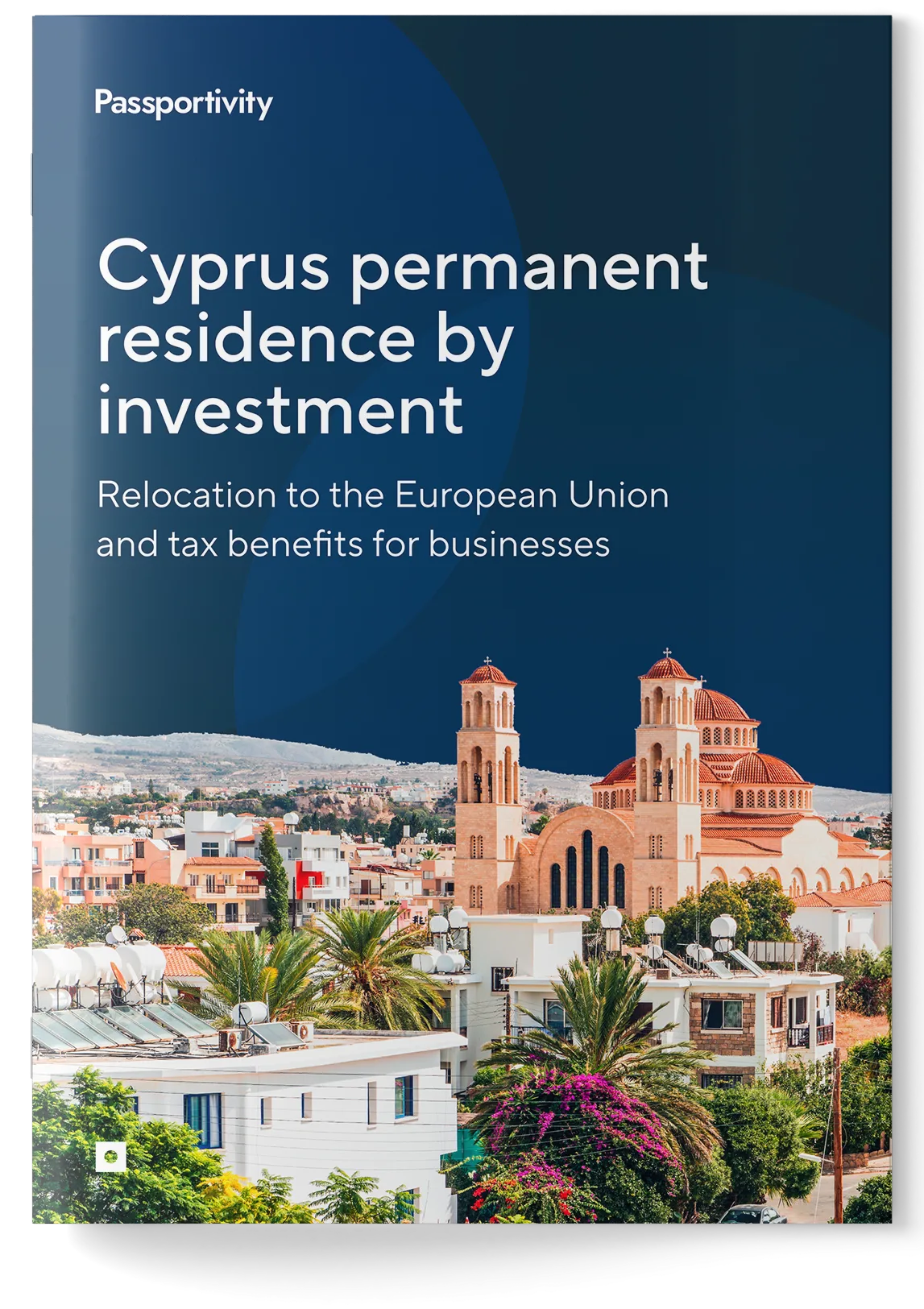
7 benefits of the Cyprus Golden Visa
Permanent residence in Cyprus provides investors with benefits. It supports capital protection and business development. It also offers a safe place to live with family.
1. Living in a Europe
Investors in Cyprus are granted permanent residence immediately. The status does not need to be extended. Only the residence card must be renewed once every 10 years. To maintain the status, the investor must visit Cyprus at least once every 2 years.
2. Status for the whole family
A spouse and children up to and including 24 years of age may be included in the application, provided they are financially dependent on the investor, enrolled in higher education, and unmarried. Children with physical or mental disabilities obtain a Golden Visa together with the investor, regardless of age.
Financially independent children may also obtain a Golden Visa; however, in this case, the investment amount increases by €300,000 for each child [1] Source: Regulation 6(2) permanent residence framework, Civil Registry and Migration Department . In addition, each child must demonstrate a guaranteed annual income of at least €50,000.
3. Returnable investment
Upon acquiring Cypriot citizenship or ordinary permanent residence after legally residing in the country for five or more years, the obligation to maintain the investment no longer applies. The investor may then dispose of the investment, for example, by selling the property or securities.
4. Opportunity to receive passive income
Real estate purchased under the Golden Visa programme may be rented out. Gross rental yields range from 4 to 7% per year [2] Source: Cyprus rental yields by city, Global Property Guide .
The Cyprus Securities and Exchange Commission does not publish official data on dividend yields. Professional financial platforms and audit firms assess fund performance based on past periods. According to these sources, investment fund returns range from 2 to 6% per annum.
5. Prospect of second citizenship
After 8 years of residence with a Golden Visa, an investor may apply for citizenship by naturalisation. To qualify, a foreign national must confirm 2,920 days of residence in Cyprus. During the last year before submitting the citizenship application, the investor may not be absent from the country for more than 90 days in total.
There is no requirement to renounce prior citizenship. Cypriot citizens are permitted to hold multiple citizenships.
6. Educational opportunities for children
The education system in Cyprus consists of four stages:
Higher education follows British standards. Some universities in Cyprus and the United Kingdom cooperate under dual degree programmes. Graduates receive diplomas from both institutions and may seek employment in the United Kingdom.
Cypriot universities offer programmes in Greek and English. For example, the University of Nicosia provides courses in business, medicine, and the arts, primarily in English. Approximately half of university students in Cyprus are foreign nationals. In the 2023/24 academic year, 27,984 out of 48,757 students enrolled in higher education institutions held foreign passports [3] Source: Cyprus higher education statistics, CYSTAT Database .
7. Access to healthcare
Each major city has both public and private clinics. According to the healthcare index for 2026, Cyprus ranks 74th in the world. For comparison, Romania ranks 76th and Hungary 82nd [4] Source: Cyprus health care rankings data, Numbeo .
Holders of permanent residence may register in the General Healthcare System — GESY. The system covers the cost of medical services, including treatment for rare, chronic, and serious illnesses.
Employees contribute 2.65% of their annual income to health insurance,
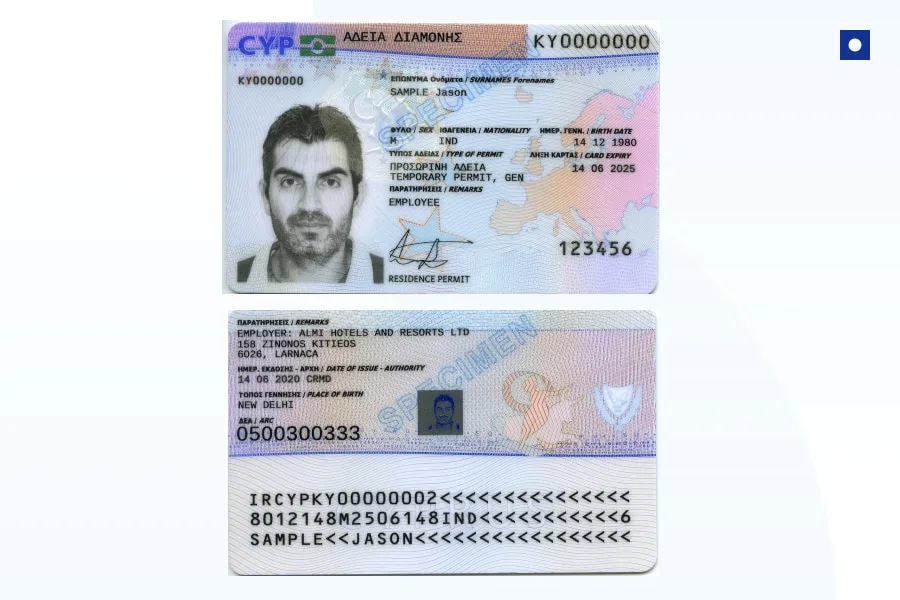
Eligibility criteria for the investor and family members
Cyprus permanent residence by investment is granted under Regulation 6(2) of the Aliens and Immigration Regulations [5] Source: Regulation 6(2) permanent residence framework, Civil Registry and Migration Department . To qualify, both the main applicant and included family members must meet specific legal, financial and compliance requirements established by the Civil Registry and Migration Department.
Requirements for the main applicant
To obtain Cyprus permanent residence, an investor must:
- Make a qualifying investment of at least €300,000.
- Confirm a secured annual income of at least €50,000.
- Meet due diligence and compliance requirements.
Permanent residence under this programme does not grant the right to work as an employee. However, the investor may be a shareholder or director of a Cyprus company.
Family members who may be included
Cyprus permanent residence may also be granted to the investor’s family members.
Eligible dependents include a spouse and children under 18. Unmarried children aged 18 to 25 also qualify. They must be financially dependent and enrolled in
Adult children aged 18 to 25 must provide proof of student status and financial dependency.
Ongoing compliance requirements
To maintain Cyprus permanent residence, the investor must:
- retain the qualifying investment;
- visit Cyprus at least once every two years;
- continue to meet the income requirement.
The authorities apply a monitoring mechanism to verify that the investment and other conditions are maintained.

Who is not eligible for Cyprus permanent residence by investment?
Cyprus permanent residence under Regulation 6(2) is available to
EU, EEA and Swiss nationals. The investment route applies only to
Individuals subject to EU restrictive measures. Applicants who are included in European Union sanctions lists or subject to entry bans within the EU are not eligible.
Investment options to obtain Cyprus permanent residence
A foreign national may obtain permanent residence in Cyprus by investing at least €300,000 in the country’s economy. The applicant chooses one of the following options:
- purchase of residential or commercial real estate;
- establishment of a new Cypriot company or acquisition of an existing one;
- investment in private funds.
Investment options differ not only in structure and risk profile, but also in the way applicants must confirm their secured annual income.
If the investor chooses the real estate option, the annual income must originate from sources outside Cyprus and may include salary, pension, dividends, or passive rental income.
If the investor establishes a company in Cyprus or purchases units in investment funds, all or part of the annual income may be derived from sources within Cyprus.
Elena Klimovskaya
Director of Partnership Development
Real estate purchase
Purchase of residential real estate. Investors can fulfil the investment requirement by purchasing residential property in Cyprus with a total value of at least €300,000. Under this option:
- Residential property must be new and purchased from a licensed developer; resale or
secondary-market homes do not qualify for the primary residency route. - An investor may buy one or two properties whose combined value meets or exceeds €300,000.
- Standard VAT of 19% applies on most property purchases; in some cases where the property will be used as a primary residence and not rented out, a reduced VAT rate of 5% may apply.
- Funds must be fully paid before submitting the permanent residence application and transferred to Cyprus from abroad.
Residential property is the most popular option chosen by investors due to its dual function as an investment asset and a means to obtain permanent residency.
Purchase of commercial real estate. Instead of residential property, an investor may choose commercial real estate. Eligible assets include offices, retail space, hotels, warehouses, or combinations thereof.
The total investment must be at least €300,000.
This option may appeal to investors seeking a purely
Establishing or acquiring a local company
Investors may also qualify by participating in the Cypriot business sector:
- The applicant may establish a new company in Cyprus or acquire shares in an existing Cypriot company with a capital injection of at least €300,000.
- The company must be registered and physically operational in Cyprus.
- It must have a genuine commercial presence and employ at least five
full-time staff members.
Investors under this option may act as shareholders or directors; although the permanent residence permit does not authorise employment as an employee, it does allow for business involvement and receipt of dividends.
Investment in units of private or collective funds
An applicant may purchase units or shares in
Eligible fund structures include:
- Alternative Investment Funds, AIFs;
- Alternative Investment Funds for a Limited Number of Persons, AIFLNP;
- Registered AIFs, RAIF.
These funds are overseen by the Cyprus Securities and Exchange Commission, CySEC, and may hold diversified portfolios including business or financial assets.
This option can appeal to investors seeking portfolio diversification or exposure to professionally managed investment strategies.
Investment options and government fees for Cyprus Golden Visa
| Investment option | Minimum investment | VAT on property investment | Application fee | Residence card fee | Registration fees | Ongoing costs |
|---|---|---|---|---|---|---|
| Residential property | €300,000+ | 19% or 5% | €500 | €70 per person | €140 | Property maintenance, utility payments, insurance |
| Commercial property | €300,000+ | 19% | €500 | €70 per person | €140 | Property management, maintenance, insurance |
| Cyprus company investment | €300,000+ | Not applicable | €500 | €70 per person | €140 | Accounting, salaries for at least 5 employees, corporate tax |
| Investment in funds | €300,000+ | Not applicable | €500 | €70 per person | €140 | Fund management fees 0. |
How to obtain permanent residence in Cyprus by purchasing real estate
Purchasing real estate in Cyprus is the most popular option for obtaining permanent residence. In 2025, foreign nationals completed 7,255 property transactions. This is the 3rd highest annual figure since records began in 2000 [7] Source: Cyprus property sales analysis, Cyprus Property Buyers News .
Investment conditions
A foreign national obtains permanent residence by purchasing real estate worth at least €300,000. One or two properties may be acquired. Residential property may be purchased only from a developer, while commercial property may be acquired on both the primary and secondary markets.
If the investor purchases commercial property, they must also confirm a residential address in Cyprus. The property for residence may be rented or purchased.
Funds for the real estate investment must originate from outside Cyprus. In addition to the property purchase, the investor must demonstrate an annual income of at least €50,000 from foreign sources.
The investor’s family members may obtain residence together with the main applicant: a spouse and financially dependent children up to and including 24 years of age, provided they are unmarried and enrolled at a Cypriot university.
Family members may be included in the application if an additional annual income of €15,000 is confirmed for a spouse and €10,000 for each child.
After completing their studies, financially dependent children may retain permanent residence if the investor confirms an additional annual income of €10,000 for each child. The residence status remains valid even after the child marries and ceases to be financially dependent on the main applicant.
Taxes and expenses when purchasing real estate
When purchasing real estate in Cyprus, the investor pays VAT at 19% [8] Source: Cyprus property index report, KPMG & RICS . If the property is the buyer’s sole residence and the foreign national intends to live in it, a reduced VAT rate of 5% applies. In practice, the investor initially pays VAT at 19%, then confirms eligibility for the reduced rate and receives a refund of the difference.
In addition, the investor pays a state fee of €500 for two applicants and €500 for each child, and purchases annual health insurance for each family member.
Rental income
Seafront property is the most in demand among investors. Such properties may be rented out at favourable rates. For example, annual rental yields reach up to 6% in Limassol, 5% in Nicosia, and 4% in Larnaca and Paphos.
Sale of property
A foreign national may sell the investment property at any time. The law does not establish a minimum holding period. However, after selling the property, the investor may lose their residence status in Cyprus.
Permanent residence may be maintained if the property is replaced with another one worth at least €300,000, or if the investor obtains Cypriot citizenship or permanent residence on another legal ground, for example by establishing a business in Cyprus or investing in private funds.
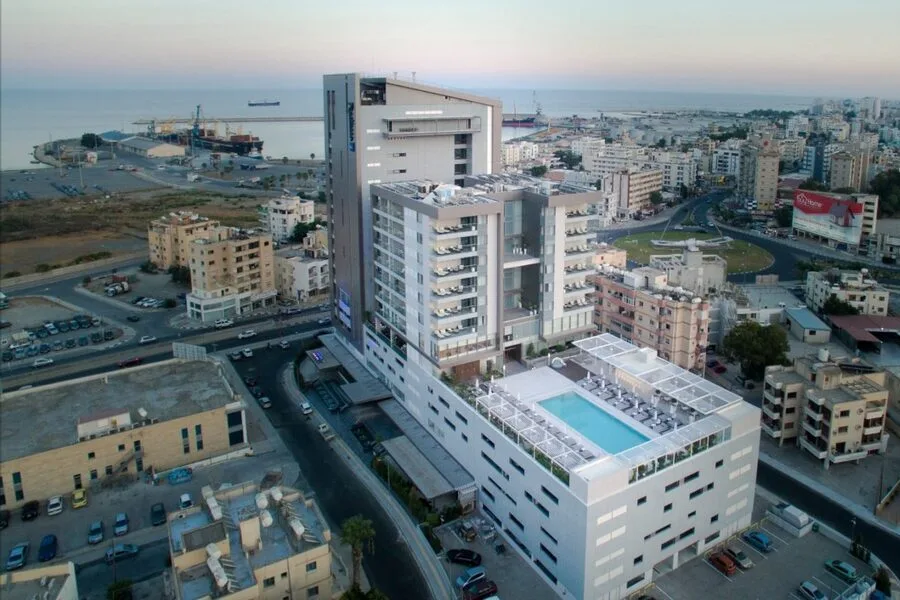
5 steps to obtain a Cyprus Golden Visa
Obtaining a Cyprus Golden Visa takes nine months. Most of the process can be completed remotely. The investor travels to Cyprus only to submit biometric data and collect the residence card.
-
2 days
Preliminary Due Diligence
A compliance specialist reviews the investor’s background before documents are submitted for the Golden Visa. The check is conducted through international open databases to identify sanctions, entry bans, or outstanding criminal records.
Passportivity experts recommend conducting such a check in advance to assess the risk of refusal and prepare additional documents if necessary.
-
2+ week sPreparation of documents
Lawyers prepare an individual list of documents for the application. The list may vary depending on the chosen investment option and the family members included in the application.
The original documents are translated and notarised.
-
2—8 weeksFulfilment of the investment condition
The most popular option among investors is the purchase of real estate. Passportivity assists in selecting properties in Cyprus according to the client’s objectives and programme requirements. The Real Estate Department works with its own database of verified developers.
During the signing of the sale and purchase agreement, a lawyer accompanies the client, oversees the legal aspects of the transaction, and assists with completing the documents.
If the investor selects another investment option, they purchase securities or units in investment funds.
-
2—3 weeksSubmission of the permanent residence application in Cyprus
Lawyers assist in completing the application for permanent residence. The document package, including proof of investment, is submitted to the Civil Registry and Migration Department of Cyprus, CRMD.
-
4+ month sObtaining permanent residence
The application is reviewed within 4 to 6 months; in practice, the process may take up to one year.
Once the investor receives an approval letter, they travel to Cyprus to submit biometric data. The residence card is issued within 45 days.
List of documents for a Cyprus Golden Visa
Documents are translated into Greek or English and notarised in advance. The main package includes:
- Passport.
- Curriculum vitae of the main applicant.
- Police clearance certificate.
- Confirmation of a registered address in Cyprus.
- Health insurance for the entire family.
- Declaration confirming an annual income of at least €50,000.
- Confirmation that the applicant is not employed in Cyprus.
- Proof of fulfilment of the investment requirement.
- Birth and marriage certificates, if applicable.
The investor pays a government fee of €500 for application examination if applying alone or with a spouse. An additional €500 is paid for each child. A fee of €70 is charged for the issuance of each residence card.
Living in Cyprus
Foreign nationals choose Cyprus for its lifestyle. A favourable climate, the opportunity to live by the sea all year round with one’s family, and the friendliness of local residents are often considered key advantages. However, alongside these benefits, there are also disadvantages to living in Cyprus.
Climate
Summers in Cyprus are hot and dry. Air temperatures reach +35°C, and sea temperatures rise to +27°C. The beach season begins in May and lasts almost until the end of autumn. July and August are the hottest months. Residents rely on sunscreen, ice, and air conditioning.
Winters are mild and rainy. Temperatures remain around +16°C but may feel lower due to humidity. There is no central heating in most homes, which may lead to dampness and mould. Dehumidifiers are commonly used to prevent this.
Cost of living
As Cyprus is an island, the cost of transporting goods increases prices compared to mainland countries. An exception is fruit and vegetables, which can be grown
For example, a single person in Limassol spends on average about €920 per month, while a family of four requires approximately €3,330. These figures exclude rent: a
Mentality
Cypriots, like many southern Europeans, are unhurried. Their relaxed pace of life is described by the Greek phrase “
At the same time, Cypriots are hospitable and friendly towards foreigners. They are often curious about newcomers’ lives and travels and readily introduce them to local culture and family traditions.
Banking system
There are 18 licensed banks operating in Cyprus. The largest are Bank of Cyprus, Hellenic Bank, and AstroBank. In 2025, Eurobank merged with Hellenic Bank to form the country’s largest banking group — Eurobank Limited.
Foreign nationals with residence permits may open accounts and place deposits in Cypriot banks. Without residence status, banks request additional documentation confirming the source of funds and may refuse to open an account.
Bank deposits in Cyprus are insured by the state up to €100,000. If a bank becomes insolvent, the state compensates its clients. Both individuals and companies are covered.
Doing business
Cyprus is a popular jurisdiction for establishing and operating a business. From January to November 2025, approximately 14,800 new companies were registered, 40% of which were founded by foreign nationals [10] Source: Registered companies statistics Cyprus, Companies Registrar .
Registering a company in Cyprus takes 7 to 15 days. The founder submits documents to the Department of Registrar of Companies. A business may be established remotely by issuing a notarised power of attorney to a local representative.
Language barrier
The official languages of Cyprus are Greek and Turkish. However, it is not mandatory to learn them for everyday life. English is widely spoken at a conversational level.
Knowledge of Greek is required primarily for those planning to enrol at a university or apply for citizenship.
Transport
Buses operate according to a timetable with intervals of
Cypriots travel to neighbouring countries by plane or ferry. Regular sea routes operate to Greece, Egypt, and Israel. A ferry journey to Greece takes approximately seven hours.
Leisure
Residents spend their free time at the beach, sunbathing, surfing, and diving. Some engage in yachting, obtain licences to operate small vessels, and organise private cruises.
Those seeking an alternative to seaside leisure arrange hiking trips in the mountains. In the north of Cyprus, trails run along the Kyrenia mountain range, while in the west they lead to the Troodos peak.

Cons of Cyprus permanent residence by investment
Despite the numerous advantages of the Cyprus Golden Visa, this residence permit also has several drawbacks. These include a relatively high investment threshold, employment restrictions, and instability in the real estate market.
High investment threshold
The minimum investment required to obtain a Golden Visa is €300,000. This amount is lower than in Andorra but higher than in Italy, Greece, or Portugal.
No visa-free travel to Schengen countries
Cyprus is a member of the European Union but is not part of the Schengen Area. To travel to Schengen countries, Cyprus residents must obtain a visa.
No working as an employee in Cyprus
Golden Visa holders are not permitted to work as employees in Cyprus. However, they may conduct business activities, establish companies in Cyprus, receive dividends, and earn rental income from property.
Visa-free destinations for residents and citizens of Cyprus
Cyprus is a member of the European Union but is not yet part of the Schengen Area. as a result, the number of
Visa-free destinations for Cyprus residence permit holders
Permanent residence in Cyprus does not currently grant the right to travel freely within the Schengen Area, as the country is not part of it. The President of Cyprus has announced the country’s readiness to join the Schengen Area in 2026; however, due to lengthy European Union procedures, the expected accession date may shift to 2027 [11] Source: Cyprus Schengen accession announcement, Cyprus Mail .
As of January 2026, residence permit holders must obtain a Schengen visa to travel within the Schengen Area.
Until 2024, holders of temporary and permanent residence permits in Cyprus could travel to Romania and Bulgaria, which, like Cyprus, are members of the European Union. However, on January 1st, 2025, these countries fully joined the Schengen Area, and a visa is now required for entry.
Visa-free destinations for Cypriot citizens
With a Cypriot passport, holders may travel
For entry into certain countries, an electronic visa, visa on arrival, or electronic travel authorisation (eTA) may be required.
List of visa-free destinations with a Cypriot passport
| Albania | Ghana | Oman |
| Andorra | Greece | Pakistan |
| Angola | Grenada | Palau |
| Antigua and Barbuda | Guatemala | Panama |
| Argentina | Guinea | Papua New Guinea |
| Armenia | Paraguay | |
| Australia | Guyana | Peru |
| Austria | Haiti | Philippines |
| Azerbaijan | Honduras | Poland |
| Bahamas | Hong Kong | Portugal |
| Bahrain | Hungary | Qatar |
| Bangladesh | Iceland | Republic of Korea |
| Barbados | India | Romania |
| Belarus | Indonesia | Russia |
| Belgium | Iran | Rwanda |
| Belize | Iraq | Saint Kitts and Nevis |
| Benin | Ireland | Saint Lucia |
| Bhutan | Israel | Saint Vincent and the Grenadines |
| Bolivia | Italy | Samoa |
| Bosnia and Herzegovina | Ivory Coast | San Marino |
| Botswana | Jamaica | São Tomé and Príncipe |
| Brazil | Japan | Saudi Arabia |
| Brunei | Jordan | Senegal |
| Bulgaria | Kazakhstan | Serbia |
| Burundi | Kenya | Seychelles |
| Cabo Verde | Kiribati | Sierra Leone |
| Cambodia | Kosovo | Singapore |
| Cameroon | Kuwait | Slovakia |
| Canada | Kyrgyzstan | Slovenia |
| Central African Republic | Laos | Solomon Islands |
| Chad | Latvia | Somalia |
| Chile | Lebanon | South Africa |
| China | Lesotho | South Sudan |
| Colombia | Liechtenstein | Spain |
| Comoros | Lithuania | Sri Lanka |
| Congo (Kinshasa) | Luxembourg | Sweden |
| Costa Rica | Madagascar | Switzerland |
| Croatia | Malawi | Tajikistan |
| Cuba | Malaysia | Tanzania |
| Cyprus | Maldives | Thailand |
| Czech Republic | Malta | |
| Denmark | Marshall Islands | Togo |
| Djibouti | Mauritania | Tonga |
| Dominica | Mauritius | Trinidad and Tobago |
| Dominican Republic | Mexico | Tunisia |
| East Timor | Micronesia (Federated States of) | Turkey |
| Ecuador | Moldova | Turkmenistan |
| Egypt | Monaco | Tuvalu |
| El Salvador | Mongolia | Uganda |
| Equatorial Guinea | Montenegro | Ukraine |
| Estonia | Morocco | United Arab Emirates |
| Eswatini | Mozambique | United Kingdom |
| Ethiopia | Namibia | Uruguay |
| Fiji | Nepal | Uzbekistan |
| Finland | Netherlands | Vanuatu |
| France | New Zealand | Venezuela |
| Gabon | Nicaragua | Vietnam |
| Gambia | Nigeria | Yemen |
| Georgia | North Macedonia | Zambia |
| Germany | Norway | Zimbabwe |
Taxes in Cyprus
Foreign nationals become tax residents of Cyprus if they spend more than 183 days per year in the country. Since 2017, individuals may also qualify as tax residents under the
- do not reside in any other country for more than 183 days per year;
- are not tax residents of another country;
- conduct business or are employed in Cyprus;
- own residential property in Cyprus.
Legal entities obtain tax resident status if they are incorporated in Cyprus.
Personal income tax
The income tax rate is calculated on a progressive scale ranging from 20 to 35%, depending on annual income. The first €22,000 is
Tax residents of Cyprus pay tax on both domestic and foreign income.
There are no taxes on inheritance, property ownership, or gifts in Cyprus.
Corporate tax
From January 1st, 2026, companies pay corporate tax at a flat rate of 15% [12] Source: Cyprus tax reform 2025 overview, Phile News . Cyprus has one of the lowest corporate tax rates in the European Union. For comparison, the rate is 25% in France and Spain and 22% in Greece.
Corporate tax applies only to net profit, that is, after deducting expenses. Dividends, foreign exchange differences, profits of foreign branches, and income from transactions with securities are excluded from the taxable base.
Prospects for Cypriot citizenship
Investors holding permanent residence in Cyprus may apply for citizenship by naturalisation under the general procedure. Citizenship is granted to foreign nationals who confirm lawful residence in Cyprus for 2,920 days, or eight years, within the last eleven years. During the year preceding the application, the applicant may not be absent from Cyprus for more than 90 days in total.
In addition to residence requirements, the applicant must:
- reside continuously in Cyprus during the year prior to application and, during the previous five years, not be absent for more than 90 days per year;
- demonstrate a clean criminal record and no sanctions, and pass a Due Diligence check;
- have knowledge of the Greek language at least at B1 level;
- demonstrate knowledge of the political and social system of Cyprus;
- have housing and a stable income;
- confirm the intention to reside in Cyprus.
Cyprus recognises dual citizenship. A foreign national may retain their original passport if this does not contradict the laws of the other country.
Why Cyprus permanent residence may be refused or revoked?
Cyprus permanent residence under Regulation 6(2) is granted subject to strict compliance with legal and financial requirements. The authorities assess each application individually and reserve the right to refuse or revoke a residence permit if the conditions are not met.
Reasons for refusal
Failure to meet investment requirements. If the qualifying investment of at least €300,000 is not properly completed, documented or transferred from abroad, the application may be refused.
Insufficient secured income. The applicant must demonstrate a secured annual income starting from €50,000, increased for dependants. If this requirement is not met or cannot be properly documented, the application may not be approved.
Negative due diligence findings. Cyprus authorities conduct background checks. Applications may be rejected if the applicant:
- has a criminal record;
- is subject to EU sanctions or entry bans;
- cannot confirm the lawful source of funds;
- provides false or misleading information.
Reasons for revocation after approval
Permanent residence may be cancelled if the investor no longer complies with the programme requirements.
Grounds for revocation may include:
- disposal of the qualifying investment without replacing it with another eligible investment;
- failure to maintain the required income level;
- absence from Cyprus for more than two consecutive years;
- submission of false information during or after the application process;
- inclusion in EU sanctions lists after approval.
The authorities review compliance on an ongoing basis. If a ground for revocation arises, the status may be withdrawn by decision of the competent body.
Monitoring mechanism residency is granted
Cyprus applies a formal monitoring mechanism to verify ongoing compliance with the programme conditions According to the Civil Registry and Migration Department, the authorities conduct periodic checks to ensure:
- qualifying investment is retained;
- required income criteria continue to be met;
- investor and dependants comply with legal obligations.
This monitoring mechanism is officially described as “Monitoring mechanism for the adherence to the criteria and maintaining the investment”. Details are published on the official website of the Civil Registry and Migration Department [13] Source: Cyprus permanent residence monitoring, Civil Registry and Migration Department .
The authorities may request updated documents confirming continued ownership of the investment and compliance with the income requirement. If the criteria are not met, the residence permit may be withdrawn.
Key points on the advantages and disadvantages of the Cyprus Golden Visa
- Permanent residence in Cyprus by investment, also known as a Golden Visa, is granted to foreign nationals who invest at least €300,000 in the country’s economy.
- To obtain a Golden Visa, applicants purchase real estate, shares in Cypriot companies, or units in investment funds.
- Investors may apply for citizenship after eight years of residence in Cyprus. There is no requirement to renounce prior citizenship, as Cyprus recognises dual nationality.
- Cyprus is not part of the Schengen Area. Therefore, residents must obtain a Schengen visa to travel within Europe.
- Golden Visa holders are not permitted to work as employees in Cyprus but may conduct business activities.
- Cyprus residents pay personal income tax on a progressive scale from 20 to 35%. The corporate tax rate is 15%.
About the authors


Frequently asked questions
Cyprus does not grant passports directly in exchange for investment. Wealthy foreign nationals first obtain a Golden Visa and may later apply for citizenship by naturalisation after eight years of residence.
The Cyprus Golden Visa is permanent residence by investment. Until November 2020, Cyprus operated a citizenship by investment programme, often referred to as “golden passports”. Currently, an investor may apply for a Cypriot passport only after residing in the country under a Golden Visa for the required period established by law.
Permanent residence grants the right to reside in Cyprus indefinitely. The status does not require renewal. Temporary residence permits may be granted for family reunification, school or university studies, internships, employment, or establishing a startup. Such permits are typically issued for up to one year. To remain in the country longer, the status must be extended or converted into permanent residence.
Only holders of permanent residence may apply for Cypriot citizenship. Temporary residents must first reside in Cyprus for at least five years, obtain permanent residence, and then reside with that status for at least two additional years before applying for citizenship.
Foreign nationals obtain permanent residence in Cyprus by investing at least €300,000. Eligible options include purchasing real estate, shares in Cypriot companies, or units in investment funds.
Additional costs include a €500 application processing fee and a €70 fee for issuing the residence card. Applicants also cover translation and notarial services.
Until 2024, Cyprus residents could visit Bulgaria and Romania without a visa. as these countries have joined the Schengen Area, holders of Cypriot temporary and permanent residence permits must now obtain a Schengen visa to enter them.
With a Cypriot passport, holders may travel
Yes, investors may also consider other European residence by investment programmes in Italy, Portugal, and other countries worldwide.
Portugal Golden Visa — minimum investment from €250,000. The programme grants a residence permit through investment in culture, regulated funds or business projects and may lead to citizenship after five years, subject to residence and legal requirements.
Italy Golden Visa — minimum investment from €250,000.The programme allows
Read also





Contact us today
Passportivity assists international clients in obtaining residence and citizenship under the respective programs. Contact us to arrange an initial private consultation.