

 Residency
 Reading time: 13 min
 15 cheapest Golden Visa and citizenship by investment programmes
Interest in the cheapest Golden Visa options has grown as investors rethink how they protect mobility, capital, and family security. Today, the cost of Golden Visas varies significantly, from €50,000 to $1,000,000.
This wide range explains why investors compare the cheapest Golden Visa countries by threshold, speed, and

 Share
Share  Telegram
  Facebook
 LinkedIn
 X
X

 Save
Save 

What are the cheapest Golden Visas?
A Golden Visa is a
- Residence by investment, RBI: residence permit or permanent residence, sometimes with a route to citizenship later;
- Citizenship by investment, CBI: citizenship under a
state-approved programme, subject to Due Diligence and the state’s decision.
In both cases, the investment may include real estate, a business contribution, government bonds, or a
Below is a practical
15 cheapest Golden Visa shortlist
| Country | Programme type | Minimum investment | Typical timeline | Schengen Area |
|---|---|---|---|---|
| Latvia | Residence permit | €50,000 | Yes | |
| São Tomé and Príncipe | Citizenship | $90,000 | 2 months | No |
| Vanuatu | Citizenship | $130,000 | No | |
| Malta | Permanent residence | €169,000 | Yes | |
| Dominica | Citizenship | $200,000 | Yes | |
| Antigua and Barbuda | Citizenship | $230,000 | Yes | |
| Grenada | Citizenship | $235,000 | Yes | |
| St Lucia | Citizenship | $240,000 | Yes | |
| St Kitts and Nevis | Citizenship | $250,000 | Yes | |
| Portugal | Residence permit | €250,000 | Yes | |
| Greece | Residence permit | €250,000 | Yes | |
| Hungary | Residence permit | €250,000 | Yes | |
| Italy | Residence permit | €250,000 | Yes | |
| Cyprus | Permanent residence | €300,000 | No | |
| Turkey | Citizenship | $400,000 | No |
Why are Golden Visa countries so attractive now?
Interest in Golden Visa countries continues to grow because investment migration has become a practical planning tool rather than a status symbol. Investors compare programmes based on resilience, flexibility, and speed.
1. Reducing geopolitical and compliance risks
Governments increasingly introduce travel restrictions, financial controls, and stricter compliance rules. International banks tighten KYC, Know Your Customer, procedures and may limit access for clients from certain jurisdictions. An additional residence permit or citizenship helps investors diversify personal and business risks, maintain access to international banking, and reduce exposure to sudden regulatory changes.
2. Focus on speed and affordability rather than maximum mobility
Investors increasingly focus on predictable timelines and lower entry thresholds. The ability to secure legal status quickly for the whole family has become more important than passport rankings alone.
This trend explains the strong interest in fast and affordable programmes in Vanuatu and São Tomé and Príncipe, as well as continued demand for
3. Building a portfolio of statuses instead of relying on one solution
According to Passportivity’s report, investors increasingly adopt a portfolio approach to status planning
[407]
Source: Citizenship by investment: market trends and outlook for
This strategy allows them to balance global mobility, access to international banking, tax optimisation, and protection against geopolitical risks. In practice, investment migration is no longer treated as a
For example, investors may obtain citizenship in Vanuatu or St Lucia while holding residence permits in Portugal or Latvia. Others add permanent residence in Malta or Cyprus to strengthen their European footprint.
Types of investments under Golden Visa and Citizenship by Investment programmes
Investment migration programmes differ not only by price but also by the structure of the required contribution. Below are the main types of investments used in current programmes, with examples from countries covered in this guide.
Real estate investment
Real estate investments are generally recoverable through resale, but market conditions and holding requirements affect liquidity. Property purchase remains one of the most common formats for residence and citizenship programmes.
Greece allows investors to qualify for residence through approved real estate acquisitions starting from €250,000 in selected areas.
Cyprus grants permanent residence through the purchase of new residential property starting from €300,000.
Caribbean countries such as Antigua and Barbuda, Grenada, and St Kitts and Nevis offer approved real estate routes as an alternative to direct government contributions. The property must usually be held for a minimum period.
Government fund contributions
These options are not recoverable. The advantage lies in simplicity and faster processing, while the drawback is the absence of capital return.
In the Caribbean, Dominica, St Lucia, Antigua and Barbuda, Grenada, and St Kitts and Nevis offer citizenship in exchange for a government fund contribution starting from $200,000 to $250,000 depending on the country.
Vanuatu provides citizenship through a contribution starting from $130,000. São Tomé and Príncipe offers citizenship from $90,000 via its national transformation fund [408] Source: São Tomé and Príncipe citizenship by investment, official website .
Business and corporate investments
These routes may be partially recoverable, but they involve commercial risk and require careful due diligence on the target entity.
Italy offers residence by investment starting at €250,000 in an innovative startup or €500,000 in an Italian company. Latvia provides residence starting from €50,000 through business investment. Hungary also offers approved investment structures linked to financial instruments.
Bonds, financial instruments, and deposits
These investments are typically recoverable after a holding period, subject to programme rules. Italy allows investment of €2,000,000 in government bonds. Turkey grants citizenship through financial investments starting from $500,000 in deposits or other financial instruments.
Some Caribbean programmes previously included bond options, although thresholds and structures have evolved.
Philanthropic and cultural contributions
These contributions are
Cryptocurrency-based contributions
El Salvador introduced a distinctive model by allowing contributions in cryptocurrency. Citizenship requires a $1,000,000 contribution payable in approved digital assets to a government account.
This format appeals to investors active in the digital economy but carries regulatory and volatility considerations.
5 cheapest residency by investment countries in Europe
The cheapest residency by investment in Europe programmes are designed for investors who want legal residence in the European Union without immediate relocation. These options focus on relatively low investment thresholds, flexible residence requirements, and predictable renewal rules.
Portugal
The Portugal Golden Visa targets investors interested in
Investment requirements. Eligible options include:
- cultural support projects — €250,00;
- investment in regulated funds — €500,000;
- research contributions — €500,000;
- business investment that creates or sustains jobs in Portugal.
Refundability of investments. Fund investments are typically held for 5 years or more. While capital may be returned at the end of the fund cycle, this depends on fund structure and performance. Cultural contributions are
Inclusion of family members. Applicants may include a spouse, dependent children generally up to 26 years of age if financially dependent and studying, and dependent parents of either spouse.
Maintaining and renewal of the status. Residence permits are initially valid for two years and renewed every two years thereafter. Investors and family members must spend at least seven days in Portugal during the first year and at least fourteen days during each subsequent
Hungary
Hungary grants investors a
Investment requirements. Applicants may invest:
- €250,000 in a
government-approved real estate investment fund; - €1,000,000 to a public trust supporting Hungarian higher education.
Refundability of investments. Fund investments are typically recoverable after the holding period, subject to fund conditions. Educational donations are
Inclusion of family members. Investors may include a spouse, children under 25 years of age, and dependent parents.
Maintaining and renewal of the status. The residence permit is issued for 10 years and may be renewed for an additional
Italy
The Italy Golden Visa targets investors willing to contribute to the Italian economy through capital investments. Citizenship may become available after 10 years of residence and integration.
Investment requirements. Investors may choose one of the following options:
- €2,000,000 in government bonds;
- €500,000 in an Italian company;
- €250,000 in an innovative startup;
- €1,000,000 as a philanthropic contribution supporting
public-interest projects.
Refundability of investments. Commercial and bond investments are potentially recoverable after the holding period. Philanthropic contributions are
Inclusion of family members. Eligible dependents include a spouse or legally recognised partner, minor children, adult children who are financially dependent on the investor, and dependent parents.
Maintaining and renewal of the status. The initial residence permit is issued for two years and may be extended for an additional three years. There is no strict minimum stay requirement to maintain the permit, but continuous residence is necessary if the applicant intends to pursue citizenship.
Latvia
Latvia Golden Visa offers one of the lowest entry thresholds among EU residence by investment programmes. The scheme provides temporary residence with access to the Schengen Area and may serve as a pathway toward permanent residence under national law [409] Source: Latvia Golden Visa, official website .
Investment requirements. A business investment route starts at €50,000, subject to additional state fees and tax contributions by the company. Other qualifying routes may exist depending on programme updates.
Refundability of investments. Business investments are potentially recoverable, although commercial risk applies and the company must remain compliant with programme conditions.
Inclusion of family members. A spouse and minor children may be included in the application. In some cases, dependent adult children or parents may qualify if financial dependency is demonstrated.
Maintaining and renewal of the status. Residence permits are issued for up to five years with annual renewal requirements in certain categories. Physical presence requirements are limited, but applicants must maintain the qualifying investment and comply with Latvian legal obligations.
Greece
The Greece Golden Visa is structured around real estate and capital investment options. It provides a
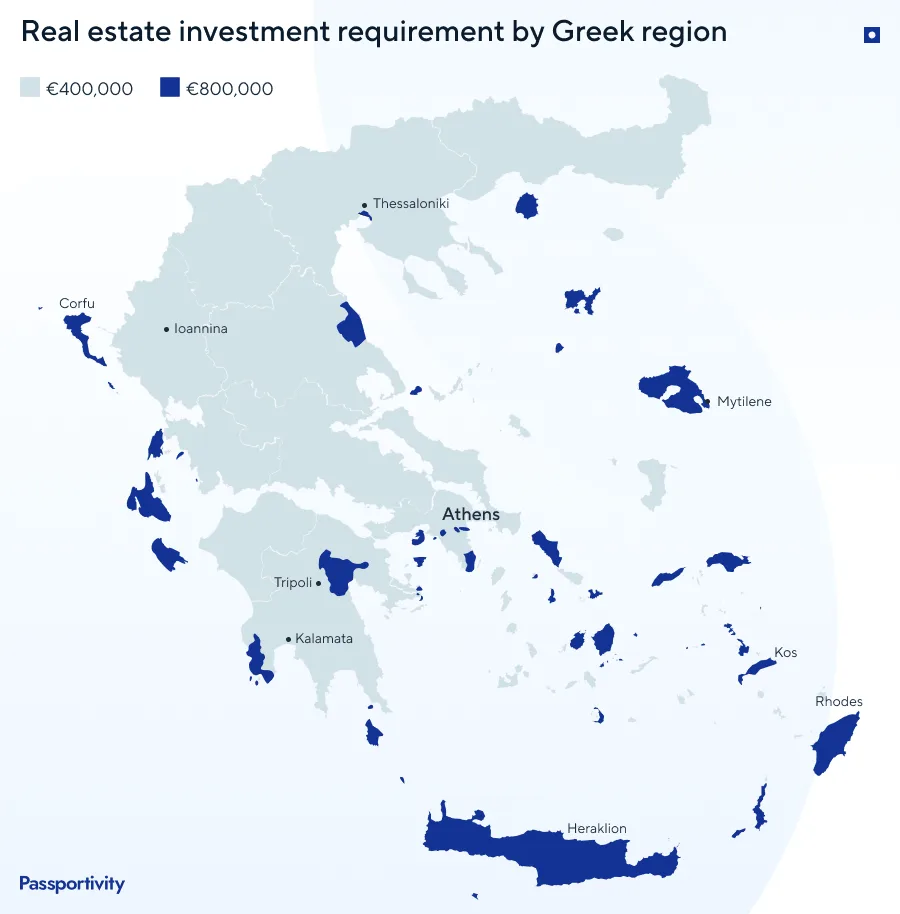
Investment requirements. Real estate investments require €400,000 or €800,000 depending on the region. A €250,000 threshold applies to specific categories such as full restoration of listed buildings or conversion of certain commercial properties into residential use.
Alternative routes include investments in funds, government bonds, or
Refundability of investments. Property investments are recoverable upon resale, provided holding requirements are met. Financial instruments and deposits may be withdrawn after the mandatory holding period, subject to programme rules.
Inclusion of family members. Applicants may include a spouse, children under 24 years of age who remain financially dependent, and parents of both spouses.
Maintaining and renewal of the status. The residence permit is valid for five years and may be renewed indefinitely as long as the investment is maintained. There is no minimum stay requirement to keep the residence permit, although extended residence would be required for citizenship eligibility.
Cheapest permanent residency in Europe
When investors look beyond temporary permits, the cheapest permanent residency in Europe becomes a separate category. Permanent residence grants
In Europe, Malta and Cyprus are most often cited as the most accessible options by investment threshold and structure.
Malta
The Malta Permanent Residence Programme grants investors permanent resident status in a European Union member state without requiring continuous relocation. Unlike temporary residence permits, this status is permanent from the outset and may be retained for life, provided programme conditions are respected.
The total required investment starts at €169,000.
Investment requirements. An applicant must fulfil several mandatory investment requirements:
- Rent real estate for at least €14,000 per annum or buy a property for at least €375,000.
- Pay €50,000 as an administration fee, regardless of whether they choose to buy or rent property.
- Make a
one-time ,non-refundable contribution of €30,000 to the government if purchasing property or €60,000 if renting. - Donate €2,000 to a local NGO, contributing to social projects in Malta.
- Demonstrate assets worth at least €500,000 with €150,000 in liquid financial assets, or show a portfolio of €650,000 with at least €75,000 in financial assets.
Refundability of investments. If property is purchased, it must be retained for a minimum of five years and cannot be sublet during this period. After five years, the investor may sell the property and recover capital, subject to market conditions. Government contributions, administrative fees, and donations are
Inclusion of family members. The programme allows inclusion of a spouse, children under 29 years of age who remain financially dependent, and dependent parents and grandparents.
Maintaining and renewing the status. Permanent residence status is granted for life. Residence cards issued to adults are valid for five years and must be renewed periodically. Minors are required to renew their residence cards shortly after reaching the ages of 14 and 18.
Continuous physical presence in Malta is not required to maintain permanent residence, but compliance with property and asset conditions must be maintained.
Cyprus
Cyprus offers permanent residence to investors through a
Investment requirements. To qualify, the main applicant must purchase new residential property with a minimum value of €300,000, excluding VAT and transfer fees. The property must be approved for the purpose of the programme.
Refundability of investments. The property investment may be sold after the residence permit is granted, provided the qualifying value threshold continues to be met by retaining qualifying assets. The purchased property value underpins the residency right, so investors typically hold the asset for a period aligned with their
Inclusion of family members. Cyprus permits the inclusion of the investor’s spouse, minor children, and dependent adult children in the application. Dependent parents or
Maintaining and renewing the status. Permanent residence in Cyprus is granted indefinitely once the conditions are satisfied. To maintain the permit, the investor must visit Cyprus at least once every two years.
Renewal of the physical residence card is required periodically, but there is no requirement for continuous residence or physical presence beyond the stated visit threshold. The investor must continue to meet financial and investment conditions to retain permanent resident status.

Cheapest citizenship by investment options globally
When investors compare the cheapest citizenship by investment programmes worldwide, they usually focus on speed, minimum investment thresholds, and flexibility. Unlike residence permits, these programmes grant citizenship directly after Due Diligence, without
Citizenship by investment programmes do not require residence or
5 Caribbean countries
The Caribbean remains the most established region for the cheapest citizenship by investment. Five countries operate
The following programmes are most often included when comparing the cheapest Golden Visas and citizenship options globally:
- Dominica — $200,000.
- St Kitts and Nevis — $250,000.
- Antigua and Barbuda — $230,000.
- Grenada — $235,000.
- St Lucia — $240,000.
All five Caribbean programmes allow investors to choose between a
Vanuatu
Vanuatu is widely recognised as one of the fastest and cheapest
Citizenship is available through a contribution starting at $130,000. Alternative investment routes through approved funds may also be available. Contributions are
A spouse and dependent children may be included in the application.
São Tomé and Príncipe
São Tomé and Príncipe represents a new generation of the cheapest and fastest citizenship by investment programmes in Africa. Citizenship is granted in exchange for a
Investors may include a spouse, children, parents and grandparents.
Children born after the application is submitted but before approval may also be included. For a family of four, the contribution is $95,000. Each additional family member requires an extra $5,000. After approval, the investor may add any family members. A child under one year of age requires an additional payment of $500.
Olga Koltsova
Investment Programs Expert
El Salvador
El Salvador offers a distinct model among the cheapest
A spouse and dependent children may be included, subject to additional state fees.
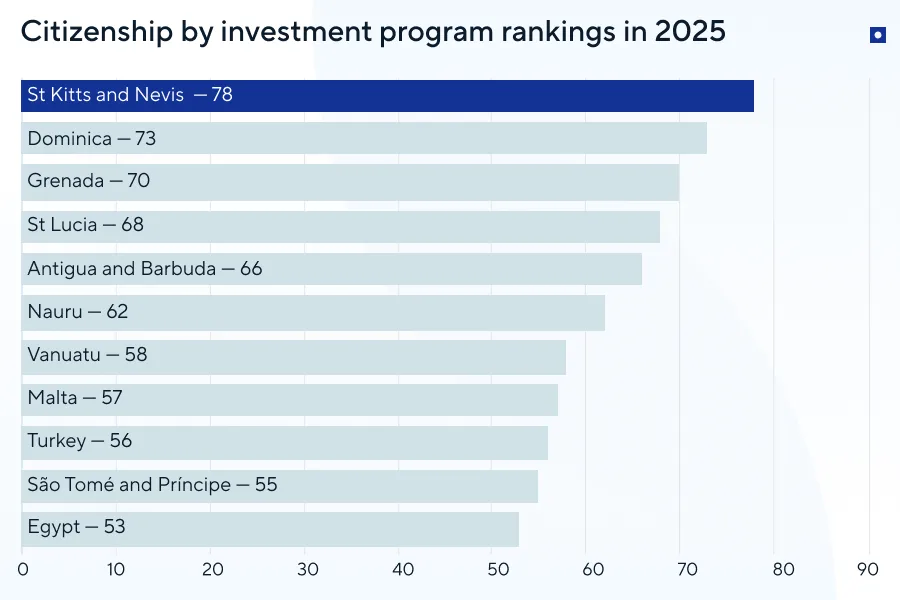
According to the CBI Index, the top seven citizenship by investment programmes include Saint Kitts and Nevis, Dominica, Grenada, Saint Lucia, Antigua and Barbuda, Nauru, and Vanuatu. São Tomé and Príncipe ranked 10th, confirming growing investor interest in African citizenship programmes.
How to apply for the cheapest Golden Visa step by step?
The process of obtaining the cheapest Golden Visas can take from one month to a year, depending on the country and the type of investment. Investors may be required to visit the country. For example, obtaining a residence permit in Portugal or Spain involves traveling to the country to submit biometrics. In contrast, Caribbean programmes allow applicants to complete the entire process remotely.
-
1+ week sSelecting a programme
The first task is choosing an appropriate country that aligns with the applicant's investment goals and lifestyle aspirations.
-
2—3 weeksGathering documents and submitting an application
To apply successfully, applicants must provide the necessary documentation, including:
- proof of income;
- police clearance certificate;
- evidence showing that all legal obligations regarding residency rights within the chosen jurisdiction have been met.
-
1+ month sDue Diligence
Applicants must undergo Due Diligence, a comprehensive background check conducted by the government or a designated
third-party agency.This process is crucial for verifying the applicant’s financial standing, criminal history, and overall eligibility for the Golden Visa. It ensures that the individual meets the required standards and helps protect the integrity of the programme by preventing fraud or illegal activities.
-
Up to 2 months
Making the required investment
The investor fulfils the investment condition according to the chosen option and provides supporting documents to confirm compliance.
-
2 to 8 months
Approval and receiving residency or citizenship
Upon approval, the applicant will receive either residency or citizenship, depending on the programme they participate in. Afterward, it is essential to fulfil the ongoing obligations required to maintain and renew the status.
How to avoid risks when applying for the cheapest Golden Visas?
Applications for the cheapest Golden Visas are regulated by law and involve strict compliance checks. Lower entry thresholds do not reduce scrutiny. On the contrary, affordable programmes often attract increased attention from regulators and banks. To reduce legal, financial, and reputational risks, investors should focus on the following points.
Understand the difference between residence and citizenship
One of the most common risks is confusing residence by investment with citizenship by investment. A residence permit does not automatically lead to citizenship and may require
Before applying, investors should clearly define whether they need temporary residence, permanent residence, or citizenship, and assess how each option fits their
Assess Due Diligence requirements in advance
All Golden Visa countries apply
Investors reduce risk by preparing a transparent financial profile, documenting the origin of assets, and disclosing relevant background information before submitting an application.
Evaluate political and regulatory stability of the programme
Some of the cheapest Golden Visa countries operate newer programmes that may change conditions more frequently. Governments can raise investment thresholds, limit eligibility for certain nationalities, or suspend programmes altogether.
To manage this risk, investors should consider whether the programme has a clear legal basis, a track record of approvals, and defined transition rules for applicants already in the process.
Consider banking and compliance implications
Obtaining a residence permit or citizenship does not automatically guarantee access to international banking. Some passports or residence statuses may face additional scrutiny from banks, especially if the programme is perceived as high risk.
Investors should evaluate how the chosen status will be treated by financial institutions and whether it supports their banking and business objectives. In many cases, combining several statuses in different regions offers better results than relying on a single solution.
Plan for long-term obligations and exit options
Even the cheapest Golden Visas come with ongoing requirements. These may include investment holding periods, renewal conditions, minimum visits, or reporting obligations. Ignoring these rules can lead to loss of status.
Before applying, investors should understand how long the investment must be maintained, whether it can be recovered, and what options exist if personal or financial circumstances change.
EU stance on Golden Visa programmes: regulatory pressure, risks, and how Passportivity helps mitigate them
The European Union treats investment migration as a
Below is an overview of the EU’s position, recent actions against specific countries, and the practical risks investors should consider.
1. EU position on citizenship by investment
The European Commission has consistently criticised investor citizenship schemes, arguing that EU citizenship must not be commercialised. According to the Commission, granting nationality primarily in exchange for financial contributions undermines the principle of a genuine link between the individual and the Member State [411] Source: EU Commission, Report on Investor Citizenship and Residence Schemes in the EU .
In April 2025, the Court of Justice of the European Union ruled that Malta’s investor citizenship scheme breached EU law. The Court found that granting nationality in exchange for predetermined payments, without requiring a genuine connection to the country, was incompatible with the obligations of Member States under EU law [412] Source: Maltese investor citizenship scheme is contrary to EU law, Court of Justice .
2. EU approach to residence by investment
Unlike citizenship schemes,
The European Parliament has repeatedly called for stricter standards, enhanced Due Diligence, transparency of intermediaries, and coordination across Member States [413] Source: Aspects of golden passport and visa schemes in the EU, European Parliament .
Key EU concerns include:
- risks of money laundering and corruption;
- security screening gaps;
- lack of physical presence requirements;
- impact on housing markets in major cities.
As a result, Member States have tightened checks, increased minimum thresholds, or adjusted programme rules. Some countries have restructured their programmes to align with EU expectations.
Cases involving specific countries
Malta’s citizenship by investment was challenged by the European Commission and ultimately found incompatible with EU law by the Court of Justice. The ruling reinforced the EU’s position that nationality cannot be granted solely in exchange for investment without a substantive link.
Cyprus and Bulgaria. Both countries previously terminated their citizenship by investment programmes after political pressure and infringement proceedings.
Other EU countries. Residence by investment programmes in countries such as Portugal, Greece, Hungary, Italy, Latvia, Malta, and Cyprus remain in place, but under increased compliance standards and political debate.
Risks for investors
Even if residence or citizenship is granted legally, international banks may apply enhanced Due Diligence depending on the jurisdiction. Some passports and residence permits receive additional scrutiny.
Programmes that receive political criticism may affect how a status is perceived by counterparties, financial institutions, or business partners. Incomplete documentation, unclear sources of funds, or inconsistencies in disclosures remain the most common reasons for delays or refusals.
How Passportivity helps mitigate these risks
Strategic programme selection. Passportivity assesses regulatory stability and EU pressure before recommending a jurisdiction. We focus on programmes with clear legal foundations and predictable rules.
Structured documentation. Our legal team prepares a transparent and consistent financial file aligned with both immigration and banking compliance standards.
Ongoing regulatory monitoring. We track
The EU’s position does not eliminate investment migration, but it makes careful planning essential. In 2026 and beyond, success depends less on finding the lowest threshold and more on choosing a legally sound, strategically aligned solution.
Recent changes in Golden Visa programmes
The landscape of Golden Visa and citizenship by investment programmes is evolving rapidly in
European Golden Visa reforms
Across Europe, many countries have restructured or closed their schemes. For example, Spain’s Golden Visa programme was terminated, and several other Member States have tightened requirements or replaced older
Shift from real estate to diverse investment routes
A key trend in
Global diversification of investor programmes
A number of Middle Eastern countries, including the UAE, have broadened
New investment residency programmes are being introduced in Latin America, with countries such as Argentina planning to launch investment pathways in 2026.
Some jurisdictions outside Europe are offering fast or
How to choose the cheapest Golden Visa that fits your goals?
- European residence programmes such as those in Portugal, Greece, Hungary, Italy, Latvia, Malta, and Cyprus are typically chosen to secure legal residence in the European Union. They are suitable for investors who value access to the Schengen Area and
long-term stability, even if citizenship is only available in the future or not offered at all. - Citizenship programmes in the Caribbean, including Dominica, St Kitts and Nevis, Antigua and Barbuda, Grenada, and St Lucia, are often used to obtain nationality within a predictable timeframe and without relocation. These options are frequently combined with obtaining European residence permits.
- Newer citizenship programmes in São Tomé and Príncipe, Vanuatu, and El Salvador are usually selected for speed, lower entry thresholds, or alternative payment models. They appeal to investors who prioritise flexibility and are comfortable with emerging jurisdictions.
- Many investors conclude that relying on a single status is no longer sufficient. A common strategy is to combine a fast citizenship programme such as Vanuatu, Dominica, or St Lucia with a European residence permit in Portugal, Greece, or Italy.
About the authors


Frequently asked questions
Among EU residence by investment programmes, Latvia is considered the lowest entry point. Its business investment route starts at €50,000, making it the most affordable Golden Visa option within the European Union in 2026.
If the question refers to the cheapest citizenship by investment globally, the lowest published threshold currently belongs to São Tomé and Príncipe, where citizenship can be obtained through a government contribution starting at $90,000.
No. New Zealand is a residency by investment destination, but its visa has a high minimum compared to Europe and the Caribbean. The official minimum investment starts at NZD 5 million for the Growth category and NZD 10 million for the Balanced category.
No. In 2026 there is no EU member state offering citizenship by investment. The Court of Justice of the European Union ruled Malta’s investor citizenship scheme unlawful in 2025, and EU citizenship by investment is not available as a legal programme within the Union.
For the lowest threshold, Latvia is often the
The lowest qualifying threshold under the Portugal Golden Visa is the cultural contribution route, starting at €250,000. In designated
All other active routes, including regulated investment funds, research contributions, or business investments, start at €500,000, making the cultural support option the most affordable entry point under the current framework.
There is no universal easiest programme. The most practical option is usually the one with clear eligibility rules, predictable documentation, and a route you can evidence cleanly.
In Europe, Greece is often viewed as straightforward for applicants using qualifying real estate routes, while Portugal is often chosen for applicants who prefer a
Hungary Golden Visa attracts investors due to its
Malta offers a permanent residency for investors who want a
Among citizenship by investment programmes, Caribbean options are often considered the most established because they have long operating frameworks and standardised Due Diligence processes. Dominica, Antigua and Barbuda, Grenada, St Lucia, and St Kitts and Nevis are typically referenced in this category.
Antigua and Barbuda citizenship by investment gives eligible applicants a direct route to citizenship for a donation starting at $230,000, as well as other investment options. Investors can include family members in one application and usually obtain passports in 6 months.
The Türkiye investment programme offers one of the most established citizenship routes. Investors can qualify by purchasing real estate worth at least $400,000 or choosing another approved option, with citizenship available in 8 months.
A guide on Dominica citizenship for Iranians explains how the Due Diligence process works in practice, what documentation is required to confirm the source of funds, and how international banking compliance affects the application.
Golden Visas carry regulatory risk, as governments may raise investment thresholds, restrict eligible areas, or change renewal rules. A residence permit under EU Golden Visa programmes does not automatically lead to citizenship.
Applicants from
TCO includes not only the minimum investment but also government fees, legal costs, taxes on rental income or capital gains, renewal fees, property maintenance, and opportunity cost of capital. Investors should also factor in banking expenses such as FX spreads, escrow fees, and
There is no universal jurisdiction where cryptocurrency escrow alone automatically qualifies as sufficient proof of source of wealth. What matters is a documented audit trail, including exchange records, tax filings, and clear ownership of wallets. Authorities and banks focus on transparency and traceability rather than the payment method itself.
European residence by investment programs allow minimal physical presence. For example, Portugal requires limited stay days to maintain residence status, while Greece does not require continuous residence for renewal.
Tax residency is generally triggered by spending more than 183 days in a country or establishing a habitual home, so immigration residence does not automatically mean tax residence.
Compliance checks have become more structured and
No. Aggregating several small units to reach the minimum investment is generally not permitted under the main routes. Investors typically qualify by purchasing one compliant property within the applicable investment category.
There is no budget residence permit programme that clearly allows foreigners to obtain a full residence card completely remotely. Investors may often start the process remotely or through a representative, but most programmes still require at least one personal visit for biometrics,
For example, Hungary’s Guest Investor Residence Permit requires the applicant’s facial photograph and fingerprints for the biometric residence permit. Greece allows electronic submission for residence permit applications, but the process still includes residence permit delivery formalities. Malta MPRP may issue approval before the card stage, but biometric data is tied to the issuance of the residence card.
Read also





Contact us today
Passportivity assists international clients in obtaining residence and citizenship under the respective programs. Contact us to arrange an initial private consultation.