

 Banks and taxes
 Reading time: 16 min
 Countries With No Income Tax: Best Tax-Free Jurisdictions for Residency and Relocation
This article explains which countries have no income tax in 2026, how they fund their budgets, and how tax residency differs from immigration status. It also compares

 Share
Share  Telegram
  Facebook
 LinkedIn
 X
X

 Save
Save 

What “tax-free ” and “no income tax” really mean
A country with no income tax does not levy personal income tax on earnings such as salaries, business income, dividends, interest, or capital gains. Residents keep their income without paying a direct tax to the government.
Examples include Bahrain, Qatar, Kuwait, Monaco, Vanuatu, and the United Arab Emirates.
A
For example, residents may still pay:
value-added tax, VAT;- customs duties;
- real estate taxes and municipal charges;
- business license fees;
- social security contributions;
- corporate taxes.
As a result, every country with no income tax may be considered
Some countries combine favorable tax policies with investment migration opportunities. For example, St Kitts and Nevis, Antigua and Barbuda, Dominica, Grenada, and St Lucia offer citizenship by investment programs.
Tax treatment depends on individual circumstances and tax residency status.

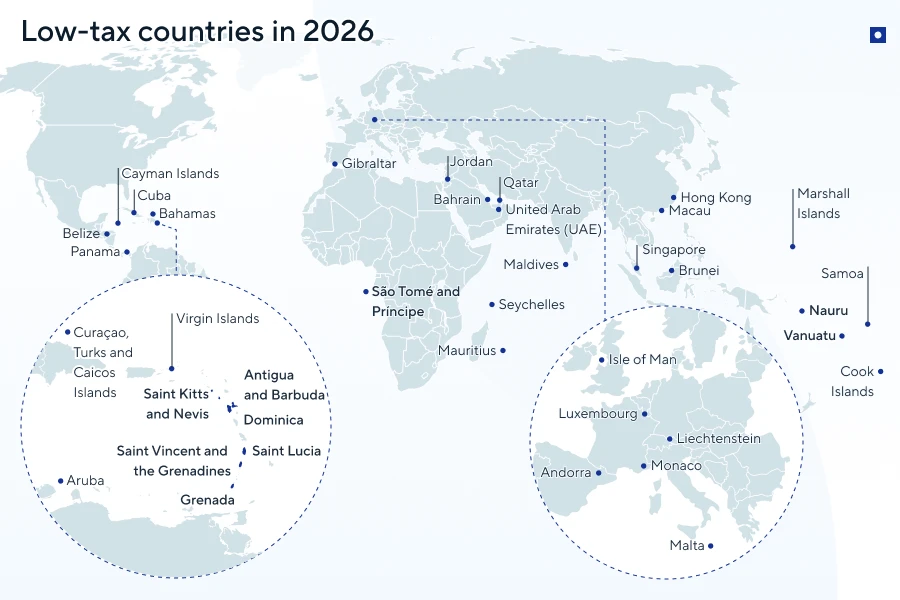
Tax-free jurisdictions on the map
The Caribbean has a high concentration of island states and territories with favorable tax rules. Many of them do not levy personal income tax, capital gains tax, inheritance tax, or wealth tax.
The Gulf region includes countries with no personal income tax, such as the UAE, Qatar, Bahrain, and Kuwait. These countries attract entrepreneurs, executives, and
Europe has fewer
Other European countries may not be
Türkiye is another example of a
The exemption applies to individuals who become tax residents of Türkiye, provided they had no domicile or tax liability in Türkiye during the 3 calendar years before becoming resident.
Sovereign countries with no personal income tax
Several sovereign states do not levy broad personal income tax. They are mainly located in the Gulf, the Caribbean, and the Pacific.
Some countries are practical relocation hubs. Others are more suitable for wealth planning, retirement, or citizenship by investment.
Antigua and Barbuda
Antigua and Barbuda does not levy personal income tax on residents [290] Source: Antigua and Barbuda taxation, Citizenship by Investment Unit . The country also offers a citizenship by investment program. Applicants who obtain citizenship do not automatically become tax residents; tax residency depends on their actual situation and local rules.
Tax residency. Citizenship and tax residency are separate concepts. A person who receives an Antigua and Barbuda passport by investment does not become a tax resident only because of citizenship. Tax residency usually requires physical presence, legal residence, and real personal or economic ties to the country.
Foreigners may obtain Antigua and Barbuda citizenship by investment. There are 4 main options:
- National Development Fund — a
non-refundable contribution of at least $230,000. - Real estate investment — purchase of an approved property worth at least $300,000, held for at least 5 years.
- Business investment — at least $1,500,000 as a sole investor, or at least $400,000 as part of a joint investment.
- University of the West Indies Fund — a $260,000 contribution for families of 6 or more.
The main applicant may include eligible family members in the application. All applicants must pass Due Diligence and receive approval from the Citizenship by Investment Unit.

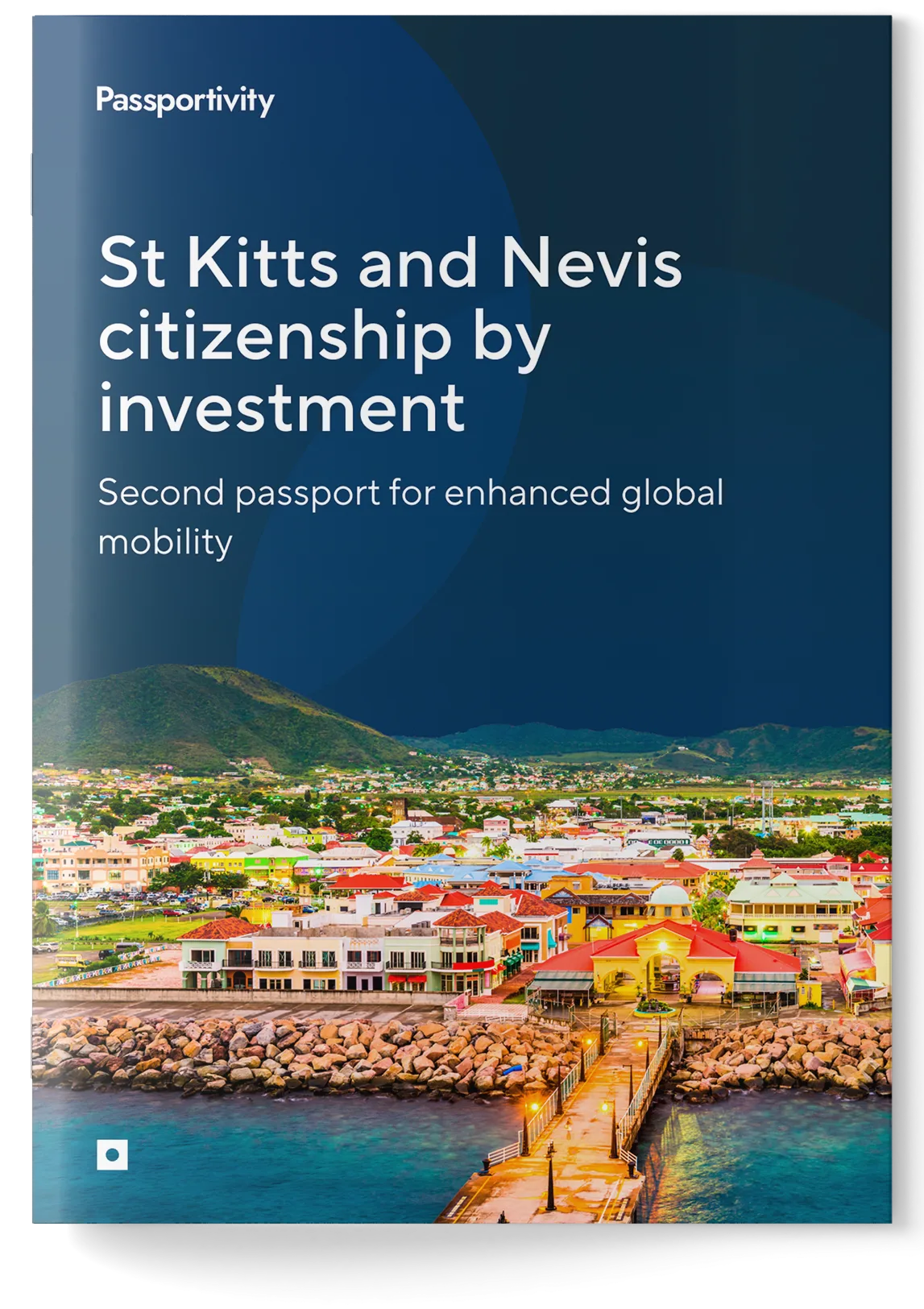
St Kitts and Nevis
St Kitts and Nevis has no current personal income tax and offers one of the oldest citizenship by investment programs
[291]
Source: St Kitts taxes, SKN Information Service
. The country still levies VAT, corporate income tax, property tax, and other charges. It may suit investors who want a Caribbean passport and a
Tax residency. St Kitts and Nevis citizenship by investment does not automatically create tax residency. A tax resident normally needs real residence in the Federation and sufficient local ties. Investors who live abroad after obtaining citizenship usually remain tax residents of another jurisdiction.
Foreigners may obtain St Kitts and Nevis citizenship by investment. There are 3 options:
- Sustainable Island State Contribution — a
non-refundable contribution of at least $250,000. - Public Benefit Option — a contribution of at least $250,000 to an approved public benefit project.
- Real Estate Investment — purchase of approved real estate worth at least $325,000.
The main applicant may include a spouse, children, and parents in the application. Investors and their family members are not required to live in St Kitts and Nevis before or after obtaining citizenship.
United Arab Emirates
United Arab Emirates does not levy personal income tax on individuals
[292]
Source: Individual taxation, UAE Government
. Residents may still pay 5% VAT, excise tax, and corporate tax if they own or operate a taxable business. The UAE is one of the most practical
Tax residency. A person may be treated as a UAE tax resident if their usual or primary residence and center of financial and personal interests are in the UAE. Other routes include staying in the country:
- for at least 183 days in a consecutive
12-month period; - for at least 90 days with additional ties, such as a residence permit, permanent home, employment, or business in the UAE.
Foreigners may obtain UAE residence by investing in real estate. There are 2 main options:
2-year residence visa — for property owners who meet the program requirements.10-year Golden Visa — for investors who purchase one or several properties worth at least AED 2,000,000 in total.
Both options allow investors to include close family members in the application. This usually includes a spouse and children, provided they meet the eligibility requirements.
Bahrain
Bahrain has no personal income tax. The country applies VAT and social insurance contributions. Bahrain is often considered by professionals and business owners who work with the Gulf market and want lower living costs than in some neighboring countries.
Tax residency. as Bahrain has no personal income tax regime, individual tax residency is mainly relevant for treaty purposes, banking, and the applicant’s obligations in other countries. Foreigners usually need a valid residence permit and real ties to Bahrain, such as employment,
Kuwait
Kuwait does not levy personal income tax on individuals. Corporate tax applies to foreign companies that carry on trade or business in Kuwait. Residency is usually linked to employment, family sponsorship, or business activity, so Kuwait is less flexible for independent relocation.
Tax residency. Individuals who need a Kuwaiti tax residence certificate must usually prove legal residence and physical presence in Kuwait. The Ministry of Finance tax certificate system refers to an entry and exit record showing presence in Kuwait for at least 183 days in the required fiscal year.
Qatar
Qatar exempts salaries, wages, and similar employment income from income tax
[293]
Source: Qatar income tax, General Tax Authority
. However,
Tax residency. A person is treated as resident in Qatar if they have a permanent home in the country, stay there for more than 183 days during a year, or hold Qatari nationality. This makes Qatar more suitable for people who can build a real employment, business, or

Saudi Arabia
Saudi Arabia does not levy personal income tax on employment income. However, tax and zakat rules may apply to business activity,
Tax residency. Individuals residing in Saudi Arabia may apply for a tax residency certificate through ZATCA. In practice, tax residency usually requires a substantial connection with the country, such as:
- legal residence;
- physical presence;
- employment;
- business interests.
The certificate is mainly used to claim double tax treaty benefits.
Oman
Oman has no personal income tax in 2026 [294] Source: Oman PIT law, Tax Authority . However, Oman has issued a personal income tax law that enters into force in 2028 and applies a 5% tax rate to taxable income under the new rules. Investors considering Oman need to factor in these future changes.
Tax residency. Until the new personal income tax regime starts applying, Oman remains a
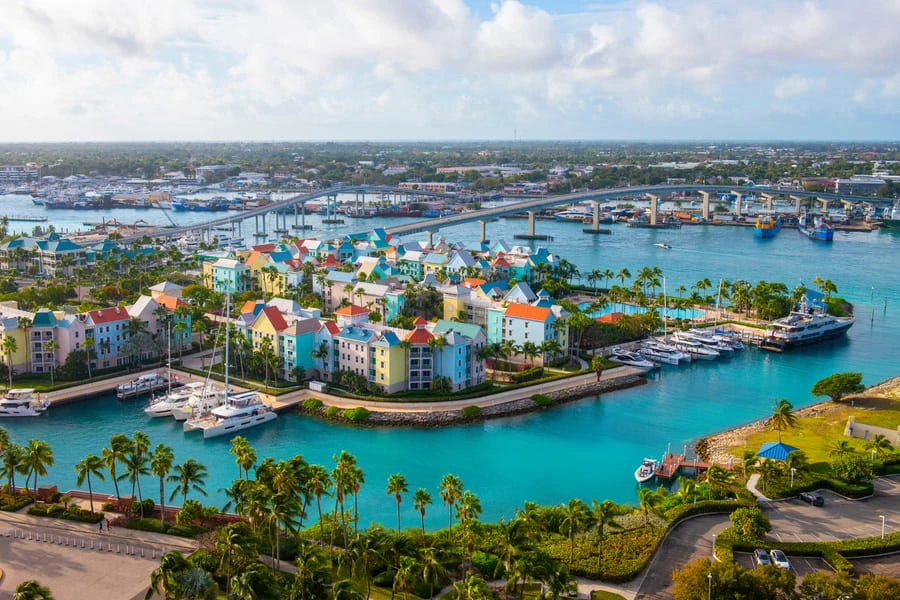
The Bahamas
The Bahamas does not rely on personal income tax as a central part of its tax system [295] Source: Bahamas taxes, Government of The Bahamas . The government collects revenue through VAT, customs duties, stamp duties, real property tax, and other fees.
The Bahamas is often relevant for retirees, property buyers, and families who want an
Tax residency. The Bahamas does not have a broad personal income tax regime, so tax residency is mainly relevant for foreign tax authorities, banking, and treaty or reporting purposes. Applicants usually need legal residence, a local address, physical presence, and evidence that The Bahamas is their main place of residence.
Brunei Darussalam
Brunei Darussalam does not tax individual income under its corporate income tax framework [296] Source: Brunei income tax, Ministry of Finance and Economy . The country is stable and wealthy, but relocation is usually linked to employment, family grounds, or official permission. Brunei is not an open investment migration destination.
Tax residency. Under Brunei’s income tax legislation, a person may be treated as resident if they are physically present or exercise employment in Brunei for at least 183 days during the relevant period. In practice, tax residency is usually linked to lawful residence, employment, or family ties.
Monaco
Monaco does not levy income tax on Monegasque nationals and most residents
[297]
Source: Monaco income tax, Monaco Public Service
. French nationals are an exception under the
Tax residency. To obtain a Monaco residence certificate for tax purposes, a foreigner must hold a valid Monaco residence permit and confirm one of the residence criteria. These include:
- staying in Monaco for more than 183 days a year;
- having the main center of activities in Monaco;
- spending the longest period of the year there;
- having a home in Monaco if the other criteria do not apply.
People who have lived in Monaco for less than 6 months may receive the tax certificate only if they provide documents proving an exemption. The certificate is valid for 1 year.

Vanuatu
Vanuatu is a
Tax residency. Vanuatu citizenship does not automatically change a person’s tax residency. Investors usually need legal residence, a local address, physical presence, and evidence of genuine ties to rely on Vanuatu as their tax residence. Their previous country of tax residence may continue to tax worldwide income until exit rules are met.
Territories and jurisdictions with no personal income tax
Some
These destinations may offer strong tax advantages. However, residence is often more restricted than in sovereign countries. Applicants may need employment, property ownership, business activity, or a special residence certificate.
Cayman Islands
Cayman Islands has no income, corporate, capital gains, inheritance, or property taxes
[299]
Source: Cayman tax system, Cayman Islands Government
. Government revenue mainly comes from import duties, stamp duties, and
Bermuda
Bermuda does not levy personal income tax, but payroll tax applies [300] Source: Bermuda payroll tax, Government of Bermuda . The cost of living is high, and residence is usually linked to employment, family, or special permission. Bermuda may suit professionals in insurance, finance, and international business.
British Virgin Islands
British Virgin Islands does not operate a broad personal income tax system, but payroll tax applies to employers and
Turks and Caicos Islands
The Turks and Caicos Islands does not rely on income tax
[302]
Source: TCI revenue streams, Turks and Caicos Government
. The local tax system includes sales taxes, business license fees, National Insurance, National Health Insurance, and
The jurisdiction is often considered by property buyers, retirees, and families seeking a Caribbean lifestyle.
Anguilla
Anguilla has no broad personal income tax and offers economic residence routes
[303]
Source: Anguilla GST, Inland Revenue Department
. The island applies GST,
Comparison of no-income-tax countries by taxes, residency and lifestyle
| Country or jurisdiction | Personal income tax | Other taxes | Residency route | Best for |
|---|---|---|---|---|
| UAE | 0% | VAT, CT | Visas, property | Business |
| Bahrain | 0% | VAT, social insurance | Work, business | Gulf access |
| Kuwait | 0% | Corporate tax | Work, family | Employment |
| Qatar | 0% on salaries | Business tax | Work, property | Executives |
| Saudi Arabia | 0% on salaries | VAT, zakat | Premium Residency | Regional business |
| Oman | 0% in 2026 | VAT, future PIT | Work, investment | Gulf lifestyle |
| Monaco | 0% for most residents | VAT, duties | Residence permit | HNWIs |
| The Bahamas | 0% | VAT, duties | Residence, property | Retirees |
| Antigua and Barbuda | 0% | Sales tax | CBI, residence | Passport |
| St Kitts and Nevis | 0% | VAT, CT | CBI, residence | Plan B |
| Brunei | 0% | Corporate tax | Work, family | Regional ties |
| Vanuatu | 0% | VAT, duties | CBI, residence | Pacific Plan B |
| Cayman Islands | 0% | Duties, fees | Work, investment | Finance |
| Bermuda | No PIT | Payroll tax | Work, permission | Insurance |
| British Virgin Islands | No broad PIT | Payroll tax | Work, business | Structuring |
| Turks and Caicos Islands | 0% | Sales taxes | Permanent Residence Certificate, property | Lifestyle |
| Anguilla | No broad PIT | GST, fees | Economic residence | Property |
How countries with no income tax fund their governments
Countries with no income tax still need stable public revenue. They fund infrastructure, healthcare, education, security, and public services through other sources.
The revenue model depends on the country. Gulf states rely partly on oil and gas. Caribbean islands use tourism, consumption taxes, customs duties, and government fees. International financial centers collect license fees, registration charges, and regulatory fees from companies and financial institutions.
Natural resources
Natural resources are one of the main reasons why some countries can avoid personal income tax. Oil and gas revenues allow governments to fund public spending without taxing salaries and personal earnings.
This model is common in the Gulf. Qatar, Saudi Arabia, Kuwait, the UAE, Oman, and Bahrain have historically relied on hydrocarbon revenues to support state budgets and public investment.
Qatar’s 2025 budget, for example, is based on conservative oil and gas revenue assumptions [304] Source: Qatar budget, Ministry of Finance . The Ministry of Finance stated that the budget uses an average oil price of $60 per barrel to maintain financial flexibility.
Saudi Arabia also reports state revenues by source in its annual budget documents [305] Source: Saudi budget, Ministry of Finance . The country is diversifying its economy, but oil remains an important part of public revenue.
The
Tourism and consumption taxes
Tourism is another major source of public revenue for
Instead of taxing personal income, governments collect taxes from spending. Visitors and residents pay VAT,
The Bahamas does not rely on personal income tax, but it collects VAT, customs duties, stamp duties, real property tax, business license fees, and other government charges [306] Source: Bahamas VAT, Government of The Bahamas .
The Ministry of Tourism, Investments and Aviation reported that The Bahamas welcomed 11.22 million international visitors in 2024, compared with 9.65 million in 2023 [307] Source: Tourism arrivals, Bahamas Ministry of Tourism . For a small island economy, tourism is not only a lifestyle advantage but also an important part of the fiscal model.
Olga Koltsova
Investment Programs Expert
The Turks and Caicos Islands follows a similar model. Its Revenue Department lists several sales taxes, including taxes imposed on tourism, financial services, and telecommunications. The department also administers the business license program.
This model links government revenue to consumption and tourism activity. It works well when the country attracts visitors, property buyers, and
For residents, the practical result is mixed. Income may not be taxed, but everyday spending, imported goods, property transactions, and business operations can still be expensive.
Financial services and international business
Some
The Cayman Islands Government describes financial services and commerce as a primary economic pillar. The jurisdiction does not need broad personal income tax because it collects revenue through business fees, work permit fees, import duties, stamp duties, and financial services activity.
The British Virgin Islands also relies heavily on financial services. Government economic reviews describe financial services and tourism as the 2 main pillars of the economy. One official review states that financial services contribute about 60% of government revenue.
In these jurisdictions, the state earns revenue from company incorporation, annual renewal fees, regulated financial services, professional services, and
Step-by-step process to get residency in a tax-free or low-tax country
Getting residency in a
The process usually takes several months. The timeline depends on the country, the applicant’s profile, the chosen route, and the speed of document preparation. Government authorities make the final decision.
-
1 to 2 weeks
Choose the immigration route
Each country has its own route to legal residence. The route usually depends on employment, investment, property ownership, business activity, family ties, or financial independence.
Citizenship by investment is not the same as residence. A passport from a
low-tax country may support Plan B planning, but it does not automatically make the holder a tax resident there. -
1 to 2 weeks
Check current tax obligations
Before choosing a new country, applicants need to understand their current tax position. Moving abroad does not always end tax obligations in the previous country.
Some countries tax residents on worldwide income. Others may apply exit tax, controlled foreign company rules, reporting duties, or tax on
local-source income after relocation.US citizens and resident aliens have a special position. They generally remain subject to US tax on worldwide income even if they live abroad. They may qualify for exclusions or credits, but these rules need separate tax advice.
-
1 to 2 weeks
Check tax residency criteria
A residence permit gives a person the right to live in a country. Tax residency determines where that person is taxed. These statuses may overlap, but they are not identical.
Tax residency may depend on:
- number of days spent in the country;
- permanent home;
- center of personal and economic interests;
- local employment or business;
- family residence;
- bank accounts and local address;
- tax residency certificate requirements.
Applicants should check both the rules of the new country and the exit rules of their current tax country before relocation.
-
2 to 6 weeks
Prepare documents
Document requirements vary by country and route. Most applications include identity, financial, legal, and family documents.
A standard document set may include:
- passport copies;
- birth and marriage certificates;
- police clearance certificates;
- proof of address;
- bank statements;
- proof of income or wealth;
- source of funds documents;
- health insurance;
- property documents or lease agreement;
- application forms;
- photos and government fee receipts.
Investment routes usually require additional documents. These may include a property purchase agreement, title deed, business documents, investment confirmation, or proof of contribution.
Documents may need notarisation, apostille, legalisation, or certified translation.
-
2 to 12 weeks
Pass Due Diligence and compliance checks
Tax-free andlow-tax jurisdictions still apply compliance checks. Banks, migration authorities, and citizenship units review the applicant’s identity, source of funds, criminal record, sanctions exposure, and business background.This stage is especially important in citizenship by investment programs. Antigua and Barbuda and St Kitts and Nevis require applicants to pass Due Diligence before citizenship is granted.
Banking checks may be separate from immigration checks. A person may receive residence approval but still need to prove source of funds to open a bank account or transfer money.
-
Depends on country
Make the qualifying investment or meet route conditions
The applicant then meets the conditions of the selected program. For real estate routes, this may include signing a purchase agreement, paying the property price, and registering ownership.
-
Several months
Submit the application and wait for approval
The application is submitted to the relevant government authority. The authority reviews documents, checks eligibility, and may request additional information. The applicant should avoid travel, banking, or tax decisions that depend on approval before the status is officially granted.
If the application is approved, the applicant receives a residence permit, permanent residence certificate, Golden Visa, or citizenship approval, depending on the route.
-
1 to 6 months
Complete relocation and establish real ties
After approval, the applicant may need to complete local steps. These can include entering the country, registering an address, collecting a residence card, opening a bank account, buying health insurance, enrolling children in school, or registering a business.
The applicant needs to show real ties to the country, including:
- actual presence;
- permanent home;
- local bank account;
- utility bills;
- family relocation;
- local business activity;
- tax residency certificate;
- exit from the previous tax country.
This stage is essential for applicants who want the move to have tax effect, not only immigration value.
-
Annually
Review the structure every year
Tax planning does not end after residence approval. Tax rules, visa requirements, reporting duties, and banking standards may change.
Residents should review their status every year. They should check whether they still meet residence permit conditions, tax residency criteria, family requirements, and bank compliance rules.
This is especially important for investors with several passports, companies, properties, or sources of income in different countries.
Common mistakes when choosing tax residency
Tax residency affects where a person reports income, pays taxes, and discloses assets. Mistakes at this stage may lead to double taxation, banking issues, penalties, or disputes with tax authorities.
A
Assuming “no income tax” means no tax at all
Countries with no personal income tax still collect public revenue. Residents may pay VAT, customs duties, stamp duties, property charges, social security contributions, business license fees, or corporate tax.
For example, the UAE does not levy personal income tax on individuals, but VAT, excise tax, and corporate tax may apply in specific situations. Other
This mistake often leads to unrealistic cost calculations. A person may save on income tax but spend more on housing, imported goods, healthcare, education, or business compliance.
Confusing immigration residence with tax residence
A residence permit gives a foreigner the right to live in a country. Tax residence determines where the person is treated as taxable [308] Source: Tax residency, OECD .
These 2 statuses may overlap, but they are not the same. A person may have a residence permit in a
Tax authorities usually look at several factors. These may include the number of days spent in the country, permanent home, family location, business interests, employment, bank accounts, and center of personal and economic interests.
This is especially important for investors who receive citizenship by investment. A second passport does not automatically create tax residency.
Ignoring tax obligations in the previous country
Moving to a
Some countries use
US citizens and resident aliens have an additional issue. They generally remain subject to US tax filing and reporting rules even when they live abroad [309] Source: US taxpayers abroad, Internal Revenue Service . Tax exclusions and credits may reduce the final liability, but they do not remove the need for analysis.
Before relocation, applicants need to check exit rules, reporting obligations, controlled foreign company rules, and
Choosing the country by tax rate only
A 0% income tax rate is not enough to make a country suitable for relocation. The best option depends on lifestyle, banking, healthcare, schools, political stability, and the route to legal residence.
For example, Monaco may suit
Applicants also need to check whether they can open bank accounts, register a company, rent or buy property, include family members, and meet renewal conditions.
A
Not considering future tax changes
Tax rules can change. A country that has no personal income tax today may introduce new taxes later or revise residence conditions.
Oman is a clear example. The country has no personal income tax in 2026, but the Personal Income Tax Law enters into force at the beginning of 2028. The tax rate is 5% on taxable income under the new rules.
Future changes may also affect VAT, corporate tax, reporting duties, banking compliance, or residence permit renewal.
Investors should review their tax residence structure at least once a year. This helps confirm that they still meet residence conditions and remain compliant in every country where they have income, assets, companies, or family ties.
Countries with the highest income taxes
There are 2 common ways to compare
The second is the tax wedge. The OECD uses this indicator to compare the total tax burden on labour. It includes personal income tax, employee and employer social security contributions, payroll taxes, and cash benefits.
For employees, the tax wedge is often more useful than the headline income tax rate. It shows the portion of the employer’s total labour cost that the worker does not receive as net income.
European countries dominate the list of jurisdictions with the highest tax burden on labour income. Belgium, Germany, France, Italy, Austria, Denmark, Sweden, and Finland combine progressive income tax with social security contributions or local taxes.
Belgium has one of the highest tax burdens on employees [310] Source: Belgium rates, FPS Finance . In income tax year 2026, federal personal income tax rates range from 25 to 50%. The top 50% rate applies to taxable income above €51,070. Social security contributions and local taxes increase the total burden.
Germany taxes personal income progressively
[311]
Source: Germany allowance, Ministry of Finance
. The basic allowance is €12,348 in 2026. Income above this level is taxed at progressive rates that rise from 14 to 42%. Very high incomes may be taxed at 45%. Social security contributions also have a major impact on
France applies a progressive income tax scale with rates from 0 to 45% [312] Source: France brackets, Service Public . The 45% rate applies to taxable income above €181,917 per family quotient share. The final result depends on the household structure, deductions, and social contributions.
Italy applies national personal income tax, or IRPEF, at 23%, 33%, and 43% [313] Source: Italy IRPEF, Revenue Agency . The top 43% rate applies to taxable income above €50,000. Regional and municipal surcharges may increase the final burden.
Austria uses a progressive income tax scale with rates from 0 to 55% [314] Source: Austria rates, Ministry of Finance . The standard top rate is 50%, while income above €1,000,000 is taxed at 55%. Employees also pay social security contributions.
Denmark has a layered tax system. In 2026, the
An additional
Sweden combines municipal and state income tax. The average municipal tax rate is 32.38% in 2026 [316] Source: Sweden rates, Tax Agency . State income tax of 20% applies to taxable earned income above SEK 643,000. Capital income is generally taxed at 30%.
Finland taxes earned income through state income tax, municipal tax, and other charges [317] Source: Finland budget, Ministry of Finance . The exact rate depends on income, municipality, church membership, deductions, and social insurance contributions. From 2026, the highest marginal tax rate on earned income is reduced to around 52%.
High income taxes do not automatically make a country unsuitable for relocation. These countries often use tax revenue to finance healthcare, pensions, education, infrastructure, and social protection.
For investors and internationally mobile families, the key question is not only the tax rate. It is whether the tax system matches their income structure, residence plans, business needs, and
Comparison of high-tax countries for individuals
| Country | Main income tax rates | Top rate applies from | Extra charges |
|---|---|---|---|
| Belgium | 25%, 40%, 45%, 50% | €51,070 | Social security, local tax |
| Germany | 0%, | High incomes | Social security, solidarity surcharge |
| France | 0%, 11%, 30%, 41%, 45% | €181,917 per share | Social contributions |
| Italy | 23%, 33%, 43% | €50,000 | Regional, municipal taxes |
| Austria | Up to 55% | €1,000,000 | Social security |
| Denmark | 12.01%, 7.5%, 7.5%, 5% | DKK 2,592,700 | 8% labour market contribution, municipal tax |
| Sweden | Municipal tax ≈ 32.38%, state tax 20% | SEK 643,000 | Pension fee |
| Finland | Progressive state and municipal tax | Around 52% marginal rate | Pension and unemployment contributions |
Final thoughts on low-tax or tax-free countries
Tax-free countries are not completelytax-free . The term usually means that a country does not levy personal income tax. Residents may still pay VAT, customs duties, property charges, corporate tax, social security contributions, or government fees.- Countries with no income tax are concentrated in specific regions. Many are located in the Gulf, the Caribbean, and the Pacific. The UAE, Bahrain, Qatar, Kuwait, Monaco, The Bahamas, Antigua and Barbuda, St Kitts and Nevis, Brunei, and Vanuatu are among the most notable examples.
- A residence permit, citizenship, or property ownership may give a person immigration status. Tax residency depends on separate rules, such as physical presence, permanent home, center of interests, family ties, or local business activity.
- The best
tax-free country depends on the goal. The UAE may suit entrepreneurs and business owners. Monaco is more relevant forhigh-net-worth individuals. The Bahamas may be attractive for retirees. Antigua and Barbuda and St Kitts and Nevis may suit investors seeking citizenship by investment and along-term Plan B.
About the authors


Frequently asked questions
Countries with no personal income tax include the United Arab Emirates, Bahrain, Kuwait, Qatar, Saudi Arabia, Oman, Monaco, The Bahamas, Antigua and Barbuda, St Kitts and Nevis, Brunei Darussalam, and Vanuatu.
Some territories and
The exact tax position differs by country. Some jurisdictions do not tax salaries, but may tax business income, companies, property transactions, imports, or consumption.
A
Residents may still pay VAT, sales tax, customs duties,
The phrase “country with no income tax” is more precise. It means that the country does not levy broad personal income tax on salaries and other personal earnings.
Moving to a
Tax obligations depend on citizenship, tax residency, income source, business structure, assets, and exit rules in the previous country. Before moving, applicants need to check both immigration rules and tax rules.
The UAE is often one of the most practical
The Bahamas may be suitable for retirees and property buyers. Antigua and Barbuda and St Kitts and Nevis may be relevant for investors seeking citizenship by investment and a
The easiest country is not always the best one. Applicants also need to consider tax residency rules, banking, healthcare, schools, cost of living, and obligations in their current country.
US citizens and resident aliens generally remain subject to US tax rules on worldwide income, even if they live in a
This means that moving to Dubai, Monaco, The Bahamas, or another
For US citizens, a
Dubai is often described as
However, Dubai is not free of all taxes. The UAE applies 5% VAT, excise tax on selected goods, and corporate tax in specific business situations. Fees may also apply to property, visas, licenses, and government services.
For expats, Dubai can be a strong
Monaco does not levy personal income tax on Monegasque nationals and most residents. It also has no wealth tax, annual property tax, or council tax.
There is an important exception. French nationals are subject to special rules under the
Monaco residence must also be genuine. Foreign residents usually need accommodation, sufficient funds, and real ties to the Principality. Monaco’s tax rules do not override tax obligations that may arise in another country.
The process starts with obtaining legal residence or another valid right to stay. After that, the applicant usually needs to meet the country’s tax residency criteria.
These criteria may include physical presence, permanent home, center of personal and economic interests, local address, family relocation, employment, business activity, or a tax residency certificate.
The previous country’s exit rules are just as important. A person may qualify for tax residency in a new country and still remain taxable elsewhere if they keep strong ties with the former country.
Common risks include double taxation, banking delays, compliance checks, reporting obligations, high living costs, limited residence rights, and changes in tax rules.
Reputational and regulatory risks may also arise if the move is not properly documented. Banks and tax authorities may request evidence of source of funds, source of wealth, real residence, business purpose, and tax residency.
A move to a
Read also





Contact us today
Passportivity assists international clients in obtaining residence and citizenship under the respective programs. Contact us to arrange an initial private consultation.