

 Residency
 Reading time: 18 min
 Top 8 Countries for European Residence by Investment in 2026
Europe’s investment migration landscape is changing. Spain, Ireland and the Netherlands have closed investor routes, while Portugal, Greece and Hungary have redesigned theirs instead of abandoning residence by investment.
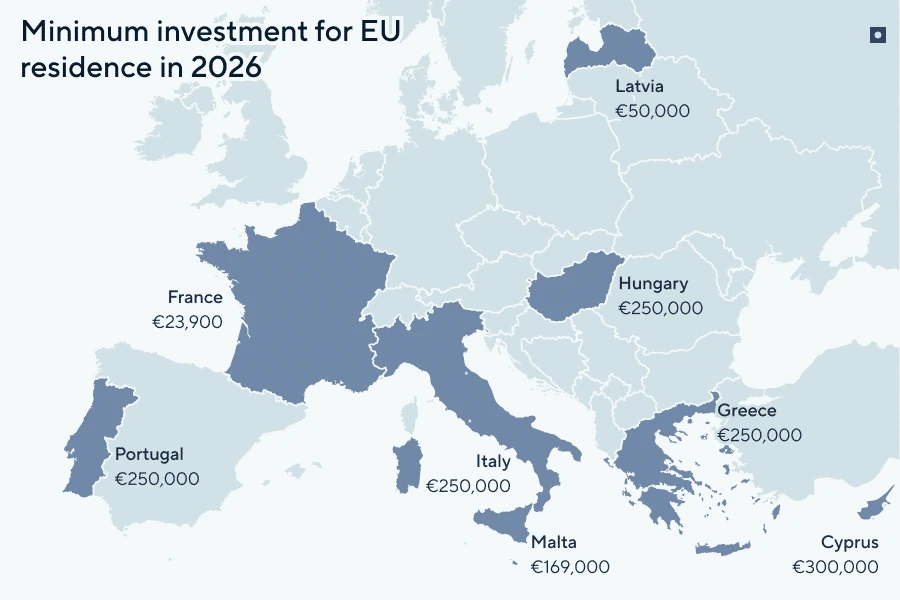
Investors still have options ranging from €50,000 business investment in Latvia to property, investment funds and startup routes across Europe. This article compares 8 European residence programmes by investment threshold, status, physical presence and

 Share
Share  Telegram
  Facebook
 LinkedIn
 X
X

 Save
Save 

What does EU residency by investment mean?
Residence by investment, or RBI, is a legal immigration route for
RBI rules are set by individual countries rather than by one common EU programme. The type of residence status and investment conditions therefore differ between jurisdictions [2] Source: Investor schemes, European Commission .
How residence by investment works
Residence by investment programmes link immigration status to a prescribed financial commitment. Depending on national rules, this may involve business capital, financial assets, property, or another qualifying contribution [3] Source: Investment models, European Commission . For example, Greece offers property routes starting at €250,000. Portugal accepts investments of €500,000 in eligible funds, while Italy allows investors to qualify by investing €250,000 in an innovative startup.
The process generally follows several stages:
- Choose a qualifying investment.
- Meet immigration requirements.
- Submit the residence application.
- Obtain residence status.
- Maintain the required conditions.
Investment residence does not itself grant EU citizenship. Naturalisation remains a separate process governed by the nationality law of the relevant country.
Is every residence-by-investment programme a “Golden Visa”?
Golden Visa is a broad market term for programmes that allow foreign nationals to obtain residence status by making a qualifying investment. Depending on the country, this may be temporary or permanent residence.
Citizenship by investment is a separate legal category and is generally distinguished from Golden Visa programmes [4] Source: Investor citizenship schemes, European Commission .
Residence by Investment vs Citizenship by Investment
| Criteria | RBI | CBI |
|---|---|---|
| Immediate result | Residence status | Citizenship |
| EU citizenship | No | Only where legally available |
| Right to vote | Usually no | Generally follows citizenship rights |
| Naturalisation | Separate process | Citizenship obtained under programme |
| Physical residence | Depends on programme | Depends on programme |
European Golden Visas in 2026: what is happening to investment migration?
European
Which programmes have closed
Three European countries have recently stopped accepting new applicants under dedicated
- Ireland — 2023. Ireland closed the Immigrant Investor Programme to new applications on February 15th, 2023 [5] Source: IIP closure, Irish Immigration Service . Applications already submitted by the closure date continued to be processed under the applicable rules.
- Netherlands — 2024. The residence route for foreign investors was abolished on April 17th, 2024 [6] Source: Investor route, IND . Holders of existing permits may still apply for an extension under the conditions that applied before the route was abolished.
- Spain — 2025. Spain abolished its investor visas from April 3rd, 2025 [7] Source: Transition rules, Spanish Foreign Ministry . Applications submitted before that date remain subject to the previous rules. Valid investor permits also remain effective for the period for which they were issued.
These closures do not mean that investment migration has disappeared from Europe. Several countries have retained investor residence while changing how applicants qualify.
Which countries have redesigned rather than abolished their programmes
Portugal retained its
Direct real estate investment is no longer a qualifying route for new applicants. The 2023 reform removed residence authorisations based on property investment from the programme framework.
Greece retained property investment but introduced different thresholds by location and property type. Standard property investment requires at least €800,000 in Attica, Thessaloniki, Mykonos and Santorini, as well as on islands with more than 3,100 residents [9] Source: Property thresholds, Greek Migration Ministry .
The standard threshold is €400,000 in the rest of Greece. Source: regional threshold, Greek Migration Ministry
€250,000 routes remain for properties converted to residential use. The same threshold applies to certain listed buildings that require restoration or reconstruction.
Hungary currently bases its Guest Investor route on financial investment or a donation [10] Source: Investor options, Hungarian OIF . The qualifying options include a €250,000 investment fund share or a €1,000,000 donation to an eligible higher education institution.
Direct residential property purchase is not included among the qualifying investments listed in the OIF’s current 2026 guidance.
Why EU institutions monitor Golden Visa programmes
The European Commission examined investor citizenship and residence schemes in a dedicated 2019 report. The assessment drew on a detailed study of national legislation and programme practices.
The report highlighted several key risks:
- Money laundering. Investor schemes may be used to conceal the origin of funds if financial controls and Due Diligence are insufficient.
- Security risks. Weak background checks may allow applicants with criminal or security concerns to obtain residence rights.
- Tax evasion. Investment migration structures may be misused to conceal assets, income, or tax residence.
- Corruption. Programme administration may create corruption risks where oversight and accountability are insufficient.
- Transparency and governance. Clear procedures, effective supervision, and access to reliable programme information are important for reducing regulatory risks.
Cross-border mobility. A residence permit issued by one Schengen state may facilitateshort-term travel across the wider Schengen Area, giving national decisionscross-border implications.
This
Olga Koltsova
Investment Programs Expert
5 advantages of European residency by investment
European residence by investment provides an alternative immigration route for investors who have sufficient capital. Benefits vary by programme, particularly in terms of status, family eligibility, and physical presence.
1. Legal residence through investment
Applicants obtain a legal basis for residence by meeting the financial and immigration requirements of a national programme. The qualifying route may involve an investment fund, real estate, business capital, or another permitted instrument.
This route does not depend on having an employment contract or enrolling at a university. Investors still undergo background checks and must prove that their funds meet the programme requirements.
2. Travel within the Schengen Area
A valid residence permit issued by a Schengen country generally allows short visits to other Schengen states. The standard limit is 90 days in any
This gives investors greater flexibility for business trips, holidays, and family visits across much of Europe. It does not, however, provide an unrestricted right to live or work in another Schengen country.
3. Residence for family members
Investor programmes often provide a route for close family members to obtain residence together with the main applicant. Eligibility depends on the country and may extend to a spouse, children, and financially dependent relatives.
Portugal, for example, provides family reunification for holders of its residence permit for investment activity. This allows families to plan relocation and residence under one immigration strategy rather than arranging an unrelated permit for every family member.
4. Choice between temporary and permanent residence
European investment routes provide different forms of legal status. Some countries initially issue a temporary residence permit, while others grant permanent residence once the programme requirements are met.
Portugal grants temporary residence by investment. Cyprus, by contrast, operates a permanent residence scheme for qualifying investors. The choice therefore depends on whether the investor prioritises flexibility,
5. Potential path to permanent residence or citizenship
Investment residence may form the first stage of a longer immigration strategy. After maintaining lawful residence for the required period, an investor may become eligible for permanent residence or naturalisation under national law.
For example, in Italy, an investor who genuinely lives in the country may become eligible for EU
Citizenship is not granted automatically after holding an investment permit. Countries usually assess residence continuity, physical presence, language knowledge, integration, and other eligibility requirements separately.

3 disadvantages of European residency by investment
Capital may remain committed for years. Some programmes require the qualifying investment to be maintained to keep or renew residence status.
Residence does not provide full EU mobility rights. A national residence permit does not give the same right to live and work across the EU as EU citizenship.
Citizenship is not automatic. Naturalisation is a separate process and may require years of residence, physical presence, language skills, and integration.
What types of investments qualify for a European Golden Visa?
European
Not every investment type is available in every country. Investors need to meet the specific conditions set by the national programme.
Real estate
Property remains a qualifying route in several European countries. Depending on the programme, an investor may purchase residential or commercial property or meet a qualifying rental requirement.
In Greece, standard property thresholds are €800,000 in
Cyprus permits an investment of at least €300,000 in qualifying residential or other real estate under its permanent residence route.
Investment funds
Investment funds provide an alternative to direct property ownership. The investor purchases units in a qualifying fund that meets national regulatory and investment requirements.
Portugal requires at least €500,000 in units of eligible
Hungary requires at least €250,000 in units of an eligible real estate fund registered by the Hungarian National Bank [13] Source: Hungary fund, Hungarian OIF .
Business capital and job creation
Some residence routes are designed to direct foreign capital into businesses and employment. Applicants may invest in an existing company, establish a business, or create jobs.
Italy's Investor Visa accepts investments of at least €500,000 in an Italian limited company or €250,000 in an innovative startup [14] Source: Italy investments, Italian Ministry .
Latvia offers a
Portugal also allows applicants to qualify by creating at least 10 jobs. Another option combines a €500,000 company investment with the creation or maintenance of at least 5 permanent jobs.
Government bonds and other financial assets
Financial instruments remain available under selected investor routes, although the eligible assets vary significantly.
Italy allows an investment of at least €2 million in Italian government bonds under the Investor Visa programme.
Latvia provides another financial route through subordinated liabilities with a Latvian credit institution. The required amount is at least €280,000, and the transaction must last for at least 5 years.
Research, culture and philanthropic contributions
Some programmes channel capital into projects with a scientific, cultural, educational, or social purpose. These options are generally contributions rather than investments intended to generate a financial return.
Portugal allows a contribution of at least €500,000 to qualifying research activities. Cultural and heritage projects require at least €250,000, with lower thresholds available in certain
Hungary offers a €1 million donation option supporting education, scientific research, or artistic creation at an eligible higher education institution.
Italy also accepts a €1 million philanthropic donation as one of the qualifying options under its Investor Visa.
Portugal
Portugal Golden Visa grants temporary residence to
Investment options
The lowest capital threshold is €250,000 for qualifying support for arts or national cultural heritage. Other options include:
- €500,000+ in qualifying research activities;
- €500,000+ in eligible investment funds;
- €500,000+ in a Portuguese company under employment conditions;
- creation of at least 10 jobs.
The fund route is suitable for investors who prefer a financial asset to direct business management. Returns are not guaranteed and depend on the selected fund and market conditions.
Family eligibility
The main applicant may apply for family reunification for qualifying relatives. Family members may include:
- spouse or registered partner;
- minor children;
- dependent children under 26 who meet the applicable conditions;
- dependent parents of the investor or spouse.
Residence requirements
Portugal has one of the lowest
The qualifying investment must remain in place while the residence permit depends on it. Residence cards also require renewal.
Path to permanent residence and citizenship
Portugal Golden Visa holders may apply for permanent residence after 5 years of temporary residence. They need to meet additional requirements, including basic knowledge of Portuguese. Permanent residence has no fixed expiry date. The residence card itself is issued for 5 years and requires renewal.
The citizenship timeline changed in May 2026. For most
Applicants also need to meet language,
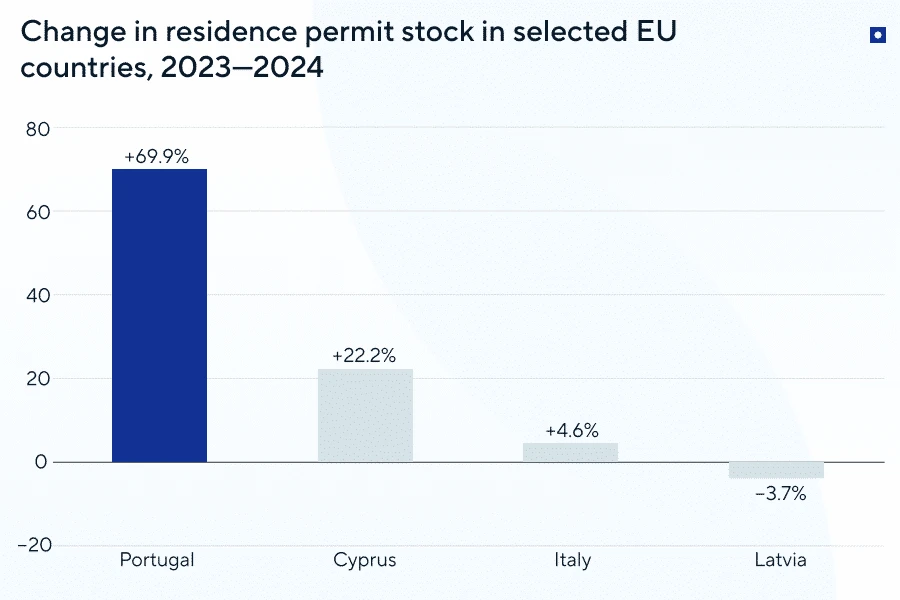
Portugal also stands out in the broader EU residence landscape. Between 2023 and 2024, the stock of valid residence permits held by
Malta
Malta Permanent Residence Programme grants permanent residence from the outset. The programme combines property, government payments, a charitable donation, and an asset requirement.
Investment options
Applicants choose between purchasing and renting residential property:
- purchase of qualifying property for €375,000+;
- rent of at least €14,000 per year.
The property requirement is combined with:
- €60,000 administration fee;
- €37,000 government contribution;
- €2,000 charitable donation.
Applicants also demonstrate sufficient assets under one of the programme's financial tests. The MPRP is therefore a package of requirements rather than a single investment.
Family eligibility
Malta provides comparatively broad family inclusion. Qualifying relatives may include spouse or partner, children under 28 parents and grandparents. Age, dependency, and financial conditions vary by family category.
Residence requirements
The MPRP does not set a fixed minimum number of days that the investor must spend in Malta each year. Applicants must maintain the qualifying property and continue to satisfy the programme conditions for the required period. Compliance does not end when the permanent residence certificate is issued.
This makes Malta suitable for investors seeking permanent status without full relocation.
Path to permanent residence and citizenship
Permanent residence is granted directly under the MPRP, so there is no temporary residence stage. Maltese citizenship is not part of the programme. Ordinary naturalisation is a separate process based on genuine residence and other legal requirements.
Maintaining MPRP status with minimal presence does not guarantee eligibility for citizenship.
Greece
Greece Golden Visa is primarily associated with property investment. Applicants receive a
Investment options
Property thresholds depend on the location and characteristics of the asset:
- €800,000+ in the most
in-demand locations; - €400,000+ in other areas;
- €250,000+ for certain properties converted to residential use or listed buildings subject to restoration or reconstruction.
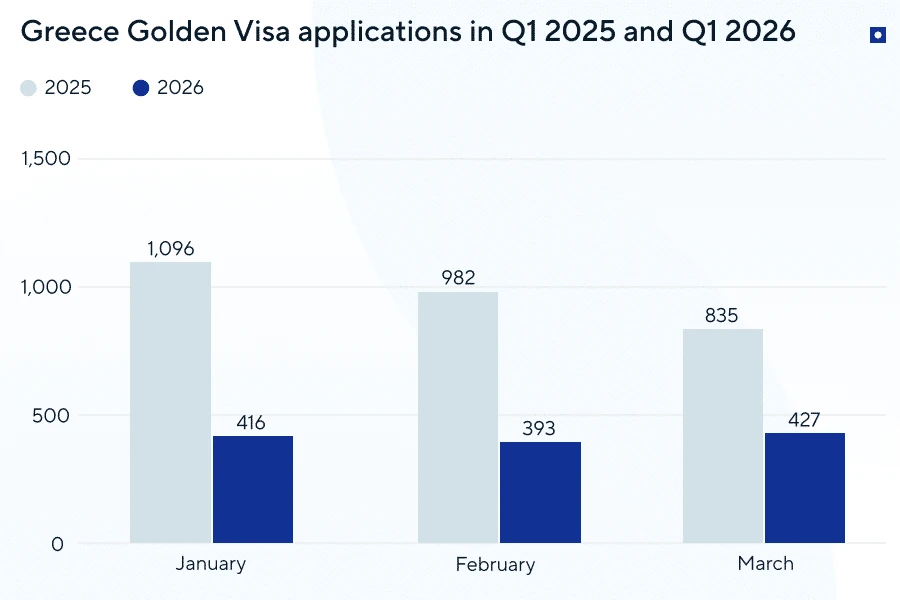
Statistics from the Greek Ministry of Migration and Asylum show a clear
At the same time, 2,886 new residence permits were approved in Q1 2026, which was 27.6% more than in the same period of 2025.
Family eligibility
A Greece Golden Visa may cover several generations of one family. Qualifying relatives generally include:
- spouse or registered partner;
- children under 21;
- parents of the main applicant and the spouse.
Adult children over 18 need to meet additional age and dependency conditions.
Residence requirements
Investors do not have a minimum annual stay requirement to maintain the Greece Golden Visa. The qualifying investment must remain in place for the residence permit to be renewed. The permit is valid for 5 years and may be renewed for further
Path to permanent residence and citizenship
The investor permit itself provides

How to choose property for obtaining a Greece Golden Visa application
Italy
Investor Visa for Italy is designed for
Investment options
Applicants select one of four investment types:
- €250,000 — in an Italian innovative startup.
- €500,000 — in an Italian limited company.
- €1,000,000 — philanthropic donation.
- €2,000,000 — in Italian government bonds.
The innovative startup route has the lowest capital threshold. The investment must remain in place to support renewal of the residence permit.
Family eligibility
Investor Visa holders may use Italy's family reunification framework. A spouse and minor children are the most common qualifying family members. Dependent children over 18 and parents over 65 may qualify if the conditions under Italian immigration law are met.
Family eligibility is assessed separately from the investor's financial qualification.
Residence requirements
An approved applicant first receives a
The qualifying investment must be completed within 3 months. Maintaining it allows the investor to apply for a further
The investor route does not impose the same type of annual minimum stay as some ordinary residence categories. Long absences, however, become important when applying for permanent residence or citizenship.
Path to permanent residence and citizenship
Citizenship by naturalisation generally requires 10 years of legal residence for
Hungary
Hungary Guest Investor route provides
Investment options
Investors choose between two principal options:
- €250,000+ in units of an eligible real estate fund;
- €1,000,000 as a donation to an eligible higher education institution.
The fund option is a financial investment and may potentially be recovered after the required holding period. Its value and return depend on the investment itself. The €1 million donation is
Family eligibility
A Guest Investor Permit holder may apply for residence for qualifying family members. The route generally covers spouse, minor children and parents.
Residence requirements
The Guest Investor residence permit is valid for up to 10 years and may be extended for another 10 years. Hungary does not impose a mandatory minimum annual stay solely to maintain this permit. The investor must continue to meet the conditions connected with the qualifying investment.
Path to permanent residence and citizenship
An investor who actually lives in Hungary may apply for a National Residence Card after at least 3 years of uninterrupted legal residence. The National Residence Card provides residence for an indefinite period. The physical card is issued for up to 10 years and can be renewed.
This route requires genuine residence in Hungary. Keeping a Guest Investor Permit while spending little or no time in the country is not equivalent to completing the
Ordinary naturalisation generally requires 8 years of continuous residence counted under Hungarian citizenship rules.
For a
Cyprus
Cyprus permanent residence programme grants permanent residence rather than an initial temporary permit. The minimum qualifying investment is €300,000.
Investment options
Applicants may select among several qualifying assets:
- Residential property.
- Commercial property.
- Share capital of a qualifying Cyprus company.
- Units of qualifying Cyprus investment organisations.
The main applicant also demonstrates secure annual income of at least €50,000. The required income rises for accompanying family members. The programme therefore combines an investment requirement with proof of continuing financial capacity.
Family eligibility
Cyprus permanent residence may include the investor's spouse and dependent children. Some adult children may qualify if they meet age, study,
The family structure should therefore be checked before selecting the investment, particularly where adult children are involved.
Residence requirements
Approved adult investors receive an unlimited right of residence. The residence card itself is valid for 10 years and then requires replacement. The investor does not need to spend most of the year in Cyprus. However, permanent residence may lapse after an extended absence, so holders need to maintain a connection with the country.
The qualifying investment and other programme conditions also need to remain satisfied.
Path to permanent residence and citizenship
General naturalisation normally requires 8 years of actual lawful residence, including a continuous period before the application. Applicants also need to meet language, integration, and other nationality requirements. Holding Cyprus permanent residence without living in the country is therefore insufficient on its own.
Latvia
Latvia grants temporary residence through two forms of investment. Its company route has one of the lowest nominal entry thresholds among the programmes covered in this article.
Investment options
Latvia adopted a new Immigration Law dated August 20th, 2026, which takes effect on September 15th, 2026 and replaces the Immigration Law of October 31st, 2002 [18] Source: Latvia’s new Immigration Law, Imigrācijas likums . Under the new rules, property purchases and bank deposits are no longer qualifying investment options.
Investors may qualify through:
- Company investment — €50,000+ in a qualifying small business or €100,000+ in a larger company.
- Fund investment — €150,000+ in a state alternative investment fund for at least 5 years.
Applications submitted by September 14th, 2026 will be reviewed under the previous Immigration Law, even if a decision is issued after the new law takes effect.
Investors who already hold a valid residence permit may also continue under transitional rules and apply for a new permit while the existing one remains valid, provided they maintain the qualifying investment.
Family eligibility
The main investor may apply together with close family members. The standard family group includes:
- spouse;
- minor children;
- other dependants where the general immigration rules permit their inclusion.
Each applicant must meet the relevant documentation requirements.
Residence requirements
Investment provides temporary residence, rather than immediate permanent residence. Investors need to keep the qualifying investment and maintain valid residence documentation.
The programme does not require the same level of continuous physical presence as a conventional relocation route. Limited presence may nevertheless affect future eligibility for permanent residence.
Path to permanent residence and citizenship
An investor initially receives temporary residence. Permanent residence generally becomes available after 5 years of continuous legal residence in Latvia. The applicant needs to demonstrate genuine residence rather than merely renew an investment permit. Financial means and Latvian language knowledge at A2 level are also required.
Citizenship usually requires a further 5 years of permanent residence. The full route from an initial investor permit to eligibility for naturalisation therefore generally takes around 10 years or more.
Applicants also demonstrate Latvian language knowledge and pass tests covering the Constitution, national history, culture, and the national anthem.
France
French Tech Visa, also known as the France Startup Visa, is intended for
Investment options
There is no fixed minimum investment for the startup route. The applicant needs to:
- Present an innovative economic project recognised by the relevant French authority.
- Demonstrate sufficient financial resources.
- Develop the commercial activity connected with the approved project.
In 2026, the required personal resources are at least €23,900 per year.
The route therefore suits founders who plan to participate actively in their business rather than investors seeking a passive financial or property option.
Family eligibility
A spouse and minor children may join the main applicant through the
This simplified family route is one of the advantages of the Talent framework.
Residence requirements
The residence permit is issued for up to 4 years. France does not structure this route around a low
It is therefore more suitable for genuine relocation than for investors seeking a residence card with minimal time in the country.
Path to permanent residence and citizenship
After 5 years of qualifying continuous residence, a foreign national may become eligible for
French citizenship by naturalisation is also commonly associated with a
Language knowledge, integration, stable residence, and compliance with French law are assessed separately. The Startup Visa therefore provides a potential
Tax residency and double taxation for European Golden Visa holders
Immigration residence and tax residence are separate concepts. Holding a European Golden Visa does not automatically make an investor a tax resident of that country [19] Source: Tax residence, Your Europe .
EU countries set their own personal tax rules and definitions of tax residence. There is no single
Residence permit does not automatically create tax residence
A residence permit gives its holder an immigration right to stay in the country. Tax residence is assessed separately under national tax legislation and the investor’s individual circumstances.
For example, an investor may hold a residence permit but continue to have their permanent home and strongest personal and economic ties in another country. These connections may remain relevant when determining tax residence.
Why the 183-day rule is only a starting point
Spending more than 6 months in a country is a common indicator of tax residence, but it is not a universal EU rule. Each country applies its own criteria
[20]
Source:
Depending on domestic law and the applicable tax treaty, the analysis may include:
- days of physical presence during the tax year;
- permanent home available to the investor;
- centre of vital interests, including closer personal and economic relations;
- habitual residence, or where the person normally spends their time;
- domestic tax legislation of each country involved.
Permanent home, centre of vital interests and habitual abode are also important
Non-Dom regimes for new tax residents
Some European countries offer preferential tax regimes for new tax residents, often referred to as
Cyprus, Greece, Malta and Italy apply different versions of these regimes. Eligibility is separate from residence by investment status and depends on the applicant becoming a tax resident and meeting national requirements.
What happens if 2 countries regard the investor as tax resident
Two countries may regard the same person as a tax resident under their domestic legislation. Bilateral Double Taxation Agreements, or DTAs, are designed to address such conflicts and allocate taxing rights between the countries [22] Source: Tax conventions, European Commission .
Many treaties based on the OECD Model use a sequence of
- Permanent home.
- Centre of vital interests.
- Habitual abode.
- Nationality.
- Mutual agreement between the tax authorities if the previous tests do not resolve the case.
The exact treaty between the two countries must always be checked, as individual agreements may differ.
Tax credits, exemptions and treaty tie-breaker rules
A DTA may eliminate double taxation through a tax credit or an exemption, depending on the treaty and income type. Under the credit method, tax paid in one country may be deducted from tax due in the country of residence within the applicable limits. Under the exemption method, qualifying foreign income or capital is exempt according to the treaty provisions.
These mechanisms reduce the risk of the same income being taxed twice. They do not guarantee a particular tax rate or a specific amount of tax savings.
Property income, dividends and capital gains require separate analysis
Different types of income may follow different treaty rules. Property income, dividends and capital gains therefore require separate analysis.
Under the OECD Model, income and gains connected with immovable property may be taxed in the country where that property is located [23] Source: Property taxation, OECD .
Dividends may involve taxing rights in both the investor’s country of residence and the country where the paying company is resident. The applicable DTA determines how these rights interact and how double taxation is relieved.
For Golden Visa investors, tax planning therefore starts with the investor’s actual residence, assets and income
Documents and Due Diligence for European residency by investment
Each country sets its own application and Due Diligence requirements under national law [24] Source: Investor residence rules, European Commission . Applicants usually need to prove their identity, financial capacity and compliance with the chosen investment route. Authorities may also examine criminal history and the origin of the applicant’s funds.
A typical application may require:
- Passport and identification documents. A valid passport is a standard requirement for investor residence applications.
- Criminal record certificates. Authorities generally assess whether an applicant poses criminal or security risks.
- Proof of financial resources. Applicants may need bank statements or other evidence showing that they have sufficient capital for the investment.
Source-of-funds andsource-of-wealth evidence. Due Diligence may examine how the applicant accumulated and transferred their capital.- Proof of the qualifying investment. Documentation depends on the selected route and may include bank confirmations, investment certificates, purchase agreements or company records.
- Additional compliance documents. Depending on the programme, applicants may also provide health insurance,
tax-related documents and evidence required for family members.
Due Diligence is more than a document check. Malta’s MPRP rules provide for checks that may involve specialised Due Diligence providers,
How to obtain European residence by investment step by step
The Greece Golden Visa shows how the process works when an investor obtains residence through a qualifying property purchase.
Obtaining a Greece Golden Visa takes 4 months. The process includes property selection, document preparation, investment, application and biometrics.
-
2 days
Preliminary Due Diligence
Passportivity conducts a background check on the investor by reviewing financial documents and assessing potential risks. The step helps identify the likelihood of refusal and allows for the preparation of additional documents in advance. The check is confidential, and the investor only needs to provide a passport copy.
-
1+ week sChoosing a property for purchase
The investor selects a qualifying property that meets their budget and investment objectives.
-
1+ week sPreparation of documents
Lawyers prepare application forms and a list of required documents. The investor collects the documents and signs a power of attorney.
-
Up to 1 week
Getting a tax number in Greece
A lawyer applies for a Greek tax identification number, which is required for the property transaction. It is usually issued within 3 to 7 working days.
-
1+ month Property purchase
The investor signs a preliminary agreement and normally pays a 10% deposit. The final agreement is signed before a notary and registered with the Land Registry and Cadastre.
-
1 day
Applying for a residence permit
The application is submitted online after the qualifying property transaction is completed. An application certificate is issued in approximately 1 week.
-
Within 6 months
Submission of biometrics
All applicants provide fingerprints and photographs for their residence cards. An appointment usually becomes available 1 to 2 weeks after filing the application.
-
3+ month sReceiving residence permit cards
After approval, the investor receives the residence permit cards personally or authorises a lawyer to collect them. Greece Golden Visa residence permits are valid for 5 years.
What happens after approval?
Obtaining a residence permit is not the end of an investment migration process. Investors need to maintain the conditions of their programme and monitor renewal, residence, and investment requirements.
Keeping the qualifying investment
Many programmes require the qualifying investment to remain in place for a specified period. If an investor withdraws capital or sells an asset too early, the residence permit may become ineligible for renewal.
For example, Greece Golden Visa holders must retain the property for as long as they want to maintain and renew their residence status. The permit is issued for 5 years and may be renewed for further
Renewing the residence card
Temporary residence cards usually need to be renewed even when the underlying investment remains unchanged. Renewal may require an updated passport, insurance, proof of investment, and confirmation that other programme conditions remain satisfied.
Meeting physical-presence requirements
Stay requirements vary significantly between programmes. Some investor routes require only limited presence, while others are designed for applicants who intend to relocate and spend substantial time in the country.
For example, Portugal Golden Visa holders spend at least 7 days in Portugal in the first year and 14 days during each subsequent
Becoming a permanent resident
The route to permanent residence depends on the initial status. Cyprus and Malta grant permanent residence through their investor programmes, while countries such as Portugal initially issue temporary residence.
Applicants moving from temporary to permanent residence usually need to maintain legal status for a required period and meet additional national requirements.
Applying for citizenship
Citizenship is a separate process and is not granted automatically after maintaining an investment residence permit. Naturalisation requirements may include years of lawful residence, physical presence, language knowledge, integration, and a clean criminal record.
Investors planning for citizenship should therefore consider naturalisation requirements from the beginning, rather than focusing only on the rules for keeping their residence permit.
Selling or liquidating the investment
Investors should check programme conditions before selling property, redeeming fund units, or withdrawing business capital. Exiting the investment before the required holding period ends may affect renewal or lead to loss of residence status.
In many cases, the investment becomes easier to exit once the mandatory holding period has ended or the investor has obtained a status that no longer depends on the original investment.
Passportivity’s European offices
Passportivity helps investors obtain residence and other legal statuses in European countries. The company supports clients throughout the process, from selecting a suitable programme and investment option to preparing documents and submitting the application.
Passportivity has offices in Cyprus, Malta, Spain, Portugal and Greece.
| Country | Office address | Map |
|---|---|---|
| Cyprus | 205 Archbishop Makarios III Avenue, 3030 Limassol, Cyprus | Show on map |
| Malta | Portomaso Business Centre, Portomaso, St Julian’s STJ 4011, Malta | Show on map |
| Spain | Calle de Velázquez 34, 28001 Madrid, Spain | Show on map |
| Portugal | Praça Marquês de Pombal 14, | Show on map |
| Greece | Show on map |
How to choose between the 8 European investor-residence programmes
The 8 programmes differ not only in minimum investment but also in the type of status they provide. Some focus on property or financial investments, while others are designed for entrepreneurs or applicants seeking permanent residence from the outset.
The lowest entry threshold is not always the decisive factor. Investors also need to compare
Comparison of European investor-residence programmes
| Country | Minimum investment | Main options | Residence status | Physical presence | Family inclusion | Time to citizenship |
|---|---|---|---|---|---|---|
| Portugal | €250,000 | Cultural support; funds, research or business; job creation | 7 days in first year; 14 days in each subsequent | Spouse, children under 26 and parents | 7 or 10 years | |
| Greece | €250,000 | Property purchase | No minimum stay | Spouse, children and parents | 7 years | |
| Italy | €250,000 | Innovative startup, company, government bonds or philanthropic donation | No minimum stay | Spouse, children and parents | 10 years | |
| Hungary | €250,000 | Qualifying real estate fund or donation | No minimum stay | Spouse, children and parents | 11 years | |
| Latvia | €50,000 | Company capital, property and selected financial investments | No minimum stay | Spouse, children and parents | 10 years | |
| Cyprus | €300,000 | Property, company capital or investment funds | Permanent residence | No minimum stay, visit every 2 years | Spouse and children | 8 years |
| Malta | €169,000 | Purchase or rental of qualifying property, contribution and donation | Permanent residence | No fixed annual minimum | Spouse, children, parents and grandparents | 5 years |
| France | No fixed investment minimum | Innovative business project under the startup route | Designed for genuine residence and business activity | Spouse and minor children | 5 years |
Final thoughts on top EU countries with residence by investment programmes
- European investor residence starts at around €50,000. Latvia offers one of the lowest entry thresholds, while many established programmes require €250,000 or more.
- Property remains a popular investment option. Greece, Cyprus, and Malta retain
property-based routes, while Portugal no longer accepts direct real estate investment for its Golden Visa. - Some programmes grant permanent residence directly. Cyprus and Malta allow qualifying investors to obtain permanent residence rather than starting with a temporary permit.
- Low physical presence is possible in selected countries. Portugal, Greece, and Hungary allow investors to maintain residence without relocating permanently.
- Investor programmes continue to evolve. Ireland, the Netherlands, and Spain have closed their investor routes, while Portugal, Greece, and Hungary have redesigned theirs.
- Residence does not automatically lead to citizenship. Naturalisation may require physical presence, language knowledge, integration, and several years of lawful residence.
About the authors


Frequently asked questions
For this comparison, the active routes covered are Portugal, Greece, Italy, Hungary, Latvia, Cyprus, Malta, and France.
Among the programmes covered here, Latvia has the lowest nominal entry points, starting with a qualifying €50,000 company investment plus the applicable state payment. Several
Yes, in selected countries. Greece and Cyprus retain qualifying property routes, while Malta's permanent residence programme requires qualifying rented or purchased property as part of a broader package.
Portugal no longer allows direct property purchase to qualify for its Golden Visa, and Hungary's current investor route is not based on direct residential property investment.
RBI grants residence status; CBI grants citizenship. An EU residence permit does not automatically make its holder an EU citizen. Citizenship normally requires a separate naturalisation process based on national law.
Depending on the country, applicants may invest in:
- regulated funds;
- businesses and company equity;
- innovative startups;
- government bonds;
- scientific or cultural projects;
- philanthropic initiatives;
- educational institutions;
- bank deposits.
Greece and Hungary, for example, have a comparatively short formal administrative stage for the
Most investor programmes provide some form of family reunification for a spouse or partner and dependent children. Some also accommodate financially dependent adult children, parents or grandparents. Definitions vary substantially by programme.
In some programmes, yes. Malta, Greece, Portugal and Cyprus can provide relatively broad family options, but age, study,
Applicants should generally expect passport and
- tax returns;
- company accounts;
- employment records;
- sale agreements;
- evidence concerning the applicant's overall source of wealth.
A previous conviction does not have one universal
Not necessarily. Several investment programmes are designed with limited
The rules for maintaining residence must also be distinguished from the much stricter
- Portugal — at least 7 days in the first year and 14 days in subsequent residence periods.
- Greece — no minimum stay requirement for maintaining the investor residence permit, provided the qualifying investment remains in place.
- Italy — no minimum residence requirement under the Investor Visa programme.
- Hungary — no mandatory minimum stay for Guest Investor Permit holders.
- Latvia — no fixed annual minimum stay is prescribed for the investor temporary residence routes; permit registration and renewal requirements still apply.
- Cyprus — the investor must establish residence within 1 year of approval and must not remain outside Cyprus for 2 consecutive years.
- Malta — the MPRP does not set a minimum annual number of days in Malta, provided the programme conditions continue to be met.
- France — no fixed annual minimum stay is specified, but the applicant must continue to meet the conditions attached to the qualifying project.
These rules apply to maintaining the residence status, not to permanent residence or citizenship. Naturalisation usually requires a much stronger record of actual residence and may include separate
Investment residence itself does not require applicants to pass a local language examination. The main requirements relate to the investment, financial capacity, Due Diligence, and compliance with immigration rules.
Language requirements may arise later if the investor applies for permanent residence or citizenship. For example, naturalisation often requires proof of language knowledge and integration, while the level and format of the test depend on the country.
If maintaining the investment is a condition of the permit, selling or liquidating it before the required holding period can prevent renewal or lead to loss of status. Some programmes permit changes between qualifying assets under specific procedures, so the investor should confirm the rules before exiting an investment.
A valid residence permit issued by a Schengen state generally allows short visits to other Schengen states within the applicable 90 days in any
No. Immigration residence and tax residence are separate concepts. Tax status is determined under national rules and, where two countries claim residence, potentially under a Double Taxation Agreement.
There is no single EU rule. Depending on the country, naturalisation commonly requires several years of qualifying lawful residence, often together with physical presence, language, integration,




Contact us today
Passportivity assists international clients in obtaining residence and citizenship under the respective programs. Contact us to arrange an initial private consultation.